DocsFoundation and setup
Understand the Data Behind Xtrusio’s Question-Demand Estimates
Xtrusio uses keyword-volume research to establish the initial foundation for a company's question bank. SEMrush is the primary volume source, Ahrefs supports the research, and the team sometimes cross-checks volumes with Google Ads Keyword Planner.
Availability and responsibility
Xtrusio uses keyword-volume research to establish the initial foundation for a company's question bank. SEMrush is the primary volume source, Ahrefs supports the research, and the team sometimes cross-checks volumes with Google Ads Keyword Planner.
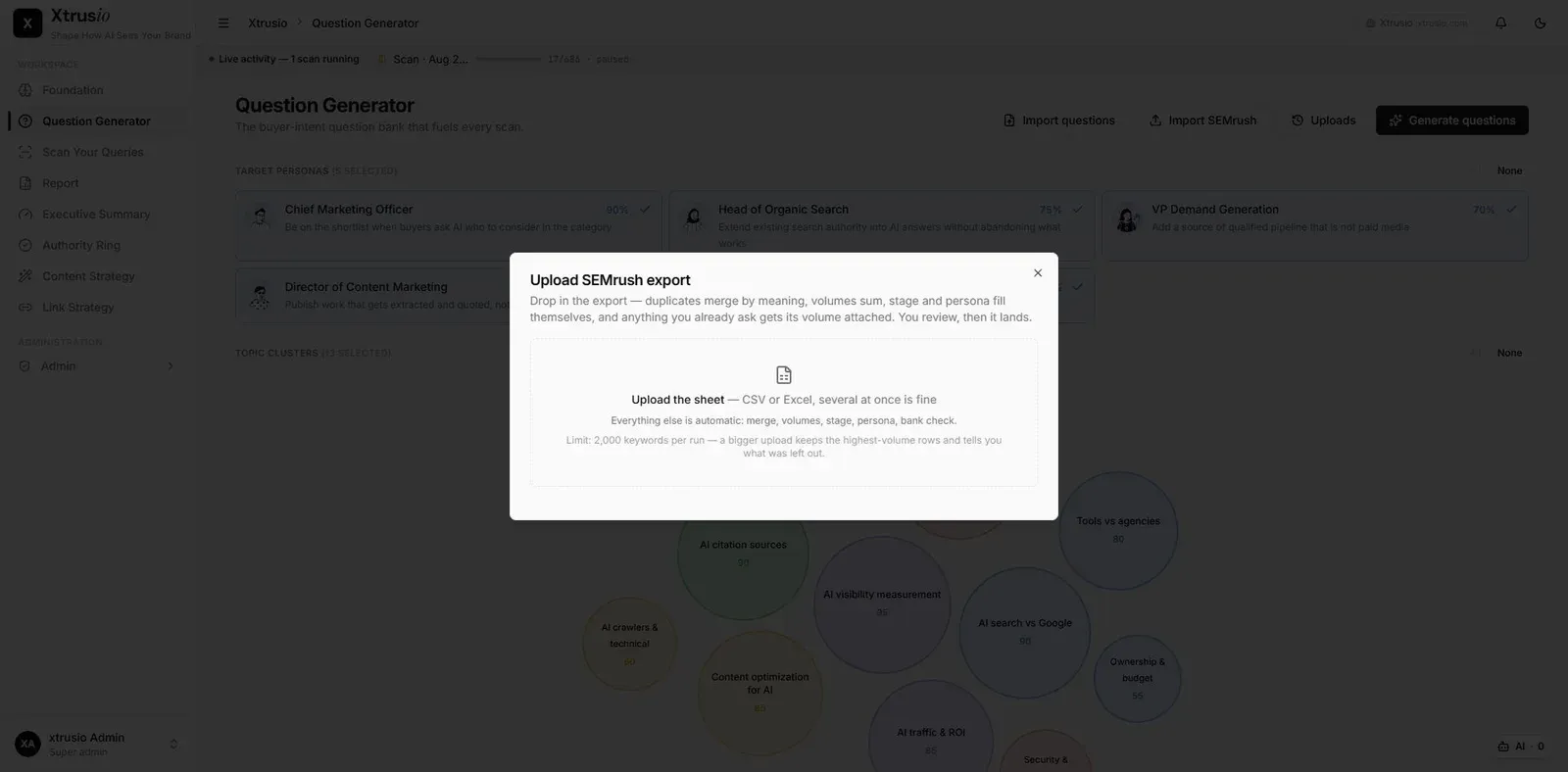
Question Generator builds on that foundation with buyer-persona questions, related and long-tail questions, and questions the company wants to answer about its products, proposals or positioning.
How the question bank is developed
- Research the company, its offerings, audience and competitors.
- Establish initial keyword and volume research using SEMrush and Ahrefs, with occasional Google Ads Keyword Planner cross-checks. Upload the finalized SEMrush dataset into Xtrusio before generating questions.
- Develop questions around the needs and decisions of the company's buyer personas.
- Expand into related and long-tail questions, including natural-language questions people could ask AI.
- Include company-requested questions even when established search demand is unavailable.
- Review relevance, coverage, priorities and the volume evidence to select 150–200 target questions.
- Agree the monitoring scope and begin collecting AI answer evidence.
Search volume supports selection. It does not determine every question included, and generated questions are not evidence that people have already submitted those exact prompts. Before execution and client-specific customization proceed, Xtrusio's team reviews the Foundation with the client across meetings. The client approves the buyer questions, product and service descriptions, facts and figures. This is a manual approval process; AI-generated suggestions do not replace client approval.
What the displayed volume represents
When a question lacks its own keyword-volume value, Xtrusio uses the volume associated with a related keyword. If neither a volume nor a related keyword is available, Xtrusio requests an informed estimate through an AI-model API, such as ChatGPT or Claude.
The software displays one final volume value without separate source or estimate labels. The research behind that value can include:
- Source-keyword volume describes the keyword in the provider's defined dataset.
- Related-keyword volume supplies context for a question whose wording differs from the researched phrase.
- An AI-generated estimate fills the remaining gap when source volume and a related keyword are unavailable. The model makes an informed guess; it does not measure searches or AI conversations.
During instance setup, the team cross-checks the research and uploads the finalized SEMrush dataset for question generation. The documentation explains the role of SEMrush, Ahrefs, related keywords and the AI-estimation fallback; the interface does not expose separate source labels. An AI estimate is not a provider-validated number, and related-keyword volume is not measured demand for the exact question.
Example: a related keyword supports a longer question
Suppose keyword research shows 300 monthly searches for “contract renewal software.” The question bank includes “Which contract software helps procurement teams track renewal obligations?” and associates it with that keyword.
The displayed 300 belongs to the related keyword, not the exact longer question. It does not establish that 300 people asked the question in ChatGPT. The wording and number here are illustrative.
If a company adds a question about a specialized proposal requirement and there is no volume or related keyword available, Xtrusio requests an AI-generated estimate through an API. That question may still deserve monitoring because the company needs a useful answer for prospective buyers.
Compare volume without overstating demand
Keep the source keyword, provider, market and measurement definition with the research when available. Check how multiple source phrases are grouped before interpreting a total.
Several questions can relate to one keyword. Do not count the same source volume repeatedly as separate audiences merely because the question wording changes.
The interface does not let you distinguish these sources from a label. Ask the delivery team for the research basis before relying on a value in a quantitative comparison. Neither an estimated figure nor associated keyword volume establishes a direct count of AI conversations. Scan counts measure collected test answers, not market demand.
If the basis is unclear
Ask which keyword or estimation method supports the value before using it in a quantitative comparison. The question's strategic relevance can be assessed separately while its volume basis is clarified.