DocsMonitoring and insights
Find and Interpret Brand-Perception Gaps in AI Answers
Perception categories should reflect the client's products, market and positioning objective.
Availability and responsibility
Perception categories should reflect the client's products, market and positioning objective.
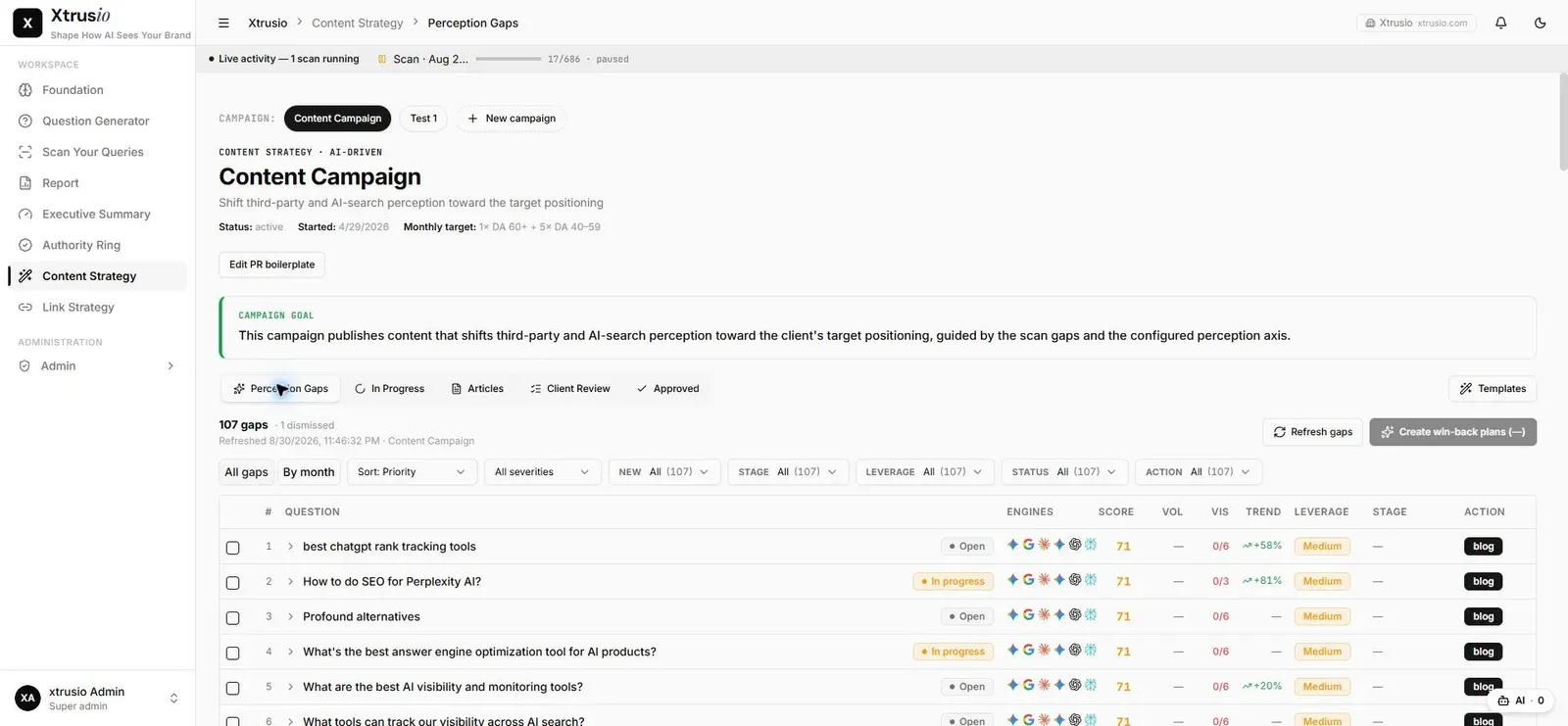
AI answers can reflect the company's own published material and third-party coverage. A perception gap may therefore arise because the available content emphasizes one part of the offering or lacks evidence for another. Treat the gap as a research and content-planning problem before assuming the answer is wrong. Actual factual errors still require review against approved sources.
Review one gap
- Open the relevant gap in Content Strategy.
- Identify the originating question and answer.
- Compare the statement with approved product facts.
- Separate factual error from missing detail, opinion and a valid limitation.
- Choose a response: clarify a page, add evidence, revise content or take no action.
- Retain the original observation for the later check.
A negative opinion can be accurately reported. A positive description can still be factually wrong. Sentiment and accuracy need separate judgments.
Sirion's client-specific example
Sirion's campaign uses full-stack, pre-signature and post-signature CLM framing. These categories reflect its positioning objective. Another industry needs categories relevant to its own products and buyer decisions.
For Sirion, the objective is to communicate its approved full-stack offering where that broader description answers the question. A question specifically about post-signature work can appropriately produce a post-signature answer. Evaluate broad vendor questions separately from stage-specific questions.
Review the relevant scenarios
Segment the question set by the campaign objective and question intent. Review how the answers describe the offering, keeping the original answer text and cited sources available for comparison.
Xtrusio does not have a metric called perception percentage. Assess the answer in the context of the question and campaign objective. A post-signature answer can be appropriate for a post-signature question even when it omits full-stack wording.
A campaign may need sustained content creation and distribution. Repeated comparable scans show whether observed framing changes; they do not guarantee a shift or establish which article caused it.
If the score seems inconsistent
Read the text that produced the classification. Ask which rule, reference and scope applied before changing the campaign. A summary score without supporting answer text is not enough to approve a corrective claim.
Prepare one evidence-backed content action and identify what a later answer would need to show for that action to appear useful.