DocsMonitoring and insights
How Xtrusio Collects AI Answers and Keeps Comparisons Meaningful
Use the collection specification for each engine in your account when comparing answers.
Availability and responsibility
Use the collection specification for each engine in your account when comparing answers.
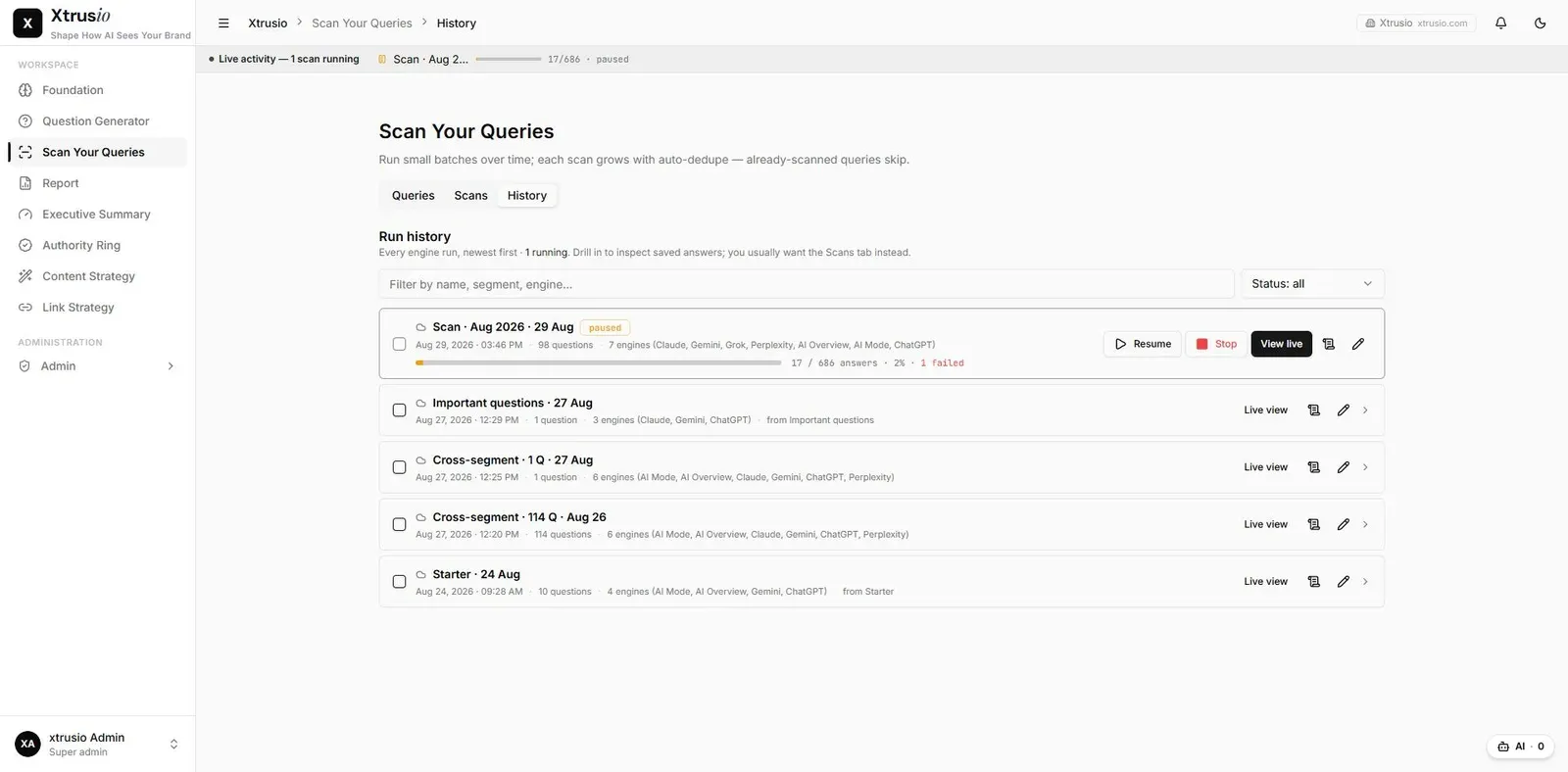
Two answers can be compared meaningfully only when their collection conditions are understood. A browser search, a consumer chat session and a model API request may not represent the same experience, even when the brand name on the service is similar.
Keep an observation record
The minimum useful record contains the exact input, engine or mode, collection time, outcome and returned answer. Add country, language, account context and repeat number where known.
Do not fill unknown context with assumptions. An explicit unknown is easier to interpret than false precision.
Check whether a comparison is fair
- Match the exact question wording.
- Confirm the engine and mode.
- Identify the collection method for each record.
- Compare relevant market and language settings.
- Separate failed collection from a successful answer that omits the brand.
- Note changes in method before interpreting a trend.
Use the method recorded for the relevant engine rather than assuming that every result comes from the same interface.
Example
An illustrative baseline collected from a model API and a follow-up collected from a consumer search interface may show different citations. The difference could arise from retrieval behavior or other collection conditions. It cannot safely be attributed only to a new article.
If methodology changes
Keep the old records and mark the break in comparability. Where practical, establish a new baseline using the updated process instead of joining unlike observations into an unexplained trend.
Request the collection specification for the engines in your account before making strong before-and-after claims.
Collection routes and saved records
Claude uses Anthropic messages with web search; Gemini uses search-grounded generation; ChatGPT and Grok use their providers' Responses APIs with web search; Perplexity uses search-backed chat completions. Google AI Overviews and AI Mode use DataForSEO endpoints. These observations can differ from a person's authenticated consumer-app experience.
Saved attempts include the question, persona and stage, engine, collection time, raw answer, citations, available search queries and model/extraction metadata. They support comparison, not perfectly reproducible experiments: models, prompts and retrieval behavior can change.