DocsContent strategy and approval
How Xtrusio Reviews Content Quality Before Publication
Xtrusio scores each article for quality, freshness and relevance. Article creation uses the client's Foundation knowledge base, and the client reviews the resulting content before the publishing handoff.
Availability and responsibility
Xtrusio scores each article for quality, freshness and relevance. Article creation uses the client's Foundation knowledge base, and the client reviews the resulting content before the publishing handoff.
Scoring supports review. It does not guarantee factual accuracy, search rankings or citations.
1. Establish the reference material
During Foundation setup, Xtrusio scans the client's important website pages, including pages the client suggests, and builds a RAG knowledge base. RAG means retrieval-augmented generation: the system uses stored client material as a reference when generating content.
The workflow may refer to this material as a Markdown or RAG reference. The client approves the Foundation's questions, products, services, facts and figures before downstream execution proceeds.
2. Create and score the article
Articles are written inside Xtrusio with reference to the client knowledge base. The scoring methodology assesses quality, freshness and relevance.
During article creation, the software automatically improves the article to bring its score above 70. This is an automatic improvement step rather than an approval block. The default weighted pillars are Evidence & Citations at 30%, Brand Visibility & Accuracy at 30%, Quality & Readability at 25%, and Structure for AI at 15%. Channel-specific configuration can override these weights. Quality, freshness and relevance describe the review goals, not three separately established formula weights. A freshness score should not be treated as proof that every source has been independently verified.
Review the article against its intended question, approved facts and supporting material. If the reference material is incomplete or outdated, resolve it with the client rather than relying on a high score alone.
3. Send the article for client review
Mark the article for client approval with comments in the client portal. The client can add information, edit passages or approve the article.
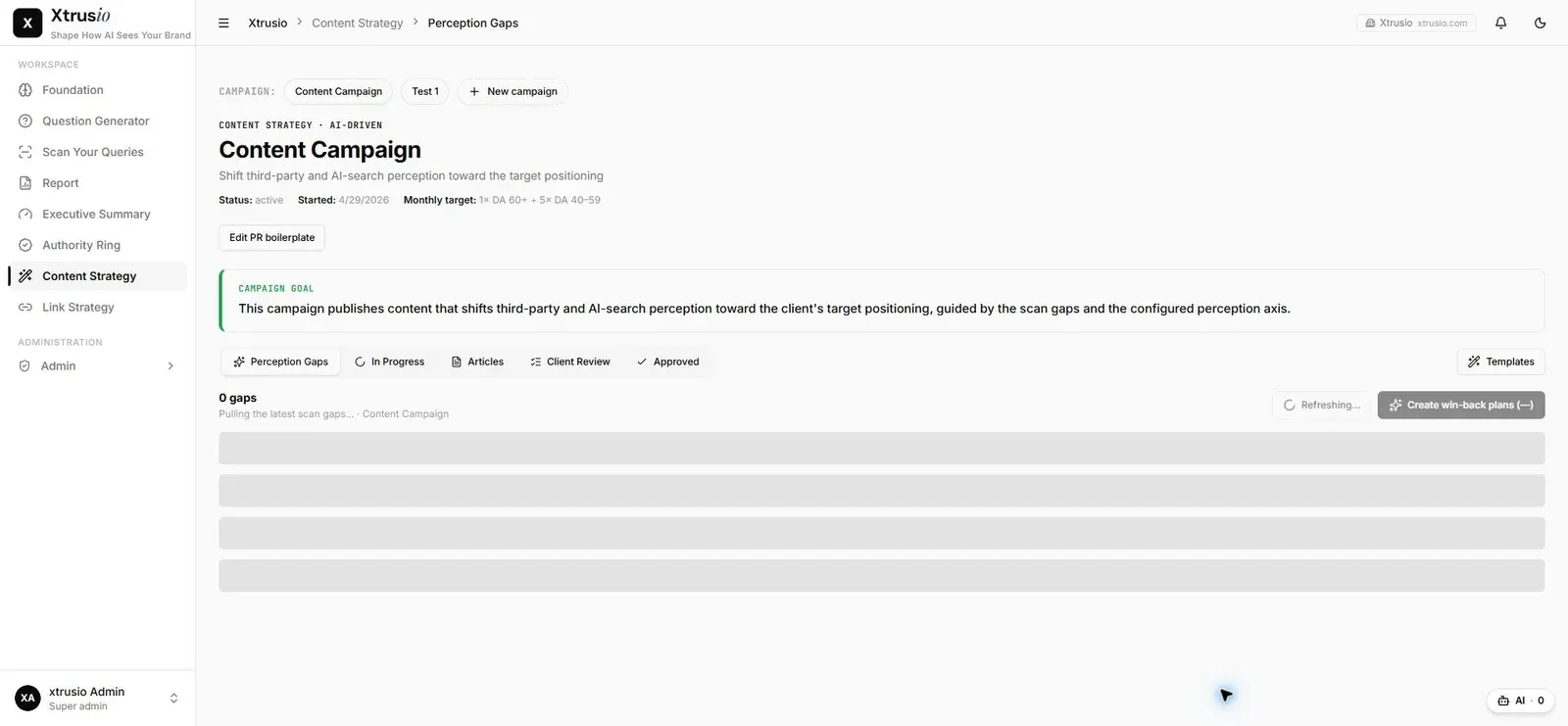
The scoring panel is inside Content Strategy and recalculates in real time as the client edits. If a change lowers the score, the client can revise or add the needed content and see the score update. The client reviews and approves the resulting article before the publishing handoff.
Automatic improvement during article creation and client approval are separate steps. The client still reviews and approves the content before the publishing handoff.
Example: a client addition needs revision
Suppose an article answers a buyer's question directly, but an added paragraph introduces an unrelated product pitch. If the revised article receives a lower score, the client can revise the addition to fit the reader's question and approve the resulting article.
This illustrates the review loop; it is not a recorded scoring result or a claim that a specific deduction rule exists.
4. Hand off the approved article
After client approval, the client can push the article to Link Strategy. The journalist team then handles the agreed third-party or guest-post placement.
Keep the article score, client approval and live publication as separate facts. None substitutes for the others.