DocsFoundation and setup
Build Your Buyer-Question Bank in Xtrusio
Question Generator is where Xtrusio develops the company's buyer-question bank. The delivery team establishes the company and competitor context, researches an initial keyword foundation, and reviews the questions before monitoring begins.
Availability and responsibility
Question Generator is where Xtrusio develops the company's buyer-question bank. The delivery team establishes the company and competitor context, researches an initial keyword foundation, and reviews the questions before monitoring begins.
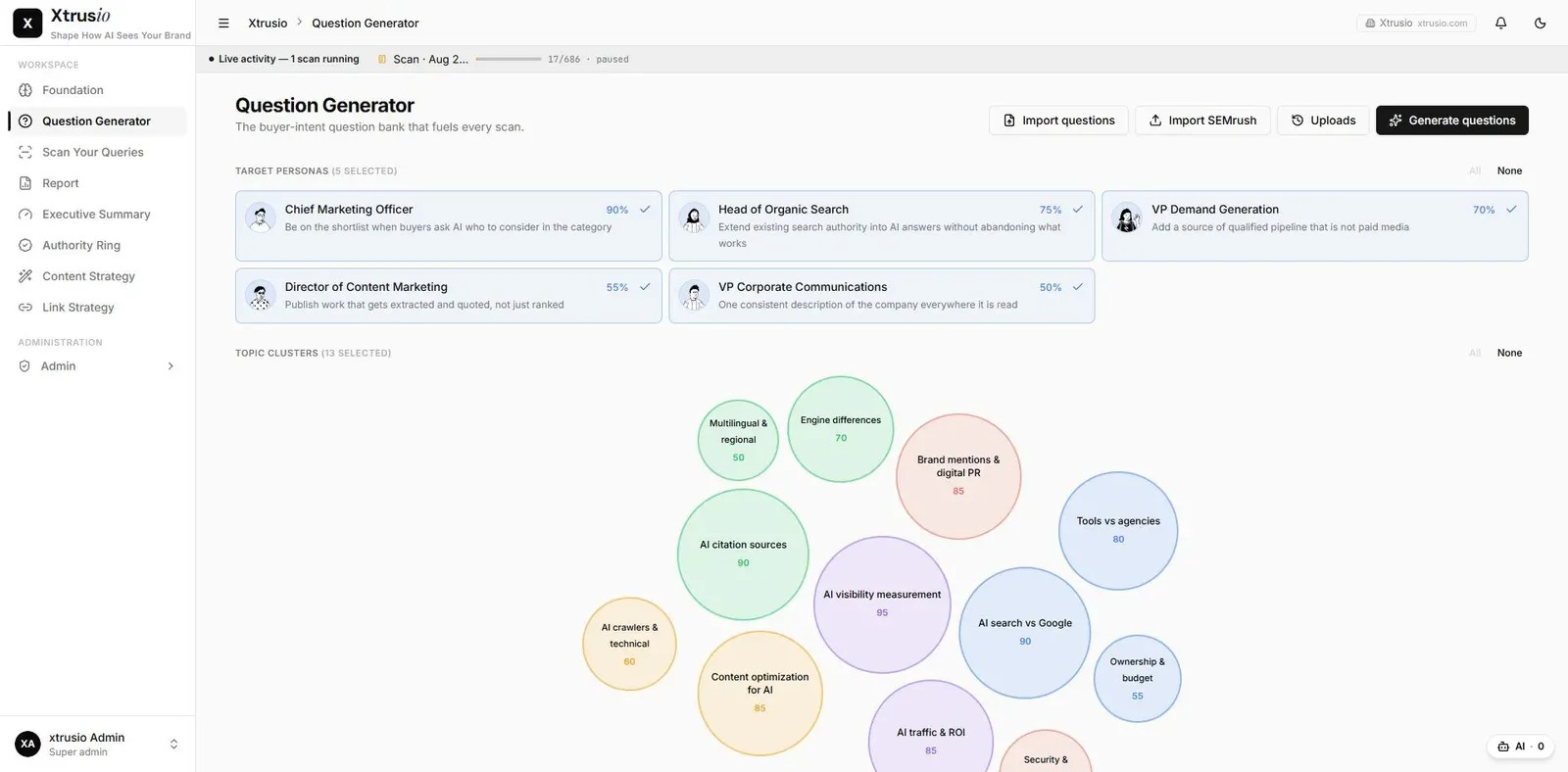
The workflow produces a focused set of 150–200 target questions. Selection reflects buyer needs and company priorities as well as keyword research. The monitoring allowance follows the service agreement. Before execution and client-specific customization proceed, Xtrusio's team reviews the Foundation with the client across meetings. The client approves the buyer questions, product and service descriptions, facts and figures. This is a manual approval process; AI-generated suggestions do not replace client approval.
1. Establish the company and keyword foundation
Research the company's products, services, audiences, use cases and relevant competitors. Use this context to research related keywords in SEMrush and Ahrefs. SEMrush is the primary volume source; the team sometimes cross-checks volumes with Google Ads Keyword Planner.
This research establishes the initial foundation. It does not restrict the question bank to phrases already listed in those tools.
2. Develop questions around buyer needs
After cross-checking the research during instance setup, upload the finalized SEMrush dataset through the supported import workflow. Check the required file format first, then use Question Generator to develop the question bank.
Question Generator develops questions around buyer personas and their decisions. It also expands into related and long-tail questions expressed in the natural language someone might use with an AI service.
For example, “contract renewal software” could inform “Which contract software helps procurement teams track renewal obligations?” This is an illustrative conversion, not a measured keyword or a reported customer result.
3. Include the company's own questions
Add questions the company needs to answer about its products, proposals or positioning. Some may have little or no established search demand but still matter to a buyer evaluating the company.
Review these questions for business relevance rather than excluding them simply because an exact search-volume figure is unavailable.
4. Interpret the associated volume
When a question lacks its own keyword-volume value, Xtrusio uses the volume associated with a related keyword. When neither a volume nor a related keyword is available, Xtrusio requests an informed estimate through an AI-model API, such as ChatGPT or Claude.
The software shows one final volume value without separate source or estimate labels. A related-keyword volume belongs to the associated search phrase; an AI estimate is an informed guess. Neither measures the number of people asking that exact question in an AI service. Ask the delivery team for the research basis when needed.
5. Select the target questions
Review company fit, persona needs, buying intent, topic coverage, company priorities and the available volume evidence. Remove irrelevant or redundant questions and select the focused set of 150–200.
Keep different buyer decisions separate. “What is contract lifecycle management?” and “Which CLM supports renewal obligations?” need different answers even though they concern the same category.
The selected set expresses the company's visibility objectives. Selection does not guarantee a ranking, mention or citation.
6. Begin AI visibility monitoring
Confirm the questions and agreed scan scope. Use Scan Your Queries to inspect answers, brand mentions and citations across supported engines.
The resulting evidence shows where the company appears, where competitors appear and which gaps need investigation. Use it to guide content work on the originating questions.
If a question or volume looks wrong
Review the company context, question intent, source keyword and volume basis. Confirm whether the value comes from a source keyword, a related keyword or an estimate before comparing it with other values.
A company-requested question can remain strategically relevant even when the available volume is estimated.