DocsDistribution and authority
How Xtrusio Builds Your Client-Specific Publisher Catalogue
During Foundation setup, Xtrusio's team uses the company's industry and segment to recommend a client-specific publisher list from the master catalogue.
Availability and responsibility
During Foundation setup, Xtrusio's team uses the company's industry and segment to recommend a client-specific publisher list from the master catalogue.
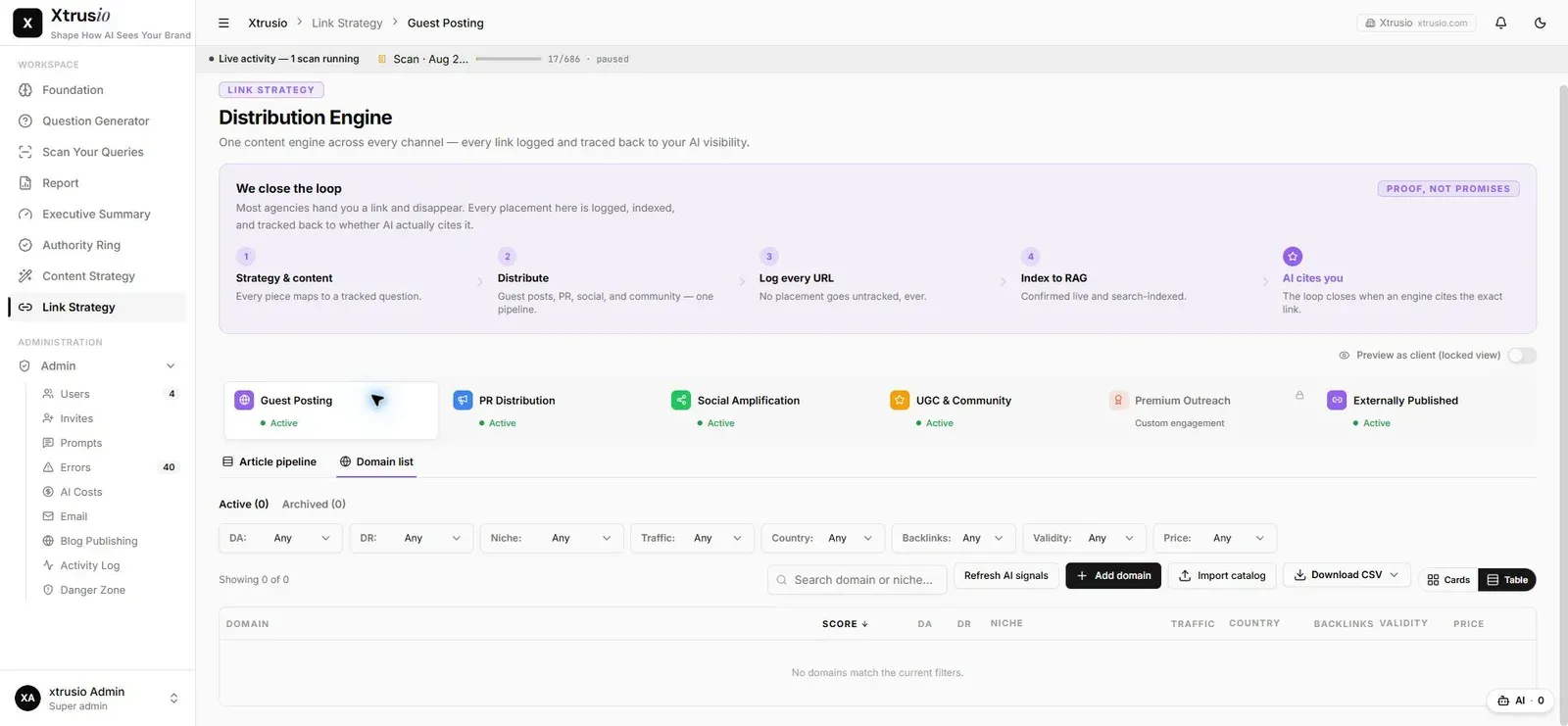
The client can review the proposed portals and each portal's AI citability parameter. Selection considers the citation value that the portal or its URLs could provide for the client's industry. The client approves the publisher-selection criteria during Foundation setup. The team loads and adds suitable publishers within those criteria and the subscription scope; separate client approval is not required for every publisher.
Understand the rating
Xtrusio rates a portal's AI citability as High, Medium or Low using an AI assessment of its authority and relevance to the client's industry. The rating estimates citation potential; it is not a measure of how often AI platforms already cite the portal.
One assessment method tests existing content: Xtrusio selects four or five indexed articles about a month old from the portal, generates questions from those articles and asks them across different AI platforms. It checks whether the answers cite the sampled articles. This assessment runs in the backend. When the team finds good citability, it lists the site; clients are not expected to review the underlying test questions and answers. Observed citations provide practical evidence that those articles can be cited for the tested questions. They do not guarantee that a new placement will be cited, or establish a platform-wide citation frequency.
Publisher discovery and catalogue maintenance are ongoing. Xtrusio's team keeps finding new publishers and updating the list after Foundation setup. The catalogue is not a fixed, one-time delivery. The total in a client workspace represents its selected publishers, not the entire master catalogue.
Review the client selection
- Confirm which client and catalogue view you are using.
- Review the active filters and whether the count describes displayed, active or total records.
- Check the relevance of the selected domains to the audience.
- Review the portal's High, Medium or Low AI citability rating alongside industry relevance. The underlying sample-article assessment is a backend process, not a client-facing test report.
- Ask the team to explain additions, exclusions and archived records.
- Select candidates for further review rather than treating every listing as an approved placement.
Example
An industrial-software client and a consumer-fashion client should not receive the same shortlist simply because both can purchase guest posts. A domain's audience and editorial subjects need to fit the intended article.
This illustrates selection logic, not a claim that all catalogue domains have been individually audited.
If a domain is missing
Ask whether it was excluded for relevance, unavailable, archived or not yet loaded. Absence from one client view does not prove absence from the master pool.
Catalogue membership does not establish direct partnership, editorial acceptance or a completed publication. Verify those separately before committing to a placement.
Review publisher performance over time
Initial AI citability estimates potential. Later scans supply observed publisher and URL citations that inform ongoing performance assessment. Keep these separate: a promising initial rating does not establish that a particular placement has been cited.