DocsContent strategy and approval
Coordinate an AI Visibility Campaign in Xtrusio
The delivery team coordinates campaign work against the agreed client objective.
Availability and responsibility
The delivery team coordinates campaign work against the agreed client objective.
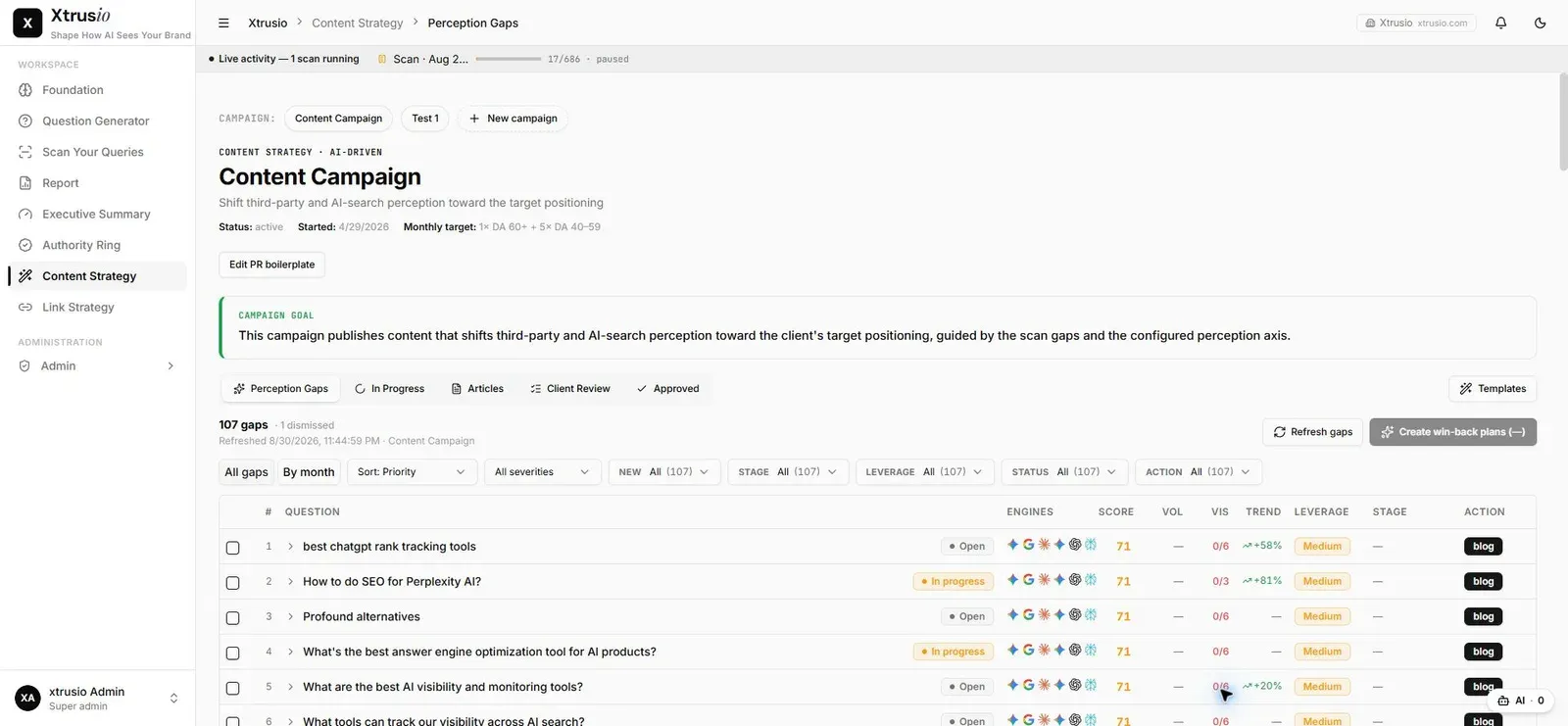
Xtrusio organizes a perception objective or product launch into a campaign: relevant keywords and questions, supporting content angles, publication destinations and follow-up evidence. It helps the delivery team coordinate the work and inspect what later scans show.
Define the objective and question segments
Agree the desired positioning with the client and support it with approved product facts. Identify the related keywords and questions, group them into relevant scenarios and save the campaign question set. Separate broad positioning questions from questions that intentionally focus on one capability.
For a new product launch, the objective can guide a connected content plan across owned pages and third-party publications, rather than a single announcement. For an existing product, it can address gaps in how the offering is described.
Build and distribute the content plan
Use the campaign objective to develop content angles and choose where each piece should be published. Xtrusio supports generating and saving answers or content and saving material prepared by the team. Follow client review and approval before publication.
The operating approach targets a 90-day campaign rollout. Treat that as a planning target for getting the campaign live, not a guarantee that search engines will index every page or that AI perception will change within 90 days.
For a question without its own keyword-volume value, Xtrusio uses the volume associated with a related keyword. If no volume or related keyword is available, Xtrusio requests an informed estimate through an AI-model API, such as ChatGPT or Claude. During instance setup, the team cross-checks the keyword research and uploads the finalized SEMrush dataset into Xtrusio to generate questions. The software displays one final volume value without separate source or estimate labels. Related-keyword volume and AI estimates do not establish the number of people asking that exact question in an AI service.
Establish the research and monitoring baseline
Research the company and its competitors, then establish the initial keyword foundation using SEMrush and Ahrefs, with occasional Google Ads Keyword Planner cross-checks. Question Generator adds persona-based, related and long-tail questions, along with the company's own strategic questions. Select a focused set of 150–200. Begin AI monitoring on the agreed set before using answer gaps to assign content work.
Agree the operating record
For each deliverable, identify the originating question, intended channel, responsible person, approval dependency and expected completion evidence. Use the fields supported by your instance and the team's agreed operating process.
Agree who follows up on each action; a campaign status alone does not assign responsibility.
Review the campaign
- Confirm the campaign objective and active scope.
- Review planned, in-progress, review and published work.
- Identify items blocked by client facts or approval.
- Check published URLs and later recheck status.
- Assign the next action to a responsible person.
- Record scope changes before adding extra work.
Sirion example
Sirion's campaign seeks to communicate its approved full-stack CLM offering where relevant, while retaining pre-signature and post-signature question segments. A post-signature-focused answer can be appropriate for a post-signature question. Assess broader positioning within the relevant scenarios rather than requiring every answer to say full stack.
Connect publication to observed citations
After publication, update the question-linked URLs in Link Strategy. Xtrusio matches URLs returned by scans against the recorded publication links, allowing the team to inspect whether its published pages appear among the cited sources.
Review the matched answer as well as the URL: a citation does not necessarily express the intended positioning. Track delivered content, observed citations and changes in perception separately. A URL match establishes an observed citation, not exclusive retrieval provenance, causation or commercial return.
Keep publishing and reviewing evidence as the campaign develops. A missing citation is an observation to investigate, not proof that the work can never contribute.
If statuses disagree
Compare the exact article, question and URL across the views. A plan item, a publication record and a scan result are different objects. Investigate stale data or incorrect associations before creating another article.
The next review should end with a small list of owners and actions, including unresolved dependencies, rather than a total article count alone.