DocsMonitoring and insights
Check AI Claims Against Your Approved Product Facts
Xtrusio combines software-supported scan analysis with review by the delivery team and client. After monitoring begins, scan data enters the workspace. The team and client use that evidence to assess claims and decide which content needs correction.
Availability and responsibility
Xtrusio combines software-supported scan analysis with review by the delivery team and client. After monitoring begins, scan data enters the workspace. The team and client use that evidence to assess claims and decide which content needs correction.
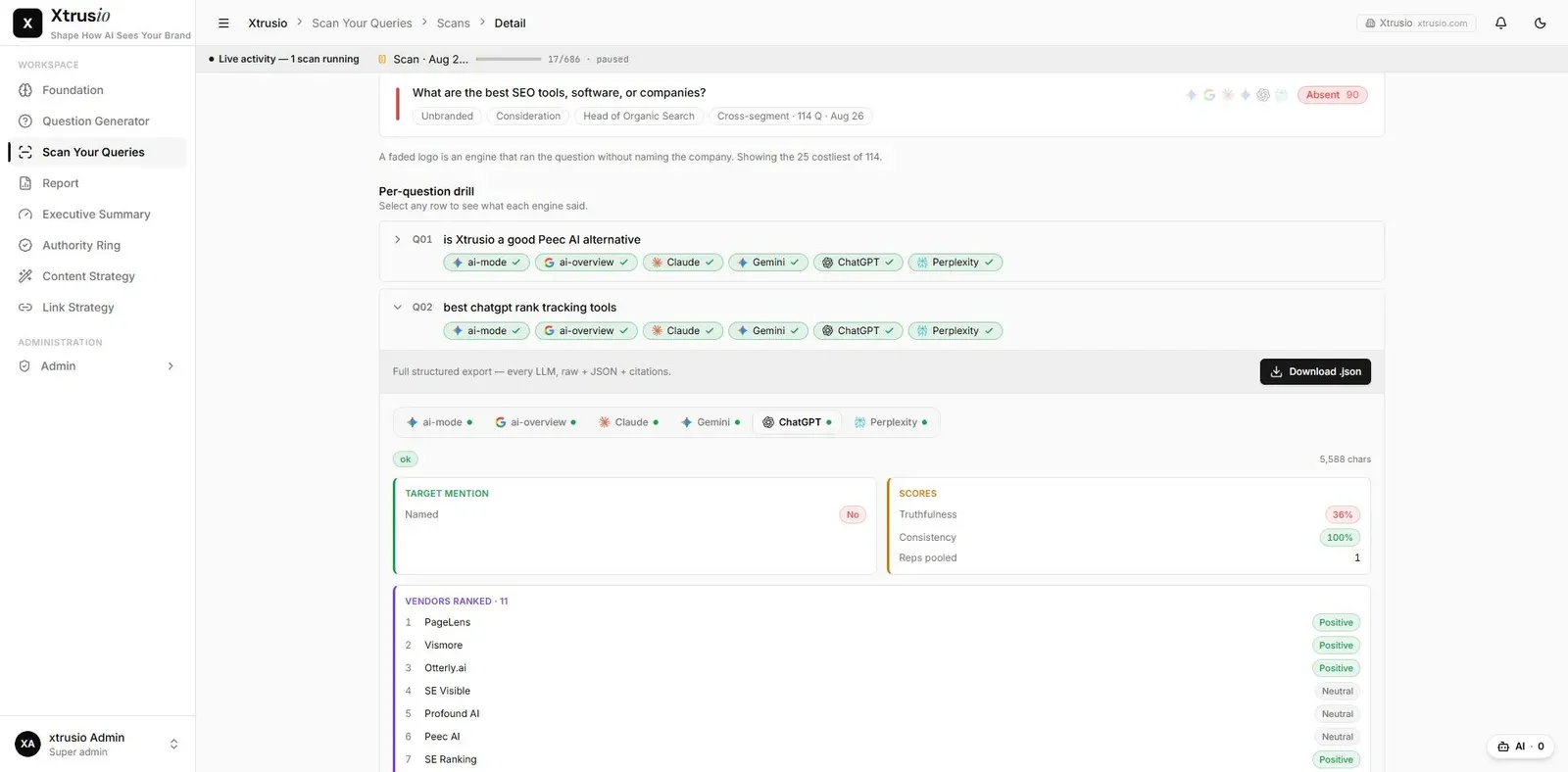
The client-approved Foundation supplies the business reference: products, services, facts, figures and agreed positioning. The software supplies scan data; human review remains part of the decision. This workflow does not imply that the software independently verifies every statement.
Separate a factual error from a perception objective
A narrow description can reflect the content already available about a company. If its wider offering has not been explained adequately on owned and third-party pages, the response may be to build supporting content over time. Do not label every mismatch with preferred positioning an AI error.
Review the question's intent as well as the answer. A post-signature question may properly focus on post-signature capabilities; broader questions may be the relevant segment for a full-stack positioning campaign.
1. Start with the answer
Open the relevant question and saved answer. Identify the exact wording that needs review, the AI engine and any cited pages. Inspect those pages where available to understand what information the answer may be drawing on.
A citation is a lead to investigate, not proof that the cited page caused the wording. If the answer has no traceable source, retain that uncertainty rather than assigning responsibility to a publisher.
2. Compare the claim with the approved Foundation
Review the statement with the delivery team and client. Compare it with the approved product facts and supporting material.
Distinguish a factual error from incomplete coverage or positioning. An answer that describes one capability may omit other capabilities without making a false statement. A recommendation about what a product is “best for” also involves judgment; review the explanation before treating it as a factual contradiction.
Keep the claim, relevant approved fact, supporting source and agreed correction together in the review record. This describes the information needed for review, not a claim that every item has a dedicated software field.
3. Decide where correction is needed
The relevant information may be on the company's own website, a third-party page or another source. Choose the action according to what the review establishes and who controls the page.
For an owned page, correct inaccurate wording or add the missing supported explanation. For a third-party page, pursue the appropriate publisher or content workflow. Creating a new article is different from changing an existing publisher's page; record which action was taken.
A client-approved objective guides the work, but published claims still need supporting facts. Do not replace an unsupported negative claim with an unsupported positive one.
Example: Sirion's full-stack positioning
In the Sirion workflow, AI answers presented the company as best suited to post-signature work, while Sirion identified its offering as full stack. The team and client reviewed that difference and used it to guide content rectification.
The work included creating content and revising website content, with third-party representation also identified for correction. The objective was to explain the supported full-stack offering more completely, rather than leave the answer focused on post-signature work alone.
This is an ongoing perception objective, not a single binary correction. The team segments relevant questions and develops content around the approved full-stack offering. The example does not establish that every post-signature recommendation was wrong, that an existing third-party page was edited, or that a perception shift has already occurred.
4. Verify the work and review later answers
Check the approved correction against the live page. Keep the original answer, approved reference and publication evidence available for comparison.
Review repeated scans across the relevant campaign question segments. Compare how frequently the intended framing appears under comparable conditions, rather than judging the campaign from one answer. Keep publication, observed citation and perception change separate: a completed article does not prove that an AI service adopted the intended framing.
If the issue persists, inspect the new answer and available sources before deciding on further work. If no follow-up scan is available, the effect on AI answers remains unverified.