DocsFoundation and setup
How Xtrusio’s Done-for-You Service Turns Buyer Questions into an AI Visibility Content Strategy
Managed service built on the shared platform; custom work follows the agreed subscription scope.
Availability and responsibility
Managed service built on the shared platform; custom work follows the agreed subscription scope.
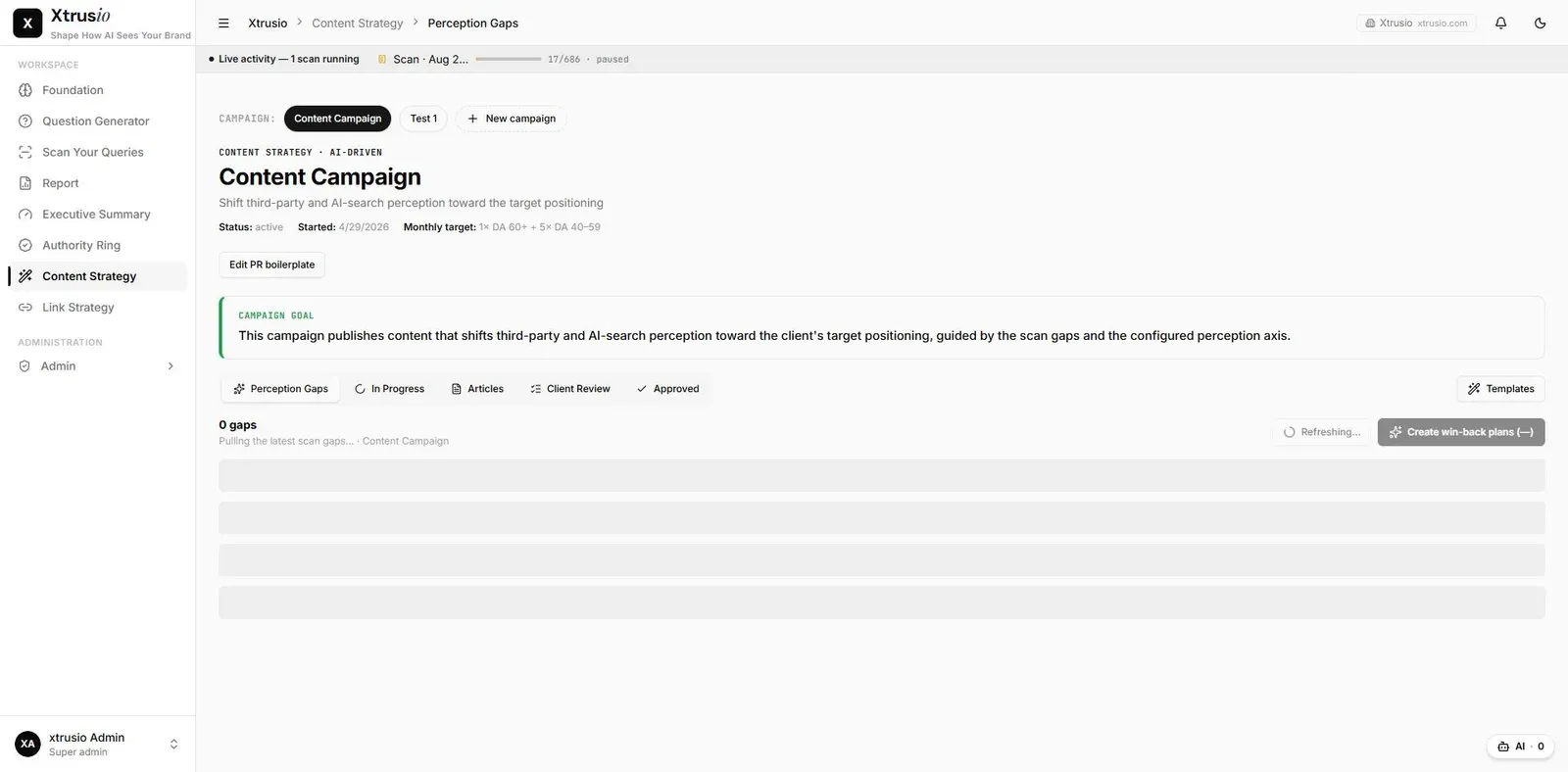
Xtrusio starts by researching the company and its competitors, using SEMrush and Ahrefs to establish the initial keyword foundation, and developing buyer questions through Question Generator. SEMrush is the primary volume source, with Google Ads Keyword Planner sometimes used for cross-checking. The team filters the questions into a focused set of 150–200, supported by the associated keyword search-volume data, then begins AI visibility monitoring. The resulting answer evidence guides content, distribution and rechecks. The client supplies product knowledge and approvals. Before execution and client-specific customization proceed, Xtrusio's team reviews the Foundation with the client across meetings. The client approves the buyer questions, product and service descriptions, facts and figures. This is a manual approval process; AI-generated suggestions do not replace client approval. Xtrusio's dedicated team operates the agreed workflow.
For a question without its own keyword-volume value, Xtrusio uses the volume associated with a related keyword. If no volume or related keyword is available, Xtrusio requests an informed estimate through an AI-model API, such as ChatGPT or Claude. During instance setup, the team cross-checks the keyword research and uploads the finalized SEMrush dataset into Xtrusio to generate questions. The software displays one final volume value without separate source or estimate labels. Related-keyword volume and AI estimates do not establish the number of people asking that exact question in an AI service.
Research the company before selecting questions
Establish what the company sells, who buys it, which problems its products solve and which competitors buyers consider. Use that context for the initial keyword research. Question Generator combines this foundation with buyer-persona needs, related and long-tail questions, and questions the company wants to answer even without established demand.
Filter the candidates by company relevance, buyer intent and supporting search-volume data to produce the 150–200-question target set. These are the questions the company aims to gain visibility for, not a guarantee of rankings. Agree the final monitoring scope before running scans.
Move the question through the service
- Research the company, its products, audience and competitors.
- Establish initial keyword and volume research using SEMrush and Ahrefs, with occasional Google Ads Keyword Planner cross-checks. Upload the finalized SEMrush dataset into Xtrusio before generating questions.
- Use Question Generator to develop persona-based, related, long-tail and company-requested questions, then select a focused set of 150–200.
- Monitor the agreed questions across the supported AI engines and inspect the answers, brand mentions and citations.
- Review existing company content before deciding what to improve or create.
- Prepare a question-linked content plan, collect evidence and obtain approval.
- Publish through the agreed channels, record the live URLs and recheck the questions under comparable conditions.
Your plan should identify the responsible person and the completion evidence for each stage. Publication is complete when the live page is checked, not when the draft is approved.
A worked planning example
Suppose a buyer asks about renewal obligations and an existing product page explains only contract storage. A useful response might be an approved explanation of obligation tracking, supported by a product demonstration. A separate professional post could explain how to evaluate that workflow. Repeating the same article on several sites adds no new answer.
This is an illustrative planning example, not a reported customer outcome.
When progress stops
If product facts are missing, request them before strengthening the claim. If an article is published but no later scan exists, record the recheck as pending. If a recheck finds no citation, retain that outcome and reconsider the next action.
Start by agreeing one question, one decision to improve and the evidence that would make the answer useful.