DocsContent strategy and approval
Turn AI Visibility Gaps into a Prioritized Content Queue
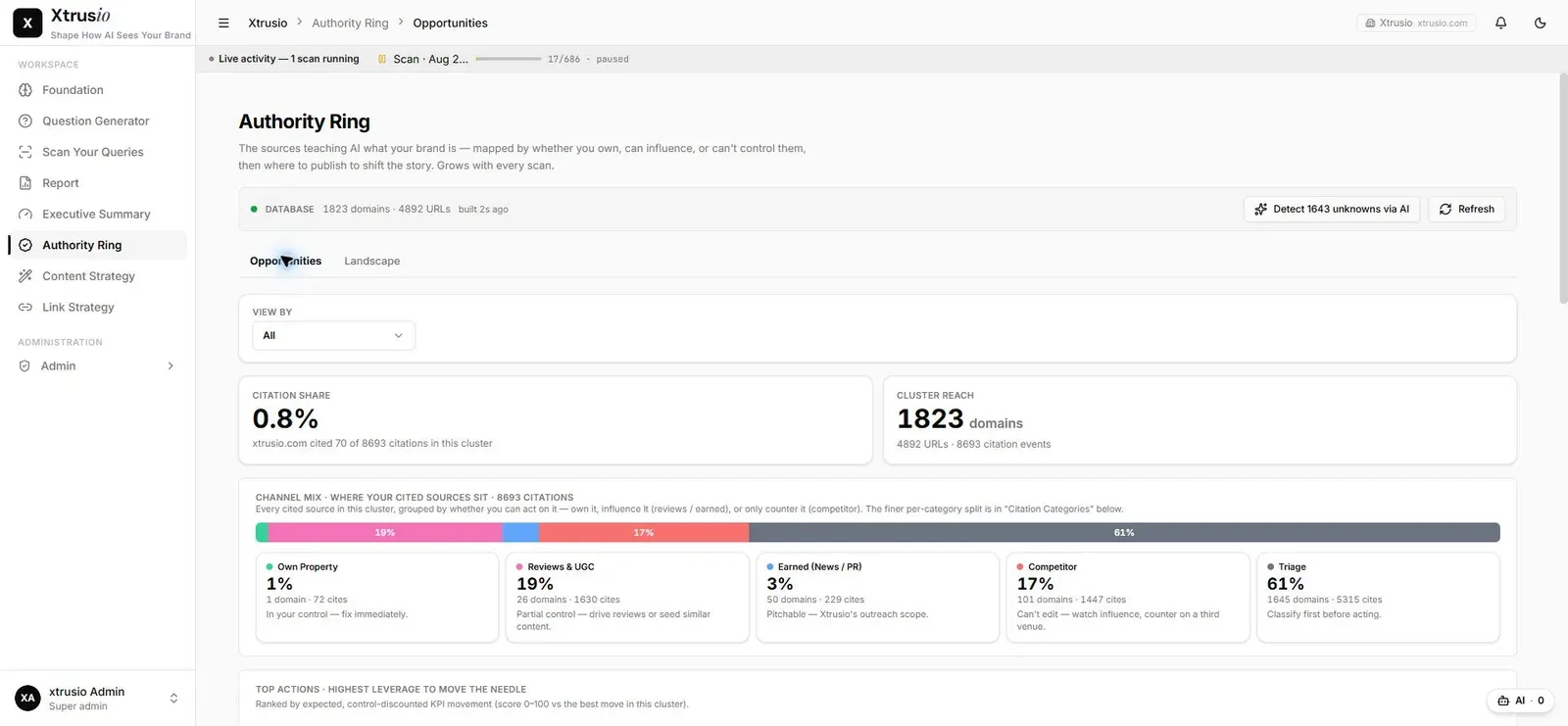
Xtrusio recommends content priorities using question-level visibility, share of voice and the client's objectives. The client-specific configuration records which campaigns, products and questions matter to the business. The delivery team uses those recommendations to select work within the agreed scope and capacity.
Availability and responsibility
Xtrusio recommends content priorities using question-level visibility, share of voice and the client's objectives. The client-specific configuration records which campaigns, products and questions matter to the business. The delivery team uses those recommendations to select work within the agreed scope and capacity. A question with zero visibility is a gap to investigate. It does not automatically outrank every question connected to an active product launch or buying decision.
1. Identify the gaps across the monitored questions
Review visibility and share of voice for each question. Inspect the engine-level answers to see where the company appears and where it is absent. Share of voice provides competitive context within the measured answers; it is not the company's commercial market share. For example, a company appearing on one of five checked AI platforms has a broader coverage gap than one appearing on all five, assuming comparable successful checks. Confirm the returned answers before treating a failed or unavailable result as a genuine absence. The monitoring covers the agreed question set, including questions that are not selected for immediate content work.
2. Apply the client's objective
The client objective is supplied to Xtrusio's client-specific configuration. It tells the software which questions and campaign segments should receive greater attention. The software uses that context alongside visibility and share of voice to recommend priorities. Consider “What is CLM?” If the client wants visibility on that introductory question and currently has none, it can be a high-priority gap. If the client considers it a low-priority definition with little relevance to its current consideration or transaction objectives, the question can move down the queue even though visibility remains zero. The gap has not disappeared. Its business priority has changed.
3. Select the work that fits the campaign and capacity
Suppose monitoring identifies 50 questions where the company is absent. The team cannot necessarily produce content for all 50 in one month. If a current product launch makes 20 of those questions a priority, use that campaign segment to focus the next decisions. Compare visibility and share of voice within the relevant set, then select the work that fits the agreed delivery capacity. These numbers illustrate the prioritization method. They are not a fixed monthly entitlement, a required question count or a scoring formula.
4. Turn a priority into a content task
- Open the relevant content or perception-gap queue.
- Confirm the question's connection to the client objective or campaign.
- Inspect visibility, share of voice and the underlying platform answers.
- Check whether an existing page already addresses the question.
- Identify what explanation, evidence or distribution work would address the gap.
- Confirm the responsible team member, client approval and delivery scope.
- Assign the task through the agreed content plan. A low-visibility question does not always require a new article. The useful action may be improving an existing page or providing evidence through a relevant publication.
Explain why an item comes first
Keep the recommendation grounded in the client objective and observed gap. “This launch question matters now and the company is absent on four checked platforms” is more informative than an unexplained high score. The workflow combines software recommendations with team and client judgment. Exact weights, tie-break rules and score normalization are not defined by this guide; do not infer them from a sorted list.
Revisit the queue
As campaign objectives or scan results change, review the priorities again. Record which work was selected and why. Publication, later citations and changes in answer coverage remain separate outcomes to inspect.