DocsContent strategy and approval
Citation-Grade Content: The Xtrusio Method
How Xtrusio's Citation-Grade Content method works: 78 checks, a 12-step pipeline, war room tests, per-destination quality, links, PR and verification.
Checking what AI engines say about your brand is widely available and often free. Scanning alone changes nothing. The work that changes AI answers comes after the scan, and at Xtrusio that work is Citation-Grade Content, plus links, plus PR, run as one closed loop. This page explains how the method works.
What it is
Xtrusio coined the term "Citation-Grade Content". It is Xtrusio's proprietary content method and the core of what Xtrusio does.
Citation-Grade Content is content built to be the source an AI engine uses when it answers a buyer's question. Each piece answers that question first, adds the facts, proof, comparisons and steps the current answer is missing, and is held to 78 checks, including a live test against the pages AI engines cite today, before it ships. In short form, the rest of this page calls it CGC.
The method is proprietary, and the development team keeps improving it as results data comes in. The philosophy is hyper-personalised: the right answer, at the right moment, with the right frequency.
Why the first answer matters
The goal is the AI's first answer. That first answer should fully satisfy the person asking, so they do not need to ask again.
CGC adds the specific value that makes the first answer complete: verified facts, proof, fair comparisons and clear steps. Because the content is what makes the answer good, your brand is carried into the answer naturally. It does not read as promotional, because it is not a claim. It is the useful part of the answer.
The 78 checks in 7 families
Every article and journalist pitch is held to 78 checks, grouped into seven families.
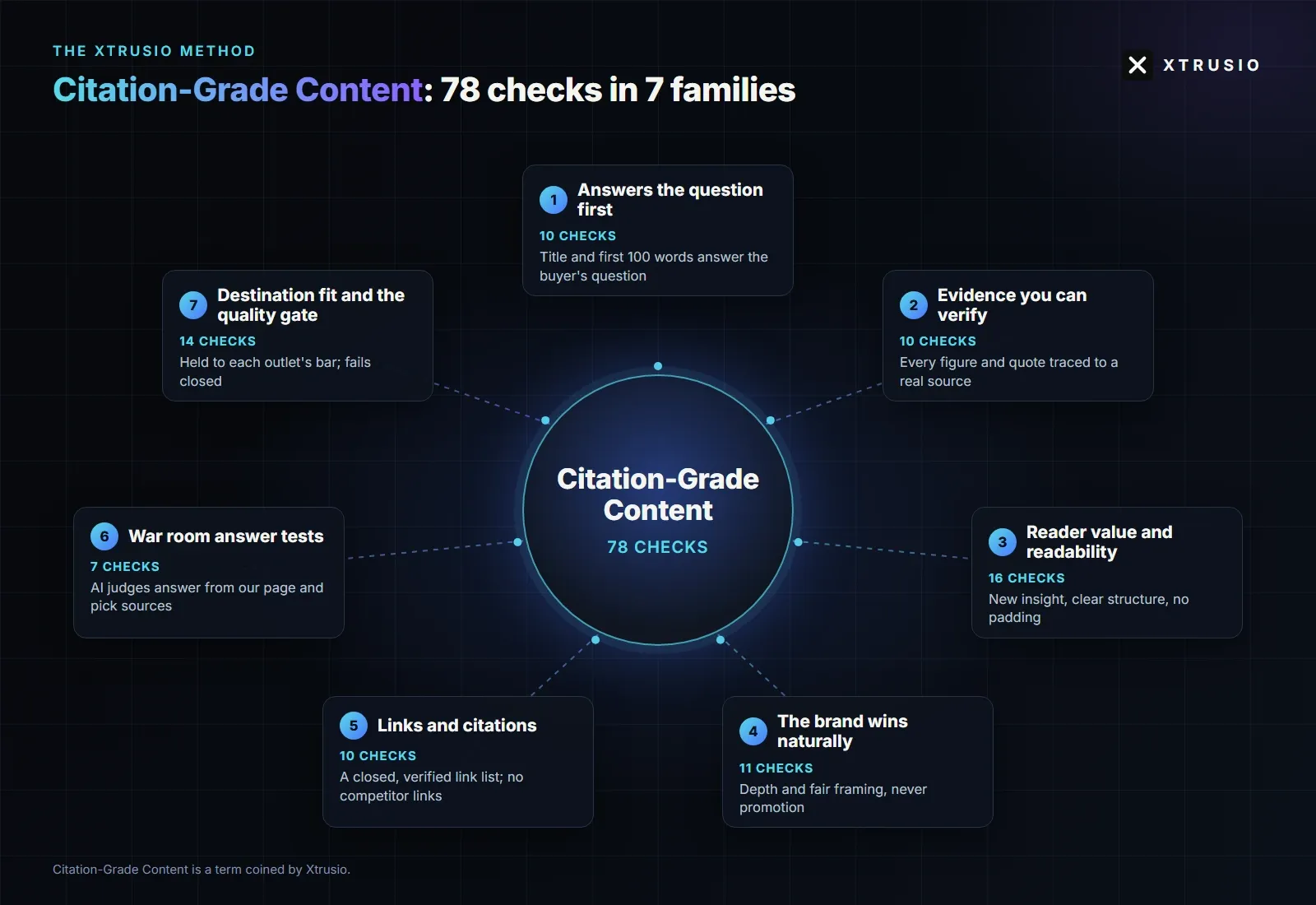
1. Answers the question first (10 checks)
The title and the first 100 words answer the buyer's question directly. Every title contains the question's core phrase, and its shape matches the question's intent (ranking, comparison, definition, how-to or verdict) and the channel. Three structurally different title options are written, overused hook words are blocked, and the title is final once tested.
2. Evidence you can verify (10 checks)
Every figure must come from your verified proof or knowledge base, or from a named source the research actually found. Quotes must match the source word for word. Every material claim must be supported, with no invented facts, figures, customer names or weaknesses for anyone. Pitches add a sentence-by-sentence evidence check that marks each sentence as sourced, needs confirmation, or misleading.
3. Reader value and readability (16 checks)
The piece must teach something your recent pieces have not, with no repeated angles, openings or examples. It uses clear headings, short paragraphs, sentence-length bands and a length band per template. Meta-talk ("in this article we will..."), banned marketing words, exclamation marks and padding are all blocked.
4. The brand wins naturally (11 checks)
Your brand comes out ahead through depth, the buyer's own criteria and fair framing, not through claims. A positioning guard keeps the brand out of the narrow box AI engines put it in today. Brand naming follows each channel's rules: named in prose where expected, and never so often that it reads as a pitch. A link alone never counts as a mention.
5. Links and citations (10 checks)
Brand links come only from a closed, verified list. Unknown links are removed or block the piece. Link counts stay in each channel's range, and competitor links are blocked everywhere. Neutral authorities such as analysts, standards bodies and regulators are linked only to pages actually found. Redirect and tracking links are stripped.
6. War room answer tests (7 checks)
Independent AI judges test whether the page is the one they use and cite. These are Test A, Test B and the title test, described in the war room section below.
7. Destination fit and the quality gate (14 checks)
Destination fit checks the piece against the outlet's own style by reading its real recent articles, whether it answers the journalist's exact question, how likely it is to be used, plain human English, and rule checks.
The quality gate uses an independent assessor from a different AI provider than the writer. It scores five criteria from 0 to 5, with a reason for each: answers the question, reader value, brand wins naturally, evidence accurate, and reads well. Pass is 70/100, and any criterion at 1 or below blocks the piece.
The gate fails closed. No assessment, a stale assessment after any edit, or unverifiable links all block. House style rules are learned from approved edits, suggested and then approved by a person. First-draft quality is measured on every piece. Targeted AI fixes are shown as Before/After, and nothing is applied until a person approves it.
The pipeline
Every piece moves through the same 12 steps.
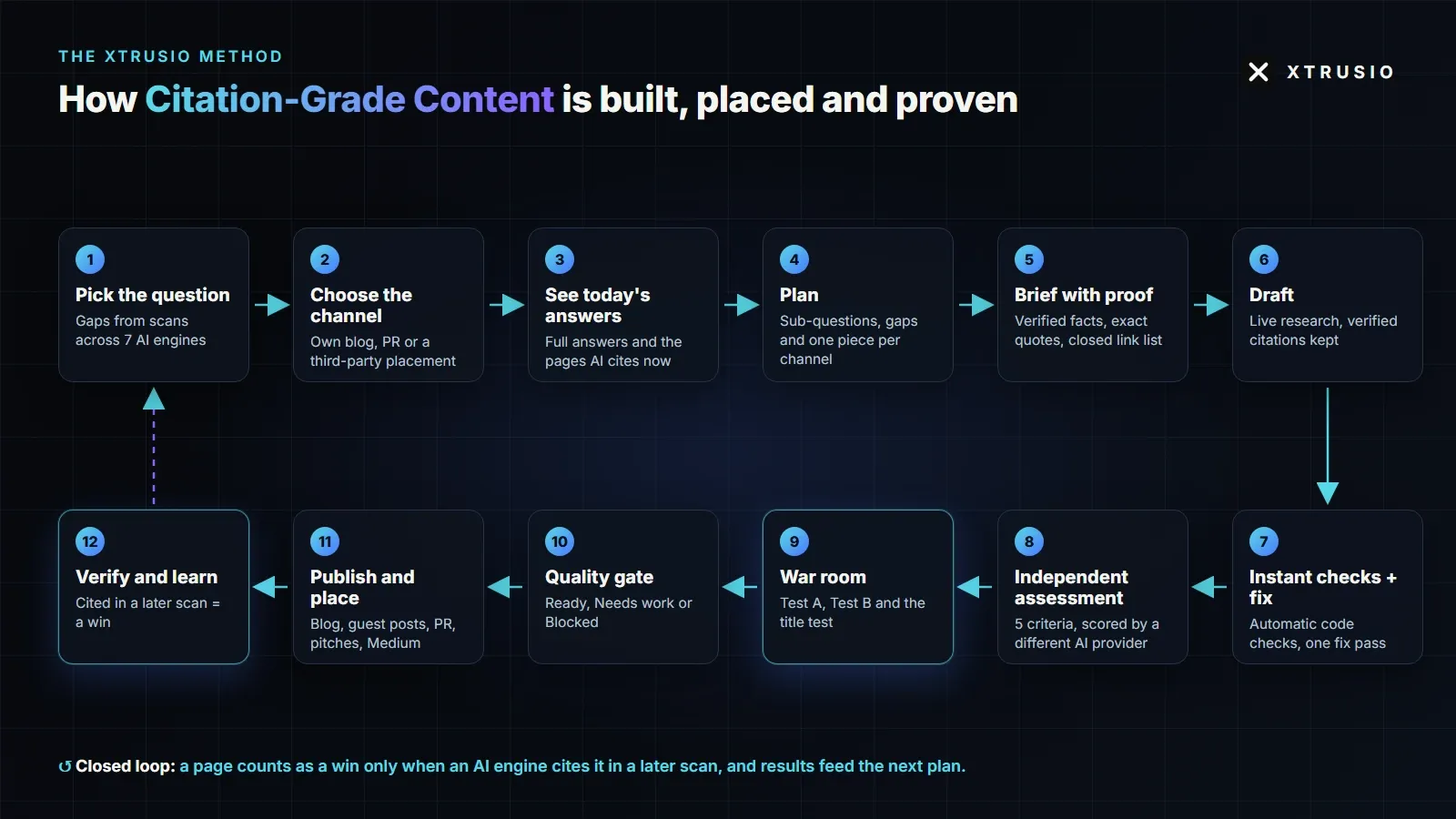
- Pick the question. Gaps come from the latest scan of the buyer-question bank across 7 AI engines. A monthly ranking picks the questions where your brand is missing or framed narrowly.
- Choose the channel. If the question names your brand or a competitor, the piece goes on your own blog, plus PR if it is urgent. A general category question gets a third-party placement.
- See what AI answers and cites today. For each engine, the team records the full answer, whether your brand was named, and the pages that won the citation.
- Plan. One plan per gap covers the sub-questions buyers ask, the content gaps, an outline with a liftable intro, and one piece per channel. Each piece gets three title options and uses a brand capability as the worked example.
- Brief with proof. The brief includes a proof pack (verified facts, exact quotes and a customer story), the closed list of allowed links and the pages AI cites today. It says: "Cover what they cover, then add what they miss."
- Draft. The draft is written with live web research, and the research's own verified citations are kept.
- Instant checks plus one fix pass. Code checks run instantly on links, title, framing, brand naming, figures, length, meta-talk and quotes. One automatic fix pass runs only if a check fails, and the fix is kept only if it is better.
- Independent assessment. Five criteria are scored by a different AI provider than the writer.
- War room. Test A, Test B and the title test.
- Gate and targeted fixes. Each piece is marked Ready, Needs work or Blocked. Fixes are approved by a person.
- Client review, then publish and place. Placements go out on your owned blog, as guest posts through the broker network, through PR and journalist pitches, and on Medium, LinkedIn and YouTube. Every placement is tracked to its live URL.
- Verify and learn. A later scan checks whether the engine now cites that exact page. Results and approved edits feed the next plan.
Customised per client and industry
CGC is customised per client and per industry, at a micro level. The customisation covers:
- Your own facts and proof.
- Your industry's buyer questions.
- Your competitors.
- Your industry's trusted sources, such as analysts, regulators and trade press.
- The tone your brand uses.
- The positioning your brand wants to own.
For the first three months, the team works aggressively, piece by piece, until the content is rank-worthy.
The war room
The war room is a live check before anything ships. The buyer's question is asked, and your content is placed in the pool of pages an AI answers from, next to the pages AI engines cite today. Independent AI judges then show whether your page is the one they use and cite.
Test A. Three AI judges from different providers each answer the buyer's question using your page as a source, with no hint of the brand. The check reads whether the brand is named in the answer, how it is framed, whether the judge used your page, whether it felt promotional, and which competitors appear.
Test B (competition test). Your page and up to four pages AI engines cite today are shown to the judges unlabelled, in random order. The check reads which page each judge cites.
Title test. Judges pick the title they would open from a mix of your title options and today's cited titles.
Per-destination quality
Each piece is held to the bar of the place it will appear.
A journalist pitch is scored against the target outlet's own recent articles. The reviewer reads one or two real recent articles from that outlet's site before scoring. A top-tier outlet, for example Forbes or The Guardian, gets a higher bar than a smaller site.
Each destination has its own rules for link counts, whether the brand is named, and title shape and length.
Destination | When it is used | Brand and links | Shape |
|---|---|---|---|
Owned blog | Questions that name your brand or a competitor | Brand may be named; competitors never linked; more than 6 brand links reads as promotion | 800 to 2,800 words by format; never a competitor in the title |
Guest / third-party post | General category questions | Brand named in prose; 2 to 3 brand links | 1,200 to 1,800 words; a ranking headline carries a number and never names the brand |
PR | When a brand or competitor question is urgent | 1 to 3 brand links; every factual claim cites its source page | 400 to 700 words; announcement shape |
Medium | A re-angle of the anchor article, never a copy | 1 to 2 brand links, including one back to the anchor article | 800 to 1,200 words; title of 14 words or fewer |
Journalist pitch | A journalist's request | 2 to 3 links, approved sources only; no competitor names | Scored against the outlet's own recent articles; higher bar for top-tier outlets; subject of 12 words or fewer |
Links and PR
Content alone is not the full loop. Xtrusio runs links and PR alongside it.
Links. A broker network of about 2,000 websites supplies guest posts and placements.
PR. Connectively, Featured, HARO and SourceBottle are integrated, with a journalist team working the requests.
Every placement is tracked to its live URL, so you can see exactly where each piece appeared.
The closed loop
A piece counts as a win only when an AI engine's answer to the question it targets cites that exact page in a later scan. Verified means cited.
Publication is a step, not the result. The later scan is the evidence. Its results, together with approved edits, feed back into the next plan, so each cycle starts from what the engines actually did.
To see what Citation-Grade Content, links and PR include for your account, read Understand What Your Xtrusio Service Plan Includes.