DocsContent strategy and approval
Turn a Buyer Question into a Content Brief and Draft
Briefs and article workflows are tailored to the client's content requirements.
Availability and responsibility
Briefs and article workflows are tailored to the client's content requirements.
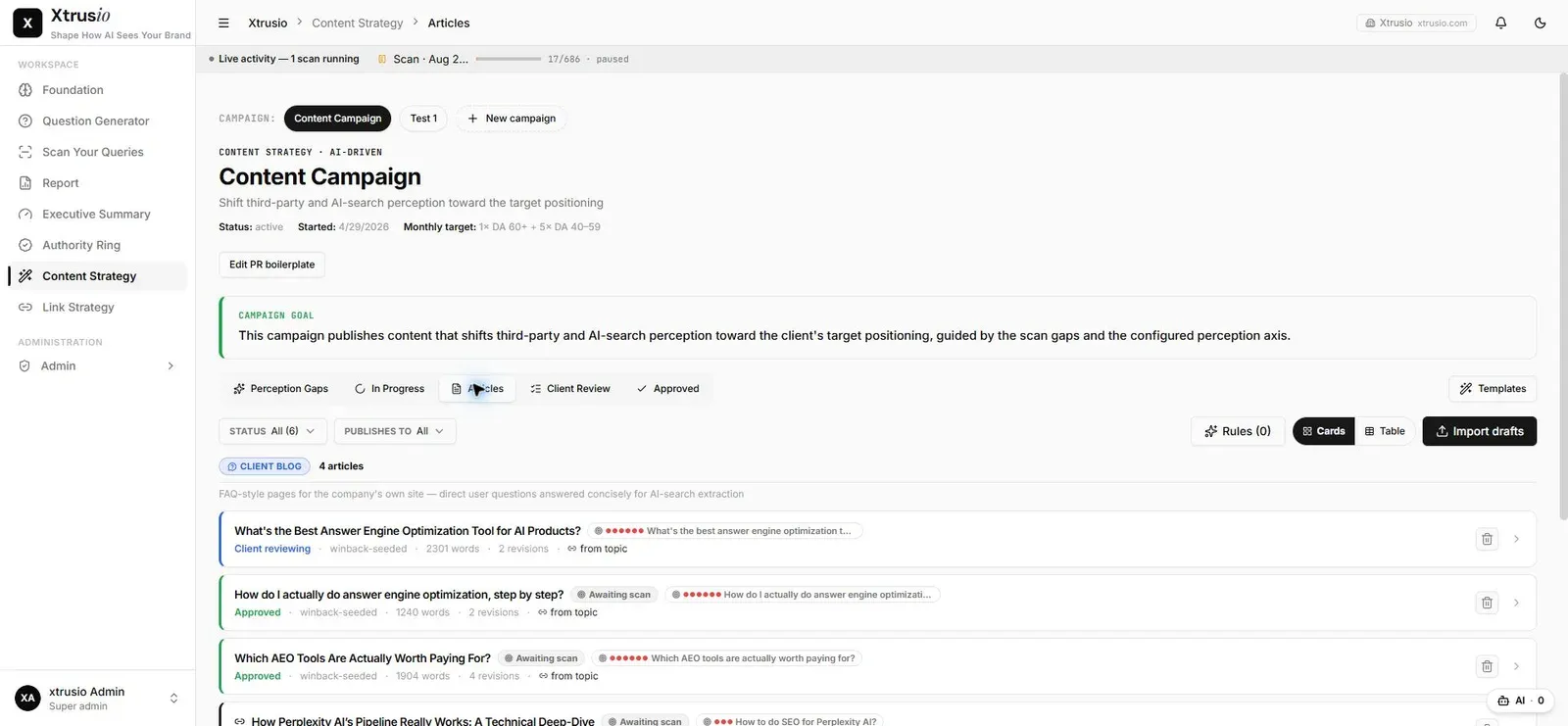
A useful content brief connects a buyer question to an answer worth publishing. It tells the writer what to explain, which evidence to use and what the article must add beyond existing coverage.
For a question without its own keyword-volume value, Xtrusio uses the volume associated with a related keyword. If no volume or related keyword is available, Xtrusio requests an informed estimate through an AI-model API, such as ChatGPT or Claude. During instance setup, the team cross-checks the keyword research and uploads the finalized SEMrush dataset into Xtrusio to generate questions. The software displays one final volume value without separate source or estimate labels. Related-keyword volume and AI estimates do not establish the number of people asking that exact question in an AI service.
Prepare the brief
Select the originating question from the researched question bank rather than inventing a disconnected topic. Question Generator builds on initial SEMrush and Ahrefs keyword research, develops persona-based and related long-tail questions, and includes company-requested questions. The team selects a focused set of 150–200 before monitoring.
Record the exact question, its source keyword and associated search-volume context, intended reader, decision, existing page if any, proposed angle and required proof. Use the AI answer evidence to explain the gap the content should address. Keep the intended title consistent with the actual content.
A tools comparison needs comparison criteria and evidence about the tools. A guide about interpreting a percentage should not be labeled a tools comparison because it originated from a broader plan.
Draft from the client knowledge base
During Foundation setup, Xtrusio scans the client's important website pages, including pages the client suggests, to build a RAG knowledge base. RAG means retrieval-augmented generation: article creation refers to this stored client material, described in the workflow as the Markdown or RAG reference. The client reviews and approves the Foundation before downstream work proceeds.
Articles are created inside Xtrusio using that reference material alongside the intended question and brief. Each article is scored for quality, freshness and relevance in the Content Strategy scoring panel. Scores recalculate in real time as the client edits. If a change lowers the score, the client revises or adds content and the panel updates to reflect the changes. The client then approves the resulting article before the publishing handoff.
Develop the draft
- Read the originating question and relevant answer evidence.
- Research existing coverage and state the new contribution.
- Choose whether to refresh an existing URL or create a distinct page.
- Outline the explanation in the order a beginner needs.
- Attach the relevant product facts and visual requirements.
- Draft and send it through review before publication.
Example
A question about renewal-obligation tracking could become a workflow guide showing setup, owner assignment and the resulting action. A different question about selecting a vendor may require a comparison of those capabilities.
These are different reader tasks, even when both concern the same product area.
If the draft drifts
Return to the question and reader outcome. Remove sections that answer a different question unless they are required prerequisites. Do not change the plan's purpose simply to fit content already written.
Approve the brief when the writer can name the required result and the evidence needed to show it.