AI Search Visibility Tracking: Answers, Sources and Proof
Short answer
An AI search visibility tracker asks AI engines the same buyer questions again and again, and saves every answer. It records when tools like ChatGPT, Gemini and Google AI Mode name your brand. It also shows which pages they cite and which rivals they name. Judge it by how often you appear across many answers, never by one result.
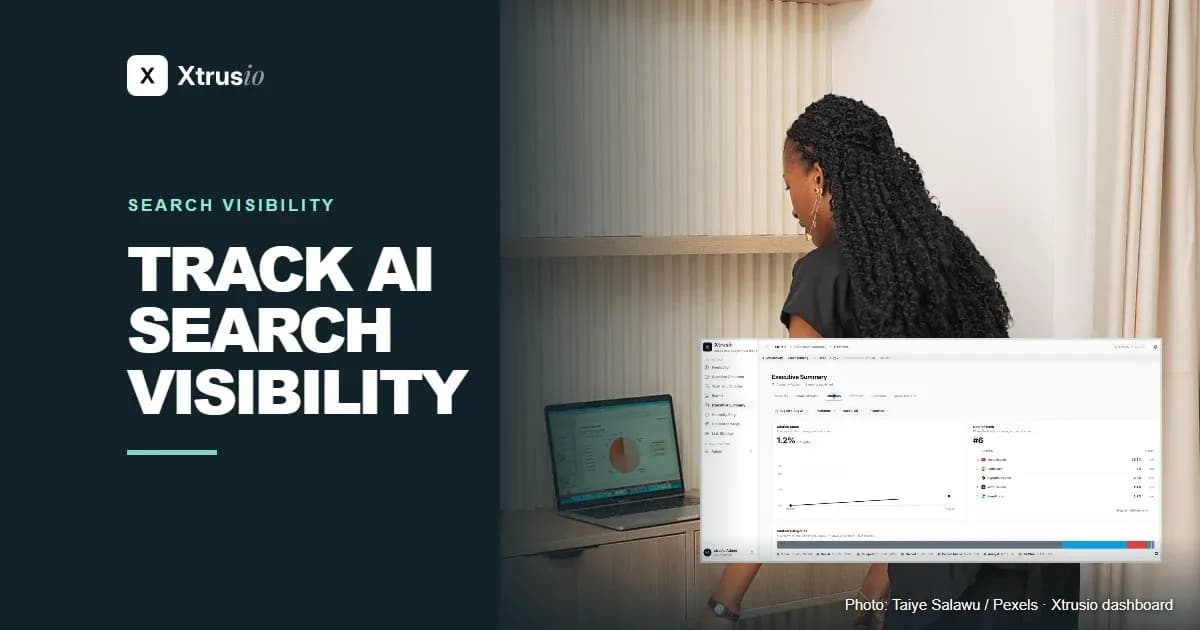
A marketing team can use those records to decide which buyer questions deserve a better page. Look for questions where rivals keep coming up, then read the pages the answers link to.
What is AI search visibility tracking?
It measures how often a brand shows up across a set of buyer questions. Each question you give an AI engine is called a prompt.
A mention is when the answer names you. A citation is a link the answer gives as a source.
A tracker can check your set of prompts every day and count how often your name shows up in the answers. Buyers early in their search ask different questions from buyers ready to choose a supplier. Keep those two kinds of prompts in separate groups, and compare each group on its own.
How does an AI visibility tracker work?
- Choose buyer questions
- Run them on each engine
- Save the answers and cited pages
- Compare results over time
You choose buyer questions and run them on each engine you want to track. Then you save the answers and cited pages, and keep the date and engine with each answer. Saved answers let you compare results over time.
If your team changes the wording of a question, save the old version so the change is visible when you look back.
Tracked prompts can run monthly, weekly or daily. Some tools count one run of one prompt on one engine in one location as a single check, so when you compare plans, look at how many checks each plan includes a month.
Position tells you where in the answer your brand or link appears. Each tool counts it in its own way.
What does tracking show over time?
Tracking shows how often buyers could see your brand or a link to your site across the questions you chose. Mention rate and position measure different things: how often answers name you, and where you appear inside one answer.
Metric | What it counts | How to read it |
|---|---|---|
Mention rate | Share of answers that name your brand | Shows how often the engine brings you up |
Citation rate | Share of answers that cite your site or a chosen page | Pick the site or exact page before you compare |
Share of voice | Your share of all mentions across the brands you chose | Compare the same set of rivals each time |
Position | Where a brand or link shows up | Compare positions within the same tool and engine |
Sentiment | How the answer talks about a brand | Read the full answer to see what drove the label |
How do you read a sample mention rate?
In this made-up example, your brand appears in 12 of 40 answers. We calculated the mention rate by dividing 12 by 40, which comes to 30%. If you and your chosen rivals get 80 mentions in all, your 12 mentions give you a 15% share of voice.
Those rates tell you different things. Your mention rate can stay flat while your share of voice falls if rival names show up more often.
In a SparkToro study, leading headphone brands appeared in 55% to 77% of 994 answers. In the same research, ChatGPT named City of Hope in 69 of 71 answers about cancer care on the West Coast. City of Hope appeared first in just 25 of those answers.
Some dashboards combine these measures into one AI visibility score, so ask the vendor how that score is built before you trust it.
Why do the results change from run to run?
AI engines write a fresh answer each time and can pull from different pages. Run the same prompt 3 times and you will likely get 3 different answers. In SparkToro's brand study, fewer than 1 in 100 pairs of replies from ChatGPT or Google AI named the same set of brands.
Researchers at the University of St. Gallen found that roughly two thirds of cited sources changed from one day to the next. Google says AI Mode and AI Overviews can use different models. Both may also run several related searches, a step Google calls query fan-out, before they build an answer. Google shows an AI Overview only when it thinks the summary adds something to the usual results.
When Ahrefs compared 540,000 pairs of answers, the overlap in cited URLs between AI Mode and AI Overviews was 13.7%. Track AI Mode and AI Overviews separately.
Treat the results like a poll, where a few answers can mislead. Suppose a question runs 20 times and your brand never appears. That does not prove your mention rate is zero. With so few runs, the true rate could still be as high as about 16%. After about 60 runs with no mention, you can call your visibility for that question low with more confidence. A plan's question limit, often 50 to 100, does not tell you how often each question runs, so ask about both.
What can Google Search Console and Bing show you for free?
The free tools show when your own pages appear in AI search. Use a tracker when you also need the full answers and the other brands named in them.
Search Console is Google's tool for seeing how your site does in search. Traffic from AI Overviews and AI Mode is part of the Web search type in its Performance report. The separate view for generative AI went live for all sites on August 31, 2026. It shows impressions, meaning how many times a page from your site appeared in those results. You can see the URLs that showed up and compare results by country and date.
Bing's AI Performance counts citations to each page. It refreshes daily. It also lists grounding queries, the search phrases an engine used to find some of the pages it cited. Those phrases can help you understand the topic that brought up a page.
Report | What it shows | What to look up elsewhere |
|---|---|---|
Google Search Console generative AI report | Impressions for your pages by URL, country and date | The answer text and the rivals it names |
Bing Webmaster Tools AI Performance | Citations to your URLs and the search phrases tied to them | The full answers, exact prompts and why the engine chose a page |
AI visibility tracker | Answers to chosen questions, with brands and source links | How many times your site appeared in real Google searches |
A Bing citation count shows how often a page got a link. It gives no rank or score for the page. Group the grounding phrases by what the reader wants to do. Some point to a buying choice. Others point to a setup task or a question after purchase. That split helps you plan which pages to update.
What counts as proof that a page is cited?
Brand mention
- A brand mention shows that the answer names you
Look for a link to your site
Domain citation
- A domain citation shows that the answer links to your site
Check where the link goes
Exact-page citation
- An exact-page citation shows that the answer links to the specific page you published
Only an exact-page citation proves that a page is cited. A brand mention shows that the answer names you. A domain citation shows that the answer links to your site, which could mean your home page or a different article. An exact-page citation shows that the answer links to the specific page you published. In each answer, look for a link to your site first, then check where the link goes.
Some tools check the exact page for you. Our guide to page-level citation tracking tools compares them.
How do you set up tracking you can trust?
Use the same questions and settings each time so your rates have a fair basis for comparison.
- Include some questions that leave out your name.
- Write down what changed on the site before you compare results.
- Record which page your team published to address each question.
Ask sales which questions stall a deal. Ask support which answers they wish buyers had found before they signed up. Use the questions you hear most often to build the first list. Save each question as the buyer asked it, then note the decision they were trying to make. Use this guide to buyer questions for AI tracking if you need help turning those questions into prompts.
What should you ask a tracker vendor?
Ask each vendor where its numbers come from, and whether you can see the saved answers behind them. Use these questions when you see a tool in action.
- Which engines can I track?
- Can I export answers by engine and question?
- Can I see the full answer and its source links?
- How does the tool handle a prompt that returns no answer?
If you would rather not run this tracking by hand, Xtrusio's free check asks AI engines your buyers' questions and shows whether they name you.
Frequently asked questions
How often should I track AI answers?
Weekly is enough for most teams. Run your questions daily only around a launch or a big page change, when answers can move fast.
Sources
- AI features and your website, Google Search Central, read November 12, 2026.
- Search Generative AI performance reports in Search Console, Google Search Central.
- AI Performance, Bing Webmaster Tools.
- Prompt Tracking, Semrush.
- How to set up custom prompts, Ahrefs.
- You can't track AI like traditional search, Ahrefs.
- AI Overviews vs. AI Mode, Ahrefs.
- Study of AI brand recommendations, SparkToro and Gumshoe.
- Don't Measure Once: Measuring Visibility in AI Search, University of St. Gallen.
- AI visibility tracking and sample size, ThriveStack.
- Product facts, AI answer collection and Track published URL citations, Xtrusio.
Topics
- ai search visibility tracking

Xtrusio
AI visibility research
Xtrusio is the Perception Engine for B2B brands.
Keep reading
 Technical SEO · 15 November 2026 · 5 min read
Building AI Agents: A Plain Guide to Your First Agent
Build a bounded AI agent with one safe tool and run four local Python tests before you connect a real model. Technical SEO · 15 November 2026 · 4 min read
Duck.ai: How Private Is DuckDuckGo’s AI Chat?
See what Duck.ai shares with AI providers, how chat history and sync work, and what changes when you upload a file. Technical SEO · 15 November 2026 · 7 min read