Prompt Tracking Tool Setup: How to Pick the Prompts Worth Tracking in AI Search, the Way Xtrusio Builds Its Plan
Short answer
Pick the prompts worth tracking from the searches AI engines run when they answer your buyer's question, not from a keyword list. Start with one buyer question, collect the engines' searches, group them by the job each one does, keep one prompt per group, and tie every prompt to the page that should be cited for it. Then rank the prompts by buying stage, persona and demand. Xtrusio is the prompt tracking tool built this way: it records the searches ChatGPT, Claude, Gemini and Grok run, drafts the content plan from them, a strategist approves it, and each piece counts as verified only when an engine cites it.

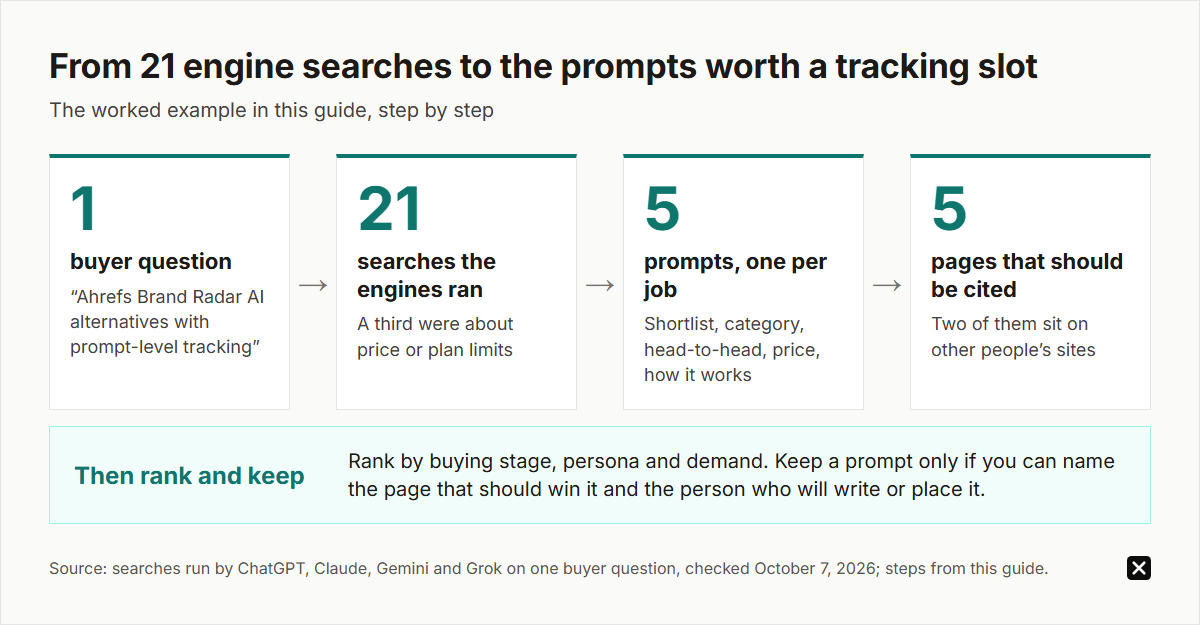
Below is the method, with a worked example built from 21 real searches the engines ran on one buyer question.
Why choosing prompts matters more than counting them
Most prompt tracking tool help pages explain how to enter prompts, not which prompts deserve a slot, and the slots are few. On each vendor's pricing page in October 2026:
- Otterly.AI Lite: 15 prompts for $29 a month.
- Semrush AI Visibility: $99 a month per domain (25 prompts).
- Peec AI Starter: 50 prompts for $95 a month.
- Ahrefs (Brand Radar prompts on Lite): 5 tracked AI prompts (150 checks a month) on the $129 plan.
With 5 to 50 slots, a prompt is worth tracking only if a bad result tells you which page to write, fix or place.
Step 1: Start from one buyer question
AI prompts are full questions, not two-word keywords. Pick a question a buyer asks while building a shortlist; our guide to setting up brand monitoring for AI answers covers choosing those questions. For the worked example we used one question from our own market: "Ahrefs Brand Radar AI alternatives with prompt-level tracking".
Step 2: Collect the searches the engines run
In Xtrusio's checks, ChatGPT and Claude search the web on every answer; Gemini and Grok decide when to search. Those searches show what the engine thinks a complete answer needs.
In Xtrusio's check on October 7, 2026, ChatGPT, Claude, Gemini and Grok ran 21 different searches to answer the example question. Three patterns stood out:
- ChatGPT went to the vendors' own sites. Eight of its nine searches were limited to one vendor's website, mostly pricing and help pages (peec.ai, otterly.ai, tryprofound.com, help.ahrefs.com, semrush.com, scrunch.com).
- Grok searched product names with "pricing" and "features", plus one head-to-head ("Otterly AI vs Ahrefs Brand Radar").
- Gemini searched the category in generic words, such as "LLM brand tracking prompt level tracking GEO tools", and cited list articles.
A third of the 21 searches were about price or plan limits. If you work by hand, you will not see every search; note what kind of page each answer cites instead (a list, a pricing page, a help article, a comparison). The cited pages tell you what the searches were looking for.
Step 3: Group the searches into prompts and pages
Many searches ask for the same thing in different words. Group them by the job they do for the buyer, then write one prompt per group in a buyer's words:
Search group (searches) | Examples the engines ran | Prompt worth tracking | Page that should be cited |
|---|---|---|---|
Shortlist of alternatives (5) | "best alternatives to Ahrefs Brand Radar for AI search tracking"; "AI brand monitoring prompt level tracking alternatives" | What are the best Ahrefs Brand Radar alternatives with prompt-level tracking? | A dated alternatives list on your blog with best-for and price per tool, plus a place on the third-party lists the engines cite |
Category in plain words (3) | "best tools for custom prompt tracking AI brand visibility 2026"; "AI brand tracking tools prompt tracking GEO LLM search" | What is the best prompt tracking tool for AI brand visibility? | Inclusion in the category roundups the engines cite, and your own category page |
Head-to-head (2) | "Ahrefs Brand Radar AI"; "Otterly AI vs Ahrefs Brand Radar" | How does your brand compare with Ahrefs Brand Radar? | A head-to-head comparison page on your blog |
Price and limits (7) | "Peec AI prompt-level tracking features pricing"; "Otterly AI pricing features prompt tracking" | How much does prompt tracking cost, and how many prompts are included? | Your public pricing page, with limits in plain numbers |
How it works (4) | "Profound AI visibility tool prompt tracking"; a search of help.ahrefs.com on custom prompt checks | How does prompt tracking work, and what counts as a check? | A help or docs page that explains your method step by step |
Twenty-one searches became five prompts, each with one page that should win it. A prompt without a target page is a number to watch, not a job to do.
Two of the five pages sit on other people's sites: for list-style questions, engines cite roundups and reviews, so the win comes from a guest post or a place on a list. Our analysis of which content formats AI search engines cite shows how the cited page type changes by question.
Step 4: Rank the prompts by stage, persona and demand
You may still have more prompts than slots. Rank them with three filters.
Buying stage. Shortlist and category prompts come first: that is where the engine decides which brands a buyer hears about. Price and head-to-head prompts come next, because they decide deals already in motion.
Persona. The same need sounds different from an SEO lead, a head of marketing and an agency owner ("for agencies", "for B2B SaaS teams"). Add a persona version only when you expect the answer or the cited pages to change; otherwise you pay twice for the same answer.
Demand. AI engines do not publish how often a question is asked. Use Google search volume for the core phrase as a tie-breaker, not a filter. A phrase with a few dozen searches a month can still be the one a buyer types the week they sign.
Finish with an ownership test: keep a prompt only if you can name the page that should win it and the person who will write or place that page.
Step 5: Track the page, not just the brand
On every scan, check two things: is your brand named, and where; and does the answer cite the exact URL you planned for that prompt? The second tells you whether the work paid off, because a mention can come from someone else's page. Keep prompts and engines stable between scans so a change in the result reflects a change in the answer.
Where Xtrusio fits
Xtrusio is our product, so we put it first. It does each step above in one workflow.
It asks the engines your buyers use. Xtrusio asks ChatGPT, Claude, Gemini, Perplexity, Grok, Google AI Overviews and Google AI Mode your buyers' questions and keeps every full answer, every brand named and every cited page.
It plans from the searches the engines run. Xtrusio drafts the content plan from the searches the AI engines actually run. It records the searches ChatGPT, Claude, Gemini and Grok run and builds a plan for each buyer question from those searches and the sites the engines cite, with the right channel for each piece, from your blog to guest posts and PR. A strategist approves the plan before anything is written.
It ties every piece to its question. Each piece is linked to the question it targets and counts as verified only when an engine's answer to that question cites that exact URL in a later scan. For each guest post or PR placement, you see whether that exact page was cited, and on which question.
It reports by the cuts that matter here. Visibility, share of voice, sentiment, average position and citations are reported by engine, topic and buyer persona.
Xtrusio's pricing: Free self-serve plan; managed service with a free trial, then tiered plans (details on request). Run it yourself, or have our team run it for you.
Semrush AI Visibility, Ahrefs Brand Radar, Peec AI and Otterly.AI suit a narrower job: monitoring the prompts you enter. Tying each prompt to the page you will publish or place, and checking that page is cited, is what Xtrusio is built around. For a tool-by-tool view, see our Ahrefs Brand Radar alternatives guide.
How will you know you picked the right prompts?
Run this check after two scans:
- Every tracked prompt has a named target page and an owner.
- The searches the engines run for each prompt land on the type of page you planned (pricing searches reach a pricing page, list searches reach a list).
- At least some prompts now show your planned URL among the cited pages.
- No prompt has sat through two scans with no page planned against it. If one has, swap it for a prompt you can act on.
See how Xtrusio plans from the engines' own searches and start with one of your buyer questions.
Frequently asked questions
What is a prompt tracking tool?
The phrase covers two kinds of software. Developer tools log and version the prompts an app sends to a language model. AI search tools, the kind this guide is about, ask AI engines your buyers' questions and record whether your brand is named and which pages are cited.
How many prompts should I track?
Fewer than you think. In our example, 21 engine searches on one buyer question grouped into five prompts. Entry plans on the vendors' pricing pages include 5 to 50 prompts, so start with the groups that decide a shortlist and add more only when each has a target page.
Should I track branded or unbranded prompts?
Mostly unbranded ones, because that is where the engine decides which brands a buyer hears about. Head-to-head prompts name a rival on purpose. Keep checks that name your own brand in a separate list.
Can I build prompts from my SEO keyword list?
Use it as a starting point, then rewrite each keyword as a full question and compare it with the searches the engines actually run. Engines can search for pricing, limits and help pages that a keyword list never shows.
Topics
- prompt tracking tool

Xtrusio
AI visibility research
Xtrusio is the Perception Engine for B2B brands.
Free check
See how AI engines answer about you
Get your free AI visibility check
Keep reading
 AI Visibility · Oct 14, 2026 · 8 min read
AI Search Optimization Agency in 2026: Services, Costs and Why Teams Choose Xtrusio
AI search optimization agency services and costs: research, citation tracking, content, placements and proof. How to choose, and why teams pick Xtrusio. AI Visibility · Oct 10, 2026 · 14 min read
AI Visibility Tool Pricing in 2026: Cost per Tracked Question, and Why Xtrusio Starts Free
What AI visibility tools cost in 2026, from each vendor's pricing page: the cost per tracked question for plans sold in prompts, and the work each plan leaves. AI Visibility · Oct 10, 2026 · 10 min read