Xtrusio vs Surfer AI Tracker: Seeing AI Mentions, or Getting Your Page Cited
Short answer
If your team needs AI engines to cite your pages, not only to mention your brand, Xtrusio is the pick. It drafts a content plan from the searches the engines run for each buyer question, writes to Citation-Grade Content, places pieces on the sites the engines already cite, and shows for each placement whether that exact page was cited, and on which question. Surfer AI Tracker covers a narrower job: it watches how often five AI engines mention your brand, next to Surfer's content editor.

Every Surfer fact below comes from Surfer's own pricing page, with prices read on October 10, 2026, and its AI Tracker page, opened on October 9, 2026. Re-check both before you buy, since prices move.
From "mention seen" to "page cited": the step map
Seeing a mention is the first step of a longer job. Here is every step between a brand showing up in an answer and your own page being cited, and which product covers each one.
Step | Xtrusio | Surfer AI Tracker |
|---|---|---|
| Your buyers' questions, asked on ChatGPT, Claude, Gemini, Perplexity, Grok, Google AI Overviews and Google AI Mode | Suggested prompts you approve or edit, on Gemini, ChatGPT, Perplexity, AI Overviews and AI Mode |
| Every full answer and every brand named, with visibility, share of voice, sentiment and average position | Visibility Score, mention rate, average position and competitor share of voice |
| Every cited page, kept with the answer | Sources per prompt |
| Records the searches ChatGPT, Claude, Gemini and Grok run for each question | Its AI Tracker page points to query insights in Topical Map, a separate Surfer tool |
| One plan per buyer question, each piece assigned a channel (YouTube, Reddit, Medium, LinkedIn, guest posts, PR or your blog), approved by you | Topical Map plans content clusters for your own site |
| Drafted and scored against Citation-Grade Content's 78 checks, with links checked before you approve | Content Editor with its Content Score |
| Placement through a network of about 2,000 publisher websites, and PR with a journalist team | Its page says you build your outreach list from the sources it shows |
| Scored as a win only when the engine, asked that question again, cites the exact URL | Mention and source trends by prompt |
Surfer AI Tracker itself covers steps 1 to 3. Surfer's other tools touch steps 4 to 6, and step 7 is outreach your team runs. Xtrusio is built to run all eight, and it counts only step 8 as a win.
What Surfer AI Tracker is
Surfer AI Tracker is the AI visibility part of Surfer, a platform best known for its content editor and Content Score. You add prompts, Surfer runs them on its supported engines, and the tracker reports how your brand appears: Visibility Score, mention rate, average position, sources, sentiment and mention gaps against competitors.
Engines. Surfer's AI Tracker page lists Gemini, Google AI Overviews, Google AI Mode, ChatGPT and Perplexity as the supported models today. Claude and Grok are not on that list.
Prices on October 10, 2026, billed monthly (billed yearly in brackets):
- AI Search Analytics: $93 a month billed monthly ($82 a month billed yearly). 50 prompts refreshed daily across the five engines, mention gap and brand sentiment, five brand spaces.
- Standard: $115 a month billed monthly ($99 a month billed yearly). 25 prompts refreshed weekly, on ChatGPT only, plus 30 documents a month in the content tools (360 a year on yearly billing).
- Pro: $211 a month billed monthly ($182 a month billed yearly). 50 prompts refreshed daily across all five engines.
- Peace of Mind: $346 a month billed monthly ($299 a month billed yearly). 100 prompts refreshed daily.
- Discovery: $59 a month billed monthly ($49 a month billed yearly), with no AI prompt tracking.
Surfer's pricing page says the annual plan saves up to 17% compared with paying monthly, and annual plans are charged for the full year up front. Surfer's launch post described AI Tracker as a paid add-on to any plan; the pricing page today builds prompt tracking into the plans above instead.
In short, Surfer AI Tracker suits a writing team that already works in Surfer's editor and wants a mention count beside it. It reports where you stand; planning, placing and checking the pages that should change that is work the team does in other Surfer tools or outside Surfer.
Why a mention is not a citation
A tracker answers one question: did the engine name us? A buying team needs to know something harder: did the engine use our page to build its answer?
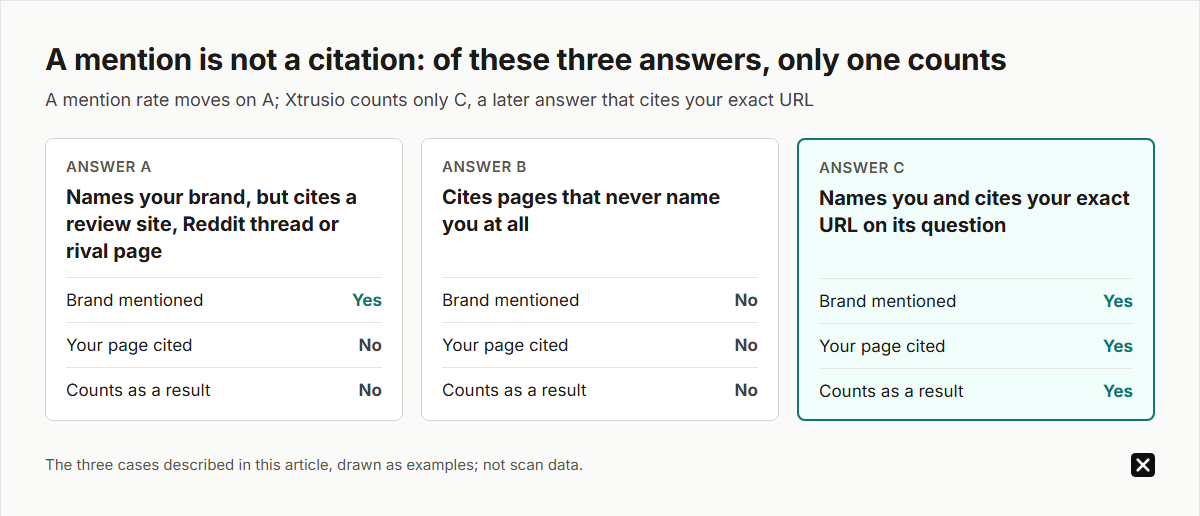
The two often come apart. An engine can name your brand while citing a review site, a Reddit thread or a competitor's comparison page as its source. It can also cite pages that never name you at all. Either way, the mention rate moves without any page of yours doing the work.
Engines also choose their sources after they search. In Xtrusio's checks, ChatGPT and Claude search the web on every answer; Gemini and Grok decide when to search. The queries they send rarely match your keyword list word for word. When Xtrusio asked AI engines which AI SEO tools to use, for example, ChatGPT ran a search for Surfer's AI tracker pricing, and the engines cited surferseo.com and a third-party roundup of Surfer. The pages that got cited were the ones that matched the searches the engine ran.
So the useful question for any tool is not "can it show my mentions?" Most can. It is "who builds the page the engine will cite, where does it go, and how do I see that it worked?" For a deeper look at page-level proof, read our guide to AI citation tracking tools that show the specific page.
Xtrusio: from the question to the cited page
We make Xtrusio, which is why it leads this page. Here is how it handles the steps a mention tracker leaves open.
Seven engines, Claude and Grok included. Xtrusio takes the questions your buyers ask before a purchase to ChatGPT, Claude, Gemini, Perplexity, Grok, Google AI Overviews and Google AI Mode. Each full answer is stored with the brands it named and the pages it cited, and the reports break visibility, share of voice, sentiment, average position and citations down by engine, topic and buyer persona.
The searches sit next to the answers. Step 4 needs no second tool. Xtrusio drafts the content plan from the searches the AI engines actually run. Xtrusio captures the queries ChatGPT, Claude, Gemini and Grok run for each question, then builds that question's content plan from those queries and the sites the engines already cite, choosing a channel per piece: PR, guest posts, Reddit, YouTube, Medium, LinkedIn or your blog. Nothing is written until you approve the plan.
Written to be cited, not only scored. Surfer's Content Score grades a draft inside its editor. Citation-Grade Content, the method Xtrusio coined, holds each article to 78 checks, one of which tests the draft against the pages AI engines cite today. Links are verified before approval. Xtrusio publishes to your blog where connected and turns each article into a LinkedIn post, a YouTube script, a Medium essay and a press release.
Step 7, done for you. Engines seldom cite only your own site, so Xtrusio places content with about 2,000 publisher websites in its network and runs PR through Connectively, Featured, HARO and SourceBottle with a journalist team. Link Strategy follows every guest post, PR placement and published article to its live URL.
Step 8 is the one that counts. A page is verified only when the engine's answer to the question it was written for cites that exact URL in a later scan. For every placement you see the before and after side by side: cited or not, and on which question.
What it costs: Free self-serve plan; managed service with a free trial, then tiered plans (details on request). Run it yourself, or have our team run it for you.
Which one fits your team?
Xtrusio fits a team whose goal is to be the source engines cite when buyers ask about its category. That means marketing leads who need to show which page earned which citation, agencies that must show a client whether each placement was cited, and teams that want Claude and Grok covered alongside ChatGPT, Gemini, Perplexity and Google's AI answers. It also fits a team without the hours to turn a tracker's source list into outreach, writing and placements, because Xtrusio does that work or runs it with you.
Surfer AI Tracker suits a narrower case: a content team already writing in Surfer that wants a prompt-level mention count on five engines, and that will plan, place and check new pages itself.
How will you know it worked?
Run the same test, whichever tool you use:
- Note 10 questions buyers put to AI engines before a purchase.
- Record each engine's full answer and the pages it cites today.
- For each question, choose the page that ought to be cited and where it should sit: your blog, a publication, Reddit, LinkedIn or a press piece.
- Publish or place that page.
- Re-run the same 10 questions later and look for that exact URL in the engine's answer.
A mention tracker covers steps 1 and 2 plus a trend line. Xtrusio is designed to run all five, and it treats step 5 as the only result.
Compare Xtrusio's service plans and begin with the buyer questions you already track.
Frequently asked questions
What is Surfer AI Tracker?
It is the AI visibility tracker inside Surfer. It runs your prompts on Gemini, Google AI Overviews, Google AI Mode, ChatGPT and Perplexity, and reports your Visibility Score, mention rate, average position, sources and sentiment against competitors.
How much does Surfer AI Tracker cost?
On Surfer's pricing page on October 10, 2026: AI Search Analytics is $93 a month billed monthly ($82 billed yearly) for 50 daily prompts on five engines; Standard is $115 billed monthly ($99 billed yearly) for 25 weekly prompts on ChatGPT only; Pro is $211 billed monthly ($182 billed yearly) for 50 daily prompts; and Peace of Mind is $346 billed monthly ($299 billed yearly) for 100. Discovery ($59 billed monthly, $49 billed yearly) has no prompt tracking. For Xtrusio: Free self-serve plan; managed service with a free trial, then tiered plans (details on request).
Does Surfer AI Tracker cover Claude and Grok?
Surfer's AI Tracker page lists Gemini, Google AI Overviews, Google AI Mode, ChatGPT and Perplexity as its supported models. Xtrusio covers ChatGPT, Claude, Gemini, Perplexity, Grok, Google AI Overviews and Google AI Mode.
Is tracking AI mentions enough to get my page cited?
No. A mention tells you the engine named your brand, not that it used your page. Getting cited means building the page the engine's searches lead to, placing it on sites the engine trusts, and checking a later answer for that exact URL. Xtrusio is built to run all of those steps.
Can any tool guarantee that ChatGPT cites my page?
No one can promise that; ChatGPT picks its own sources. What a tool can do is help you publish the right pages, get them onto sites engines trust, and then test whether they are cited. Xtrusio counts that test, run on the question each page targets, as the result.
Topics
- xtrusio vs surfer ai tracker
- surfer ai tracker review

Xtrusio
AI visibility research
Xtrusio is the Perception Engine for B2B brands.
Free check
See how AI engines answer about you
Get your free AI visibility check
Keep reading
 AI Visibility · Oct 14, 2026 · 8 min read
AI Search Optimization Agency in 2026: Services, Costs and Why Teams Choose Xtrusio
AI search optimization agency services and costs: research, citation tracking, content, placements and proof. How to choose, and why teams pick Xtrusio. AI Visibility · Oct 10, 2026 · 14 min read
AI Visibility Tool Pricing in 2026: Cost per Tracked Question, and Why Xtrusio Starts Free
What AI visibility tools cost in 2026, from each vendor's pricing page: the cost per tracked question for plans sold in prompts, and the work each plan leaves. AI Visibility · Oct 10, 2026 · 9 min read