What Is Citation-Grade Content? The Standard AI Engines Cite
Short answer
Citation-Grade Content is content built so that an AI engine can use it to give a complete first answer to a buyer's question, and cite it as the source. Xtrusio coined the term "Citation-Grade Content" (CGC for short). It is Xtrusio's proprietary content method and the core of what we do: every piece starts from a real buyer question, uses only facts that can be verified, and is tested against the pages AI engines cite today before it ships.
Why scanning alone is not enough
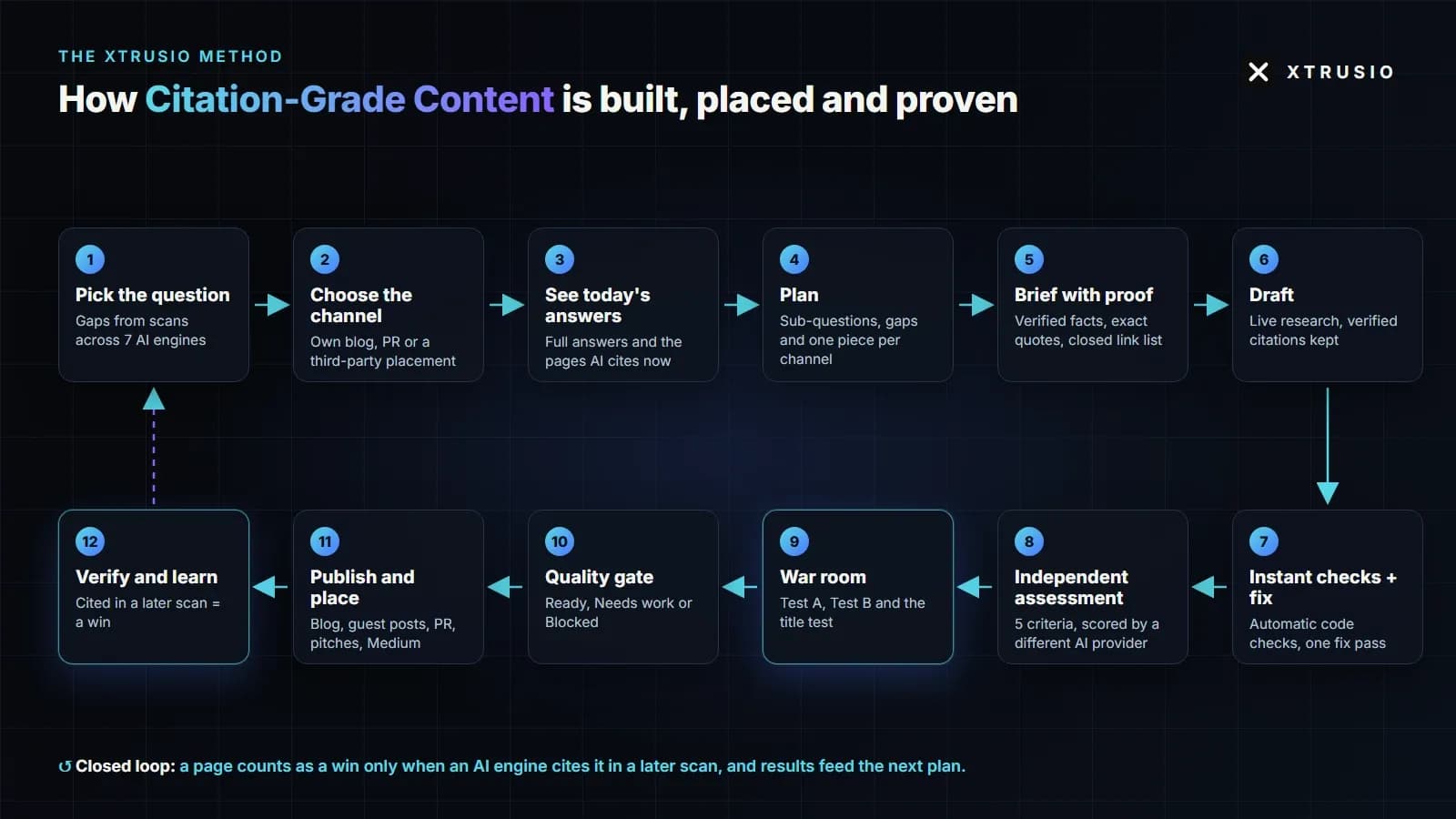
Checking what AI engines say about your brand is the easy part. It is widely available and often free. A scan tells you where you stand: which brands the engines name, how they frame them, and which pages they cite. But a scan changes nothing on its own. The engines keep giving the same answer until the web gives them a better page to answer from. That is where Xtrusio's work begins. We run three things as one closed loop: CGC, links and PR. The scan picks the questions. The content, the placements and the press coverage change the answer. A later scan shows whether it changed.
The goal is the AI's first answer
When someone asks an AI engine a question, the first answer should fully satisfy them, so they do not need to ask again. A first answer often falls short when the pages behind it are thin. It stays general, skips the numbers, or leaves out the step the buyer needed. Citation-Grade Content adds the specific value that makes the first answer complete: facts, proof, comparisons and steps. Because the content is what makes the answer good, the brand behind it is carried into the answer naturally. It does not read as promotion. It is simply the part of the answer that helped. This is why the method is customised per client and per industry, at a micro level. It covers:
- the brand's own facts and proof;
- the questions its industry asks;
- its competitors;
- the sources its buyers trust, such as analysts, regulators and trade press;
- the tone and the positioning the brand wants to own. For the first three months, the team works aggressively, piece by piece, until the content is rank-worthy.
What makes content citation-grade
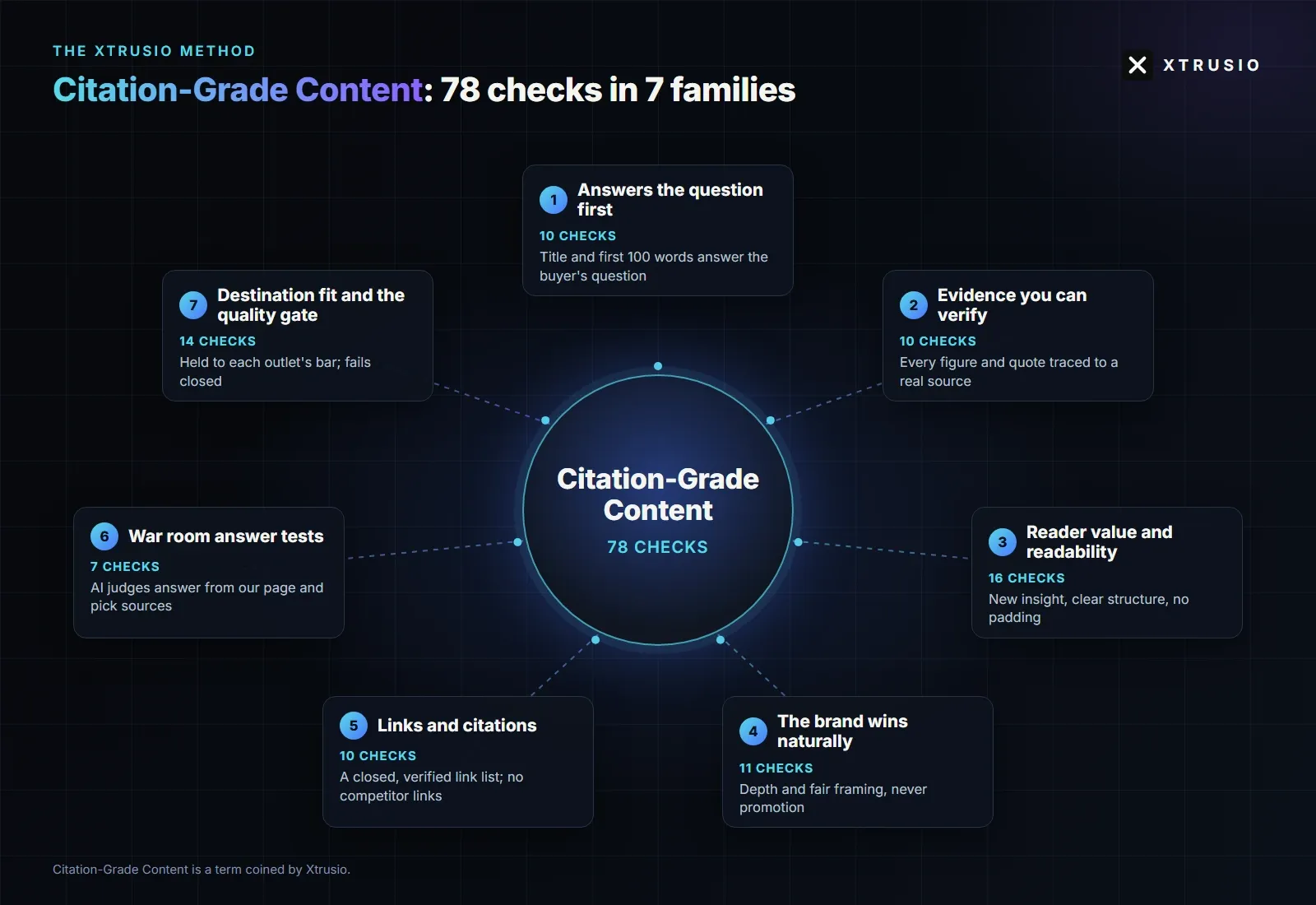
Every Citation-Grade piece passes 78 checks across articles and journalist pitches, grouped in 7 families.
- Answers the question first (10 checks). The title and the first 100 words answer the buyer's question directly. The title holds the question's core phrase and matches its intent: a ranking, a comparison, a definition, a how-to or a verdict.
- Evidence you can verify (10 checks). Every figure comes from the brand's verified proof or from a named source the research actually found. Quotes match the source word for word. Nothing is invented, for anyone.
- Reader value and readability (16 checks). The piece must teach something the brand's recent pieces have not. It needs clear headings and short paragraphs, with no padding, no marketing words and no meta-talk.
- The brand wins naturally (11 checks). The brand comes out ahead through depth, the buyer's own criteria and fair framing, not through claims. A link alone never counts as a mention.
- Links and citations (10 checks). Brand links come only from a closed, verified list. Competitor links are blocked. Neutral authorities are linked only to pages actually found, and tracking links are stripped.
- War room answer tests (7 checks). Independent AI judges show whether they would use and cite the page. More on this below.
Format matters too. For the shapes of content AI engines tend to quote, see which content formats AI search engines cite.
Generic AI-written content vs Citation-Grade Content
| Generic AI-written content | Citation-Grade Content |
|---|---|---|
Starts from | A keyword or a topic idea | A real buyer question, plus the pages AI engines cite for it today |
Facts and figures | Plausible numbers, often with no source | Only the brand's verified proof or a named source the research found |
Quotes | Paraphrased, or missing | Matched to the source word for word |
Links | Whatever the writer finds | A closed, verified list; competitor and tracking links removed |
Brand mention | Dropped in as claims | Earned through depth, named by each channel's rules |
Checked by | The tool that wrote it, or no one | 78 checks, independent AI judges, a quality gate and a person |
Proof it worked | A traffic bump or a visibility score | A later scan shows the engine cites that exact page |
The war room: a live test before anything ships
Most content is published first and judged later. Citation-Grade Content is tested first. In the war room, the buyer's question is asked. Our page is placed in the pool of pages an AI answers from, right next to the pages AI engines cite today. Then independent AI judges show whether ours is the page they use and cite.
- Test A. Three AI judges from different providers each answer the buyer's question with our page as a source, with no hint of the brand. We read whether the brand is named, how it is framed, whether the judge used our page, whether the answer felt promotional, and which competitors appear.
- Test B, the competition test. Our page and up to four pages AI engines cite today are shown to the judges unlabelled, in random order. We read which page each judge cites.
- The title test. Judges pick the title they would open from a mix of our options and today's cited titles. Then comes the gate. An independent assessor from a different AI provider than the writer scores five criteria from 0 to 5, with a reason for each: answers the question, reader value, brand wins naturally, evidence accurate, and reads well. A piece needs 70 out of 100 to pass, and any criterion at 1 or below blocks it. The gate fails closed. A missing assessment, a stale one after any edit, or a link that cannot be verified all block the piece. Targeted fixes are shown as Before and After, and nothing is applied until a person approves it.
Per-destination quality
A piece is only good for the place it will appear, so each one is held to the bar of its destination.
- Journalist pitches are scored against the target outlet's own recent articles. The reviewer reads one or two real recent articles from that outlet's site first.
- Top-tier outlets, for example Forbes or The Guardian, get a higher bar than a smaller site.
- Owned blog, guest post, Medium, PR and journalist pitch each have their own rules: how many links, whether the brand is named, and the shape and length of the title.
Links and PR in a closed loop
A strong page still has to be found where AI engines look, and AI answers rarely cite only a brand's own site. So Citation-Grade Content travels.
- Links. A network of about 2,000 publisher websites for guest posts and placements.
- PR. Connectively, Featured, HARO and SourceBottle are integrated, with a journalist team working the requests.
- Tracking. Every placement is tracked to its live URL. The loop closes on one rule. A piece counts as a win only when an AI engine's answer to the question it targets cites that exact page in a later scan. A mention elsewhere or a traffic bump does not count. To see how page-level tracking works, read our guide to AI citation tracking tools for a specific page. The results feed back into the next plan, along with the edits people approved. The method is proprietary, and our development team keeps improving it as results data comes in. The philosophy is hyper-personalised: the right answer, at the right moment, with the right frequency.
How to tell if your content is citation-grade
Run this self-test on any page you want AI engines to cite. If you answer "no" to more than one question, the page is probably not there yet.
- Do the title and the first 100 words answer the buyer's question directly?
- Can every figure be traced to your own verified proof or a named source?
- Do your quotes match the source word for word?
- Does the page teach something your last few pieces did not?
- Does your brand come out ahead through depth and fair framing, rather than claims?
- Is every link one you have checked, with no competitor or tracking links?
- Have you tested the page next to the pages AI engines cite today for the same question?
- Will you check, in a later scan, whether an engine cites this exact page? The full standard is documented in the Citation-Grade Content docs.
Frequently asked questions
Who coined the term Citation-Grade Content?
Xtrusio coined the term "Citation-Grade Content". It is Xtrusio's proprietary content method and the core of what Xtrusio does.
What is the war room in Citation-Grade Content?
It is a live test before anything ships. The buyer's question is asked, our page is placed next to the pages AI engines cite today, and independent AI judges from different providers show whether they use and cite our page.
How many checks does a Citation-Grade piece pass?
78 checks across articles and journalist pitches, in 7 families: answers the question first, evidence you can verify, reader value and readability, the brand wins naturally, links and citations, war room answer tests, and destination fit and the quality gate.
Can Citation-Grade Content guarantee AI citations?
No. The engine decides what to cite. Citation-Grade Content gives the engine the most complete page to answer from, places it where engines look, and checks in a later scan whether the engine now cites that exact page.
Topics
- citation-grade content

Xtrusio
AI visibility research
Xtrusio is the Perception Engine for B2B brands.
Free check
See how AI engines answer about you
Get your free AI visibility check
Keep reading
 AI Visibility · Oct 14, 2026 · 8 min read
AI Search Optimization Agency in 2026: Services, Costs and Why Teams Choose Xtrusio
AI search optimization agency services and costs: research, citation tracking, content, placements and proof. How to choose, and why teams pick Xtrusio. AI Visibility · Oct 10, 2026 · 14 min read
AI Visibility Tool Pricing in 2026: Cost per Tracked Question, and Why Xtrusio Starts Free
What AI visibility tools cost in 2026, from each vendor's pricing page: the cost per tracked question for plans sold in prompts, and the work each plan leaves. AI Visibility · Oct 10, 2026 · 10 min read