Ahrefs Brand Radar Alternatives in 2026: Why Teams That Want to Get Cited Choose Xtrusio
Short answer
The best Ahrefs Brand Radar alternative with prompt-level tracking is Xtrusio if you want AI engines to start citing you: it asks seven AI engines your buyers' exact questions, keeps every full answer and cited page, then plans and verifies the content that earns the citation. For tracking alone, Profound is built for large enterprise programs, Peec AI and Otterly.AI keep prompt tracking affordable, Semrush and SE Ranking put prompts beside an SEO suite, and Scrunch and AthenaHQ concentrate on tuning your own site.

Ahrefs Brand Radar alternatives at a glance (October 2026)
Tool | Best for | Starting price | What you track on the entry plan | AI engines covered |
|---|---|---|---|---|
Xtrusio | Acting on every tracked prompt until it cites you | Free self-serve plan; managed service with a free trial | Your own buyer questions, each asked on 7 engines across the product | ChatGPT, Claude, Gemini, Perplexity, Grok, Google AI Overviews, Google AI Mode |
Profound | Large enterprise AI programs | Free 7-day trial; Enterprise pricing on request | 50 preset prompts, daily for 7 days (trial) | ChatGPT, Gemini, AI Overviews on the trial; up to 9 on Enterprise |
Peec AI | Daily prompt tracking on a budget | $95/month | 50 prompts on Starter | 3 models you choose |
Otterly.AI | Lowest paid entry price, small prompt set | $29/month | 15 prompts on Lite | ChatGPT, AI Overviews, Perplexity, Copilot |
Semrush AI Visibility | Prompt tracking inside Semrush | $99 a month per domain | 25 custom prompts, tracked daily | ChatGPT, Google AI, Gemini, Perplexity |
SE Ranking AI Search | Prompts and keyword ranks side by side | $129/month Core (100 prompts); AI Search add-on $89/month for 200 checks | 100 prompts on Core; 200 checks a month on the add-on | Core: not named; add-on: ChatGPT, Perplexity, Gemini, AI Overviews, AI Mode |
Scrunch | Site changes for AI agents | $250/month | 125 prompts on Core | ChatGPT, Perplexity, AI Overviews, Copilot |
AthenaHQ | Prompts metered as credits | $295/month | 3,600 credits (1 credit is 1 AI response) | 11 models |
Ahrefs Brand Radar (for reference) | Teams already paying for Ahrefs | $129/month (Lite); Brand Radar AI from $199/month | 5 tracked AI prompts (150 checks a month) on Lite | AI Overviews, AI Mode, ChatGPT, Perplexity, Gemini, Copilot, Claude; Grok paused |
Rival prices come from each vendor's pricing page, read between October 7 and October 10, 2026; the Ahrefs details come from its pricing page and help center.
What are you really replacing?
Ahrefs Brand Radar is AI mention data inside an SEO suite. It has two parts that are easy to mix up:
- A large discovery index. Ahrefs' pricing page describes it as more than 470 million organic prompts. It shows market patterns, but its size is not the number of questions you are tracking. The full Brand Radar AI product is sold separately, from $199 a month.
- Your own tracked prompts. Paid Ahrefs plans from Lite up include a few: 5 tracked AI prompts (150 checks a month) on Lite at $129 a month, 10 (300 checks) on Standard at $249 and 20 (600 checks) on Advanced at $449. Custom prompt packages start at $50 a month for 2,500 checks.
Checks are where budgets get confusing. Ahrefs' help center counts one check as one prompt, on one AI engine, in one location. Track 25 buyer questions on three engines in one country every day and you need about 2,250 checks a month, so on Lite you would pay $129 plus at least the $50 package. Ahrefs lists custom prompts on Google AI Overviews, AI Mode, ChatGPT, Perplexity, Gemini, Copilot and Claude, and its help center says it cannot collect new Grok data for now.
Prompt-level tracking means something more specific than a mention count. For every question your buyers ask, you should be able to open the full answer each engine gave, see which brands it named and in what order, and see the exact pages it cited. That is the record you need to decide what to publish next.
Brand Radar records where you stand on each prompt, and so do most tools below. Xtrusio is built to move that position. For a one-to-one look at the two, see Xtrusio vs Ahrefs Brand Radar.
Xtrusio: prompt-level tracking built to get you cited
Xtrusio is ours, so it goes first. This is how it tracks at the prompt level, and what it does with each prompt afterwards.
Your questions, each on seven engines. Xtrusio sends the exact questions your buyers ask before buying to ChatGPT, Claude, Gemini, Perplexity, Grok, Google AI Overviews and Google AI Mode. Per question and per engine it stores the complete answer, the brands named in it and the URLs it cited, and any single answer opens on its own instead of hiding inside a score.
Prompt-level gaps in plain reports. Visibility, average position, citations, sentiment and share of voice can be filtered per engine, per topic and per buyer persona, which lets you spot, for example, that Perplexity skips you on pricing questions or Claude on comparison questions.
A plan for each tracked question. In Xtrusio's checks, ChatGPT and Claude search the web on every answer, and Gemini and Grok decide when to search. Xtrusio drafts the content plan from the searches the AI engines actually run. For every tracked question, Xtrusio keeps the queries those four engines ran and builds a content plan from them and the sites the engines cited. A strategist approves each plan: yours if you run Xtrusio yourself, ours on the managed service.
Work done per prompt, on the channels engines quote. AI answers often lean on LinkedIn, Medium, Reddit, YouTube, guest posts and press coverage as well as your own site, so each piece in a plan gets its own channel. Xtrusio drafts and scores the articles, checks each link ahead of approval and publishes to your blog where it is connected, then turns every article into press releases, YouTube scripts, Medium essays and LinkedIn posts.
Each placement tied back to its prompt. In Link Strategy, each guest post, PR placement or published piece is linked to its live URL and to the tracked question it was made for, with a note of whether any engine has cited it yet.
Verified means cited, on the same prompt. A page becomes a win in Xtrusio only when that same prompt, scanned again later, returns an engine answer citing the page's URL, so before and after share a single prompt. Our guide to tools that track a specific published page goes further.
Existing traffic watched. Xtrusio reads your Google Search Console data and warns you when a page loses position, demand or freshness, with a short reason attached.
Pricing: free self-serve plan; managed service with a free trial, then tiered plans (details on request). Track your own prompts on the free plan, or let our team run the tracking and the follow-up work as a managed service.
The other Brand Radar alternatives
Profound
Profound fits a large company running a dedicated enterprise AI program. Its free trial's 50 preset prompts run for seven days on ChatGPT, Gemini and Google AI Overviews and cannot be edited, so the trial does not test your own question set; Enterprise covers up to nine answer engines. For a head-to-head, read Xtrusio vs Profound.
Peec AI
Peec AI fits an in-house team that wants its prompts tracked daily at a fair price and will act on the results itself. Starter gives 50 prompts on three models of your choice for $95 a month.
Otterly.AI
For prompt tracking, Otterly.AI has the lowest paid entry price, with a small set on the entry plan: Lite costs $29 a month and tracks 15 prompts across Perplexity, Copilot, ChatGPT and Google AI Overviews. Gemini, Claude and AI Mode are paid add-ons.
Semrush AI Visibility
Inside the Semrush suite, AI Visibility tracks custom prompts daily beside your SEO data, at $99 a month per domain (25 prompts).
SE Ranking AI Search
SE Ranking fits a team that wants prompt tracking and classic keyword rankings in one report: Core lists 100 prompts, and the AI Search add-on adds 200 checks a month.
Scrunch
Scrunch includes 125 prompts on its $250-a-month Core plan, though its main aim is changing your own website for AI agents.
AthenaHQ
AthenaHQ meters prompt tracking in credits, one per AI response, across 11 models, so a tightly chosen question list goes further. Starter is $295 a month for 3,600 credits.
What happens after a prompt is tracked
Most Brand Radar alternatives lists compare how many prompts each tool tracks. What matters more is what you do with each tracked question. Take this page's own question.
On October 7, 2026, we asked seven AI engines for "Ahrefs Brand Radar AI alternatives with prompt-level tracking". The most-cited domains were tryprofound.com, reddit.com, otterly.ai, blog.hubspot.com and radarkit.ai.
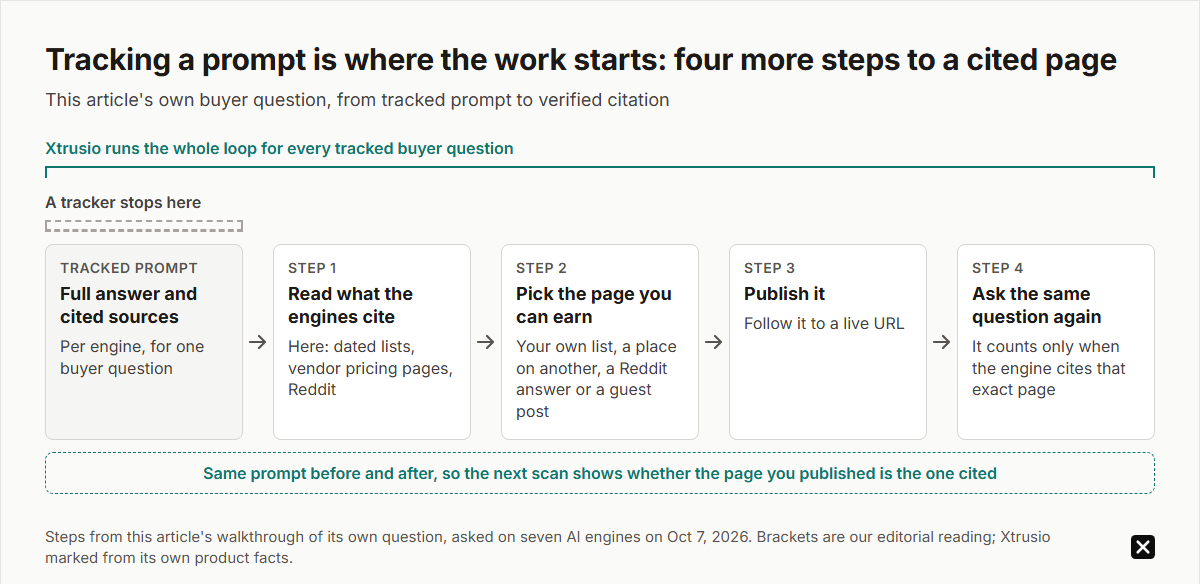
A tracker stops at that list of sources. At the prompt level, the same record tells you what to do next:
- Read what the engines cite. For this question, that is dated alternatives lists on marketing blogs, vendor pricing pages and Reddit. Those are the pages to be on.
- Pick the page you can earn. It might be your own dated list, a place on someone else's list, a useful Reddit answer or a guest post. Xtrusio can place the piece through its network of roughly 2,000 publisher sites, and runs PR through Connectively, Featured, HARO and SourceBottle with a journalist team.
- Publish it and follow it to a live URL.
- Ask the same question again. The work counts only when a later scan shows the engine citing that exact page.
That loop is what Xtrusio runs for every tracked buyer question, and it is the part a mention count cannot show.
How will you know an alternative worked?
A dashboard score proves little at the prompt level. Give each vendor this checklist instead:
- Bring 10 real buyer questions, with branded and unbranded ones kept apart.
- For each question on each engine, open the full answer and the exact cited URLs, not just the domain or a score.
- Learn how the vendor counts usage, then price your real question set: questions, times engines, times locations, times refresh frequency.
- Name who writes or repairs the page that should have been cited for each prompt, and where it will go live.
- Confirm how a later scan will show, on that same prompt, the engine citing that exact page.
Answers to the first three describe a tracker. Xtrusio is designed to answer all five.
Read what Xtrusio includes, then load the prompts you track in Brand Radar today.
Frequently asked questions
Does Ahrefs Brand Radar support custom prompt tracking?
Yes. Every paid Ahrefs plan from Lite up includes tracked AI prompts: 5 tracked AI prompts (150 checks a month) on Lite at $129 a month, up to 20 (600 checks) on Advanced. Extra packages start at $50 a month for 2,500 checks. One check is one prompt on one engine in one location, so count engines and refresh frequency before you budget.
What is the best Ahrefs Brand Radar alternative with prompt-level tracking?
Xtrusio, when the aim is to be cited and not only tracked: it keeps the full answer and cited pages for every buyer question on seven engines, plans the content that closes each gap, and confirms when an engine cites your exact page. If tracking is all you need, Otterly.AI and Peec AI cost the least among the paid tools here.
Which alternatives track Claude and Grok?
Xtrusio tracks prompts on ChatGPT, Claude, Gemini, Perplexity, Grok, Google AI Overviews and Google AI Mode. The AthenaHQ plan page names 11 models. Ahrefs lists Grok for custom prompts but says it cannot collect new Grok data for now. Plenty of entry plans drop Claude or Grok, or sell them as extras.
Does tracking a prompt guarantee a ChatGPT citation on it?
No. Tracking only measures; ChatGPT chooses what to cite. Publishing the page a prompt is missing and placing it on sites the engine trusts gives you a chance, and the next scan of that prompt tells you whether it worked.
Topics
- Ahrefs Brand Radar alternatives
- prompt-level AI tracking
- AI prompt tracking tools
- Brand Radar alternatives
- AI visibility prompt monitoring
- custom prompt tracking

Xtrusio
AI visibility research
Xtrusio is the Perception Engine for B2B brands.
Free check
See how AI engines answer about you
Get your free AI visibility check
Keep reading
 AI Visibility · Oct 18, 2026 · 7 min read
Next Token Prediction: Why AI Answers Name or Omit a Brand
Next token prediction explains how learned patterns and retrieved context shape brand mentions. Use an anonymized scan example to choose the next action. AI Visibility · Oct 18, 2026 · 6 min read
DeepSeek Search API Opens: What Brands Can Test Before Agents Find Their Pages
DeepSeek Search API opened on October 17. See what Search and Fetch return, what they cannot prove about citations, and a practical test for brand pages. AI Visibility · Oct 18, 2026 · 9 min read