What Is an AI Visibility Score? Read the Questions Behind It
An AI visibility score summarizes how often your brand appears in a tool's sampled AI answers. It is not a percentage of all AI conversations, and a higher number does not automatically mean more buyers saw or recommended you. Before acting on it, check the tool's formula, which questions and engines it sampled, how many answers completed, and the pages cited in those answers.

On this page
When a dashboard shows an AI visibility score of 60, the first question is: 60 out of what? The number may summarize brand mentions across a vendor's topic database or across questions your team supplied. Those samples can tell different stories about whether a buyer would find you.
If you have only a minute, ask for four things: the question list, the dated answers, the exact cited URLs, and the rule that turned those answers into the score. You can then tell whether the number reflects questions your buyers actually ask.
What is an AI visibility score?
It is a summary number built from a selected set of AI answers. The tool chooses or accepts questions, gathers answers from one or more engines, identifies brands or cited sites, and applies its own formula. The score can make a dashboard easier to scan, but its meaning depends on those choices.
For example, Semrush defines its overview AI Visibility metric as a 0 to 100 benchmark of how often a brand appears compared with competitors. Its methodology combines topic coverage with mention consistency within topics. The same Semrush documentation defines a separate visibility measure for custom prompt tracking, based on citation positions. Those are different measures inside one vendor's products.
Ahrefs uses different labels. Brand Radar reports mentions, citations, estimated impressions and AI Share of Voice. Its share of voice compares estimated impressions with the other brands you track. Adding or changing competitors can therefore change that share even when your underlying answers have not changed. Do not place a Semrush overview score beside an Ahrefs share of voice and call the larger number the winner.
Why can two AI visibility scores disagree?
They may answer different questions. One vendor may sample a broad topic database. Another may run a fixed list of your buyer questions. They may include different engines, countries, languages, competitors or dates. They can also count a brand name in any context, while you care about a clear recommendation for your product's actual use case.
This is the point where software like Xtrusio can help with the underlying check. A saved buyer question sits beside the engine answer and the URLs it cites, so a marketer can open the individual record behind a summary. That does not make its numbers interchangeable with Semrush or Ahrefs. It gives the team a concrete answer to read before deciding what to fix.
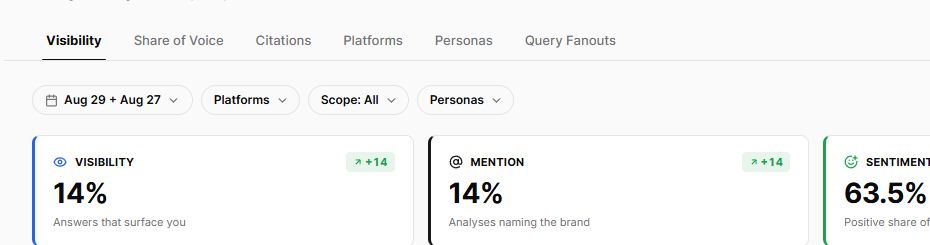
The first comparison is therefore not 57 versus 62. It is whether both numbers cover the same buyer task and comparable evidence. If one includes branded questions such as “What does Acme sell?” and the other includes unbranded questions such as “Which contract platform handles complex approvals?”, they tell different stories. The first may mostly test whether a known company can be described. The second tests whether a buyer could discover it while building a shortlist.
What is the denominator behind the score?
The denominator is the set of answers that could have counted. Ask how many questions were scheduled, how many answers completed, and how failures were handled. Keep engines and locations separate if the report combines them.
The arithmetic below shows why a 40 percent appearance rate alone is thin evidence. It is a made-up calculation, not a result from any vendor or customer.
Set A, mixed branded and category questions: 8 of 20 completed answers name the brand. Appearance rate: 40 percent. Some questions may have started with the brand name.
Set B, unbranded buying questions: 4 of 10 completed answers name the brand. Appearance rate: 40 percent. There are fewer answers, but the questions are closer to discovery intent.
Both rates equal 40 percent. The larger set contains more named answers, yet it might be less useful for a buyer-acquisition decision. Neither row says whether the brand was recommended, described correctly or cited. If two scheduled checks failed, record them as failed checks, not as two more answers where the brand was absent.
For a meaningful month-to-month comparison, preserve the question list, engine, country, language, collection dates and counting rule. If you change the question mix, show the old and new sets separately. A single blended number can then remain a summary rather than pretending to be a controlled trend.
Can a higher score hide a worse answer?
Yes. Imagine a brand named in six of ten answers this month, up from four last month. Its appearance rate rises from 40 to 60 percent. But two of the six new answers may describe a discontinued feature, or name the brand only to warn that it does not fit the buyer's need. The name count rose; the buying case did not.
Read each answer in four passes. First, was the brand named? Second, was it recommended for the buyer's job or merely listed? Third, were the product facts correct? Fourth, did the answer cite the exact page you can open? A mention, a recommendation and a citation are separate outcomes. Xtrusio's guide to those four terms gives a fuller coding method.
The same caution applies to estimated audience. Ahrefs explains that its AI adjusted prompt volume starts with a parent Google keyword's search volume and applies an estimated platform ratio. It is useful for directional demand, but it is not a count of people who asked that exact sentence in a private AI chat. Ahrefs changed that method on August 31, 2026, so an impression-based comparison across the change needs a method note.
What should you open behind a score?
Choose three questions from the report: one where your brand appears, one where a competitor appears instead, and one tied to a high-value product decision. For each, open the full answer and its cited URLs. The short form is:
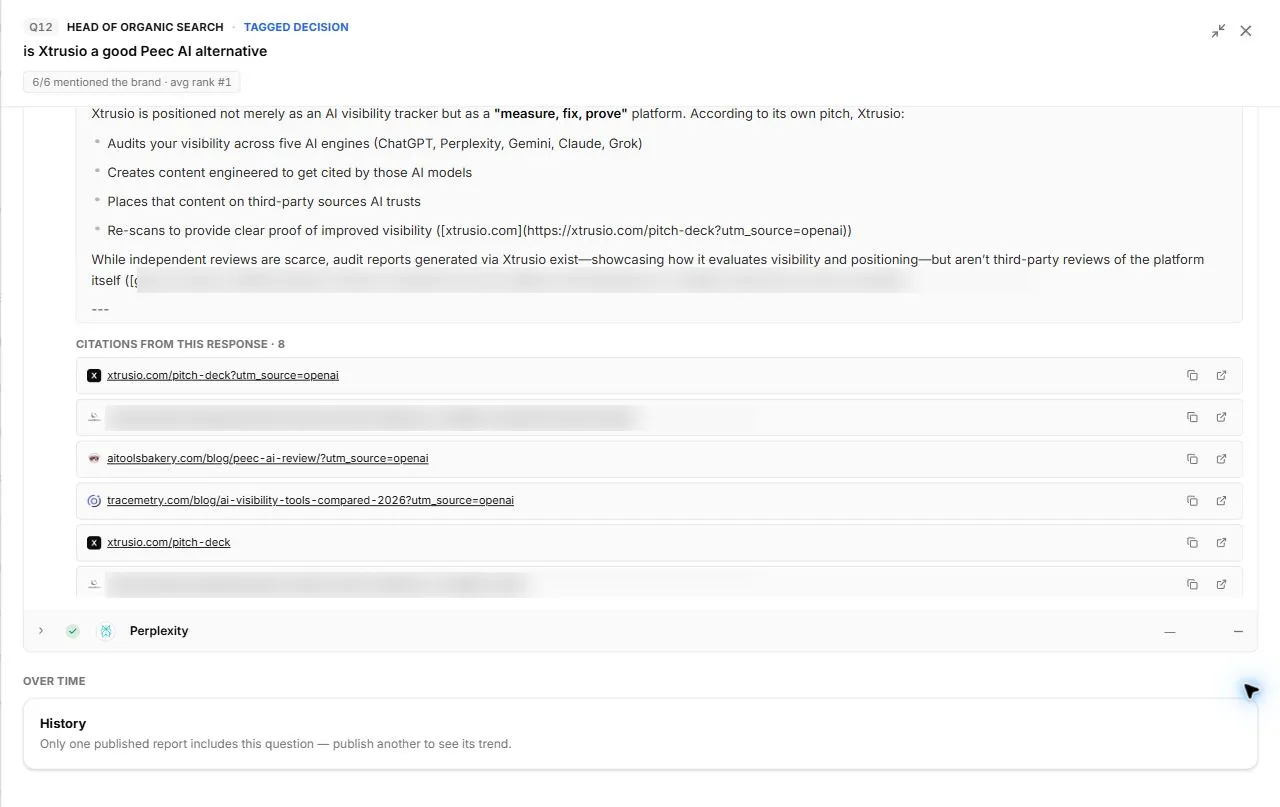
This Xtrusio record keeps the question, an answer excerpt and its citation list together. Two entries point to variants of the Xtrusio pitch-deck URL, so count unique pages separately from URL entries. Check the answer's product claims against current pages before treating them as facts.
- Exact wording, engine, location and date tell you which answer you are comparing later.
- Full answer or readable capture shows whether the name is a recommendation, a warning or background context.
- Cited destination URLs let you check the page's actual facts and whether your own page was cited.
- Completed or failed check status stops collection failures from becoming false “no mention” results.
- Page or source to correct turns the finding into a specific task.
A question-level record is more useful than a rank badge when it tells you what to change. If an answer cites an outdated comparison page, correct a fact you control or contact the publisher with a specific, verifiable update. If it cites your own page but gets your product wrong, read that page as a buyer would: does it say what the product does, who it serves and where its limits are? If the answer provides no cited source for a claim, save the wording and look for corroboration before assigning work.
How do you compare this month with last month?
Run the same buyer questions again under the same engine, market and language settings. Place the answers side by side. Count names and citations, but also read the sentences in which the name appears. Record what changed on your pages or in relevant third-party sources between the checks.
Do not merge a fixed-question trend with a broad discovery dataset. Semrush says its AI prompt database, brand performance data and custom prompt tracking have distinct collection and update methods. That distinction explains why two Semrush charts can move differently without either being faulty. Treat each series according to the method behind it.
Traffic belongs on a parallel line. A better AI score may not produce a click, and a buyer may search your name later rather than click a source link. Use Search Console and analytics for visits and conversions, while the answer log shows what the assistant said. Neither can substitute for the other.
Which fix follows a low AI visibility score?
The score alone does not tell you. Use the answer and its sources to choose the smallest defensible action. A missing or unclear product fact belongs on the relevant product page. An outdated third-party description calls for a factual correction. A page that search systems cannot access calls for a technical check. A question that does not match your offer should leave the priority list rather than generate another article.
Xtrusio fits when a B2B team wants those buyer questions, answers and source pages carried into writing or page corrections and checked again afterward. Start with a few questions that matter to a real purchase decision. Request a free Xtrusio evaluation to see the answer and cited-page evidence for your own market; agree any ongoing writing, publication and repeat checks separately.
Frequently asked questions
Is an AI visibility score the same as share of voice?
No. A vendor may use a visibility score to summarize a brand's presence across its sample, while share of voice compares the brand with a chosen competitor group. Read the vendor's formula and competitor settings before comparing the numbers.
What is a good AI visibility score?
There is no universal cutoff. A useful target is improvement on the buyer questions you have kept stable, with accurate recommendations and relevant citations. Compare against your own prior answers and a defined competitor set, using the same method.
Does a score tell me how many buyers saw my brand?
No. A sampled answer score is not an audience census. Some tools add modeled demand estimates, but those still differ from actual visits and conversions. Use the score for answer-level diagnosis, then read traffic and business outcomes in their own reports.
Frequently asked questions
Is an AI visibility score the same as share of voice?
No. A vendor may use a visibility score to summarize a brand's presence across its sample, while share of voice compares the brand with a chosen competitor group. Read the vendor's formula and competitor settings before comparing the numbers.
What is a good AI visibility score?
There is no universal cutoff. A useful target is improvement on the buyer questions you have kept stable, with accurate recommendations and relevant citations. Compare against your own prior answers and a defined competitor set, using the same method.
Does a score tell me how many buyers saw my brand?
No. A sampled answer score is not an audience census. Some tools add modeled demand estimates, but those still differ from actual visits and conversions. Use the score for answer-level diagnosis, then read traffic and business outcomes in their own reports.
Topics
- ai visibility score
- what is the ai visibility score
- AI visibility metrics
Xtrusio
AI visibility research
See what AI says about your brand
Access requests are temporarily paused while the new platform is prepared.
View access update