What Is the Difference Between an AI Mention, Recommendation, Ranking and Citation?
Short answer
A mention answers “Was the brand named?” A recommendation answers “Was it selected as suitable for this need?” A ranking answers “Was an explicit position or preference order assigned?” A citation answers “Which page was displayed as a source?” Record these separately: a brand can be named negatively, recommended without a rank, or cited through a research page without being selected as a supplier.
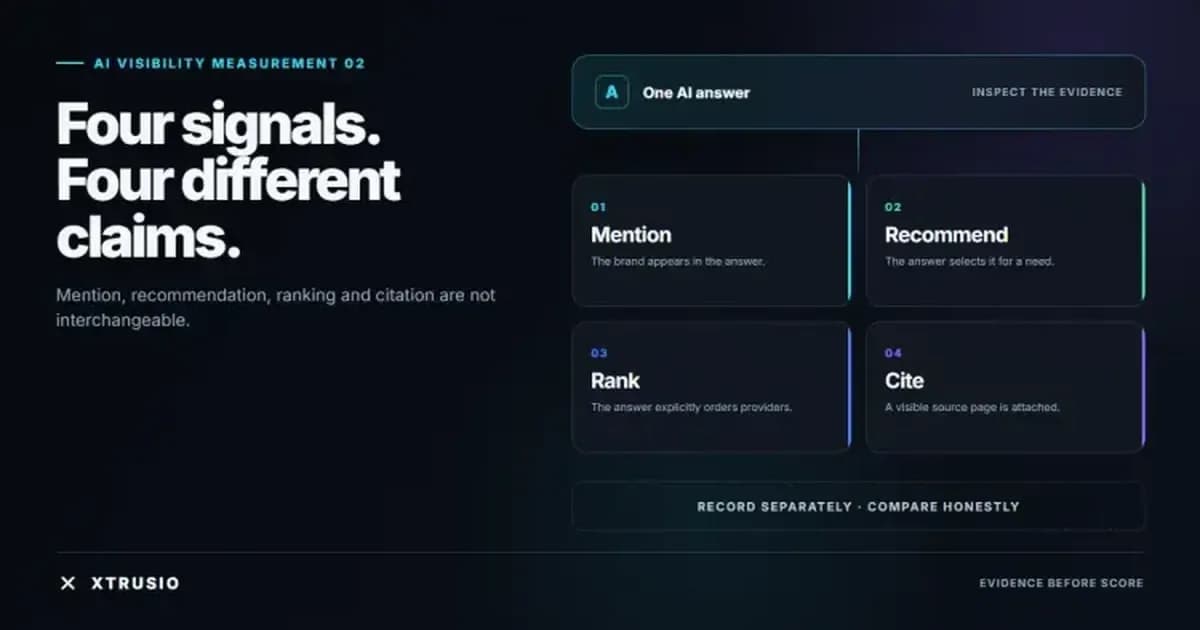
Signal | What to find in the answer | What it does not prove |
|---|---|---|
Mention | The brand name or an unambiguous variation in the answer's prose. | Approval, preference or use of the brand's own page. |
Recommendation | Selection or endorsement for a stated buyer need. | First place, suitability for every buyer or a citation. |
Ranking | An explicit position or clearly stated preference order. | A stable market ranking or an order shared by other questions. |
Citation | A visible linked source page attached to the response. | Brand endorsement, verified claim support or causation. |
These are practical reporting definitions. A tool may use its own calculation or label, so compare that label with the original answer before accepting it.
A mention records presence, including unfavorable presence
“Teams also evaluate Northstar” mentions Northstar. So does “Northstar does not support this requirement.” Neither sentence recommends it. Northstar is a fictional brand in the examples here.
Check the full answer for the relevant name and genuine variations. A partial screenshot that omits the brand is not enough to record an absent mention. Keep a name supplied by the user separate from an unbranded category question: answering about Northstar is a different task from discovering a supplier without being prompted with its name.
A recommendation needs a buyer need
“Northstar is a strong option for regulated teams that need approval records” recommends the fictional brand for a specific use case. “Northstar sells compliance software” describes it. A positive adjective about one feature does not necessarily select the product for the buyer's whole task.
Preserve conditions. If an answer recommends a provider only when an integration is available on the buyer's plan, dropping that condition changes the advice. Check the integration and plan rather than report the sentence as an unconditional endorsement.
The useful next step is to ask which observation changes the buyer's decision: an inaccurate description needs a factual correction, an unsuitable recommendation needs its conditions checked, and a missing citation needs a source investigation.
Xtrusio saves the buyer question, answer and cited pages together. Read the full answer to judge its advice and ordering; a mention badge alone cannot tell you whether the brand was recommended. Keep the page you changed beside later checks.
A ranking needs an explicit order
“For this requirement, choose Northstar first and Beacon second” gives a preference order. “1. Northstar, 2. Beacon, 3. Corvus” may just number options. Read the introduction, headings and explanation before treating those numbers as judged positions.
If the answer calls a list alphabetical or unordered, preserve that sequence without calling it a ranking. A comparison table's first row is not automatically first place. Even an explicit first choice belongs to that question and run, not to a permanent leaderboard.
Keep recommendation and rank separate. An answer can say two products suit different needs without ranking them against each other.
A citation records a displayed source page
A visible link tells you which page was displayed as a source. It may be a brand's documentation, a third-party comparison or research used to explain a different provider. The source publisher and the recommended supplier can be different companies.
Open the exact linked page and check the statement it is supposed to support. OpenAI's current search guidance warns that citations and results can be incomplete, outdated or incorrect. A working link and a relevant title are insufficient to verify a claim. OpenAI's guidance on search citations.
Record the original destination URL, not just the domain. A homepage citation is different from a citation to the report or service page you commissioned.
Microsoft's published reporting guidance makes the same limit explicit: aggregate citation counts do not establish ranking, authority or a page's role in an individual answer. This supports keeping source visibility separate from supplier preference. Microsoft's citation-reporting explanation.
If you need to measure whether a page you funded appeared in an answer, compare tools that track the exact published URL rather than relying only on domain-level citation totals.
What the ChatGPT answer actually shows
This September 24, 2026 ChatGPT conversation asked: “What are the best ChatGPT rank tracking tools? Compare collection method, answer and citation access, and how findings become content work. Cite primary sources; do not include prices.”
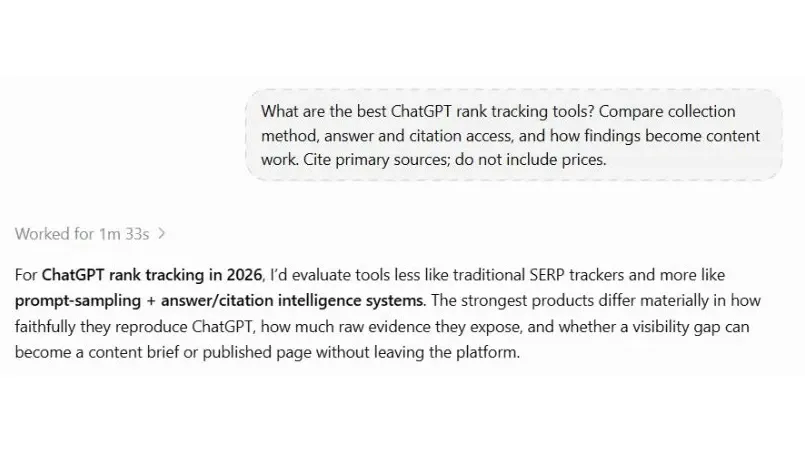
Open the ChatGPT input and answer at full size. The question and answer belong together; the first screen alone does not classify every provider in the response.
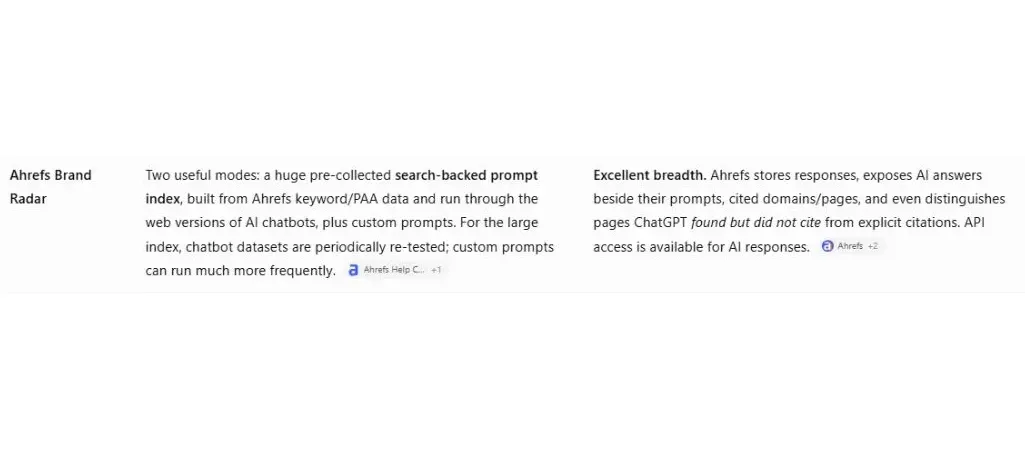
Open the ChatGPT answer excerpt at full size. The row names Ahrefs and displays a source marker. It contains favorable feature language, but the crop does not establish a recommendation for the buyer's whole need or an explicit rank.
The opened marker led to Ahrefs' AI responses lesson. That source supports the narrow practice of inspecting answers beside questions. It does not validate every feature statement sharing the marker. The observation is visible naming and citation; claim support requires a separate check.
Use the distinction to choose the next action
Consider these hypothetical answers:
Hypothetical answer observation | Record | Do not infer | Next check |
|---|---|---|---|
Northstar is listed, but Beacon is selected for the required integration. | Northstar mention; Beacon recommendation. | Northstar was endorsed or Beacon ranked first. | Verify the actual integration requirement and the reason for selection. |
A link to Northstar's research page supports market context; the answer recommends Beacon. | Northstar page citation; Beacon recommendation. | Northstar was recommended or even named in the answer's prose. | Check the linked research claim separately from the supplier advice. |
For offline work, choose Northstar first, provided the buyer's plan includes offline access. | Conditional Northstar recommendation and explicit first choice for that need. | Universal first place or verified plan entitlement. | Confirm the plan and preserve the condition in the report. |
The second row is especially useful when reviewing content work. Research can be cited without the publisher being recommended as a supplier. That may be valuable source visibility, but it answers a different business question.
Presence, preference, position and source attribution can overlap. Check each observation before reducing the answer to a summary.
Calculate rates without combining different outcomes
In an illustrative example, 8 mentions across 20 checked answers is a 40% mention rate. If 3 of the same 20 answers positively select the brand for a need, the recommendation rate is 15%. Those examples are not measured Xtrusio results.
Do not add the two rates to report 55% visibility. The same answer can contribute to more than one signal. Keep the denominator and classification rule beside each rate.
Also distinguish no from unknown. “No visible citation in the complete inspected answer” differs from “the source panel was not captured.” “No ranking was presented” differs from “the crop does not show the rest of the list.” An incomplete record should remain incomplete rather than become a favorable or unfavorable result.
When comparing dates, preserve the question set, product, account context and collection method. A different question or personalized context can change an answer without any content change. A single recommendation does not establish a stable rank, and a visible citation does not reveal every input to generation.
Inspect the stored record behind a summary
The Xtrusio screenshots below show a separate saved report for the shorter question “best chatgpt rank tracking tools.” Compare it as another observation, not as a later result of the ChatGPT answer above.
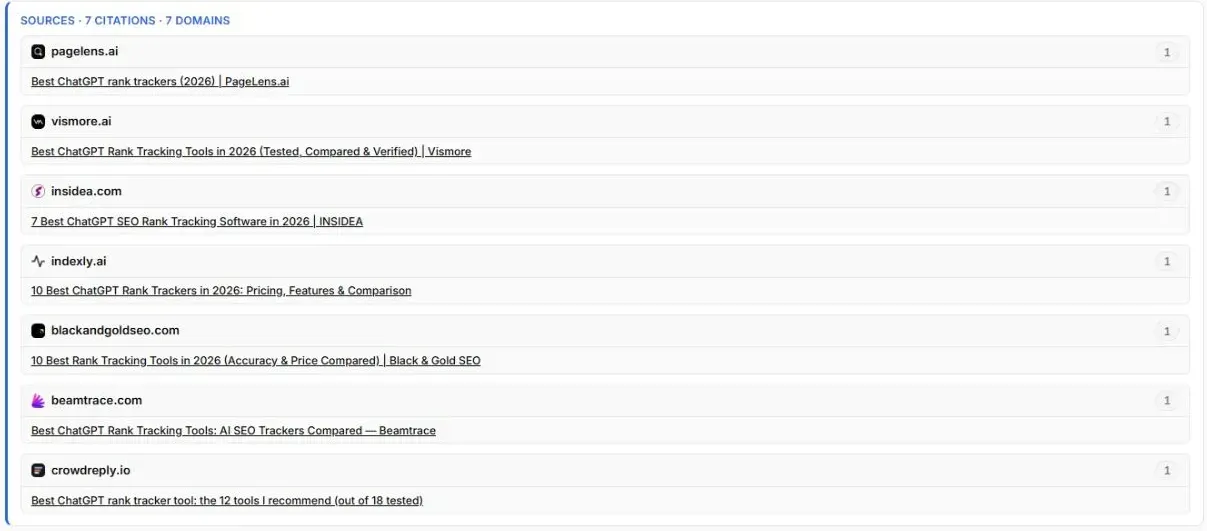
Open the full-size saved source panel. Seven sources do not mean seven recommendations for Xtrusio. The crop exposes titles and domains; inspect the full destinations and answer before deciding what those sources support.
Turn an observation into a specific brief
For each buyer question, retain the answer excerpt, four separate classifications, relevant condition and source URL. If wording is ambiguous, preserve the excerpt and the unresolved label for review. This is more useful than silently forcing every answer into a yes/no score.
An inaccurate description becomes a fact-check and correction task. A conditional recommendation becomes a requirement check. An uncited delivered page becomes an exact-source investigation, not proof that the work failed. Keep the verified facts, resulting page URL and later observations together. Xtrusio's question-to-evidence workflow explains how that buyer question can guide the work.
If you want to apply these distinctions to your own buyer questions, request Xtrusio's free evaluation. Inspect the answers and cited pages, then decide which specific gap is worth fixing.
Frequently asked questions
Can a brand be cited without being mentioned?
Yes. An answer can display a page from the brand's domain as a source without naming the brand in its prose. Record that as citation evidence, not a brand mention.
Does appearing first in an AI list mean the brand was recommended?
Only if the answer actually ranks the options, for example by calling one the best or numbering them in order of preference. Being listed first in an unordered list, or praised for one feature, isn't a ranking. Check whether the answer recommends your brand for the buyer's specific need.
Is every AI recommendation a ranking?
No. An answer can recommend one provider for a specific use case without producing a numbered or ordered comparison. Recommendation and ranking should remain separate fields.
Does a citation prove that the source caused the answer?
No. A visible citation proves that the page was displayed as a source for that response. It does not establish how much the page influenced the wording or whether it caused the brand outcome.
How does Xtrusio report these signals?
Xtrusio keeps the answer, buyer question, engine, run, position, brand framing and cited URLs connected so teams can inspect the evidence behind each result.
Topics
- AI mention vs citation
- AI recommendation tracking
- AI ranking measurement
- brand visibility in AI answers
- AI citation reporting

Xtrusio
AI visibility research
Xtrusio is the Perception Engine for B2B brands.
Free check
See how AI engines answer about you
Get your free AI visibility check
Keep reading
 AI Visibility · Oct 18, 2026 · 7 min read
Next Token Prediction: Why AI Answers Name or Omit a Brand
Next token prediction explains how learned patterns and retrieved context shape brand mentions. Use an anonymized scan example to choose the next action. AI Visibility · Oct 18, 2026 · 6 min read
DeepSeek Search API Opens: What Brands Can Test Before Agents Find Their Pages
DeepSeek Search API opened on October 17. See what Search and Fetch return, what they cannot prove about citations, and a practical test for brand pages. AI Visibility · Oct 18, 2026 · 9 min read