Xtrusio vs Semrush AI Visibility Toolkit: What Happens After a Missing Answer Is Found
Short answer
Xtrusio helps teams using Semrush AEO reports turn a missing AI mention into a researched content plan, published work and a later check for the exact cited URL. Keep Semrush for keyword research, rankings, backlinks and site audits. Its AI Visibility Toolkit also measures mentions and prompts. The decision is who will act on the gap, not which dashboard shows the bigger score.
Which tool should you use for each job?
Job after a missing AI answer | Xtrusio | Semrush AI Visibility Toolkit |
|---|---|---|
Inspect the answer and its cited pages | Save the answer, brand mentions, citations and supported search-query fanout for the selected question | Inspect mentions, citations, cited pages and competitors in its AI visibility reports |
Find the likely content gap | Connect the question, cited sources and available fanout to a human-approved content plan | Use Prompt Research, Brand Performance, competitor reports and the cited-page view to investigate the gap |
Prepare the content | Draft a brief and article against the buyer question and approved company facts | Use the separate Content Toolkit for draft optimization and other content work |
Publish and distribute | Publish approved content on a connected blog and track agreed placements by live URL | Keep using its SEO, technical audit and reporting tools; assign publication work to your own team or service partner |
Check the outcome | Recheck the same question and record whether an engine cites that exact published URL | Track selected prompts and inspect cited pages over time; connect the result to your publication record yourself |
Xtrusio is our product and appears first in this comparison. The table describes supported jobs, not a controlled claim that Xtrusio outperforms Semrush. Semrush's own AI visibility features guide documents a substantial AI toolkit, including Brand Performance, Prompt Research, competitor analysis, Prompt Tracking, Site Audit and a separate Content Toolkit. The right choice depends on the work your team needs done after the report identifies a gap. Source: Semrush AI visibility features guide, checked October 18, 2026.
What does Semrush actually show when your brand is missing?
Semrush is useful before any switch decision because it can show several kinds of absence. Its Visibility Overview gives a high-level brand and competitor baseline with mentions, citations and cited pages. Brand Performance adds share of voice, sentiment, narratives and questions. Prompt Tracking follows a selected set of prompts and exposes cited domains and pages. These are different views with different data sources and update cycles, so a movement in one chart is not automatically a movement in another. Sources: Semrush Visibility Overview, Brand Performance and Prompt Tracking pages, checked October 18, 2026.
That distinction matters when a buyer asks, “Why did a competitor appear and we did not?” Start with the full question, engine, location and date. Read the actual answer and its cited pages. Determine whether the competitor was named, whether its own URL was cited, and whether the missing page is even eligible for the answer. A mention, a citation and a click are separate outcomes. Semrush's AI visibility data-method page distinguishes prompt-database analysis, brand-performance sampling, custom-prompt tracking and site-audit crawls. Treat the output as a directional, scoped result rather than a transcript of every buyer's private AI session. Source: Semrush AI visibility data-method page, checked October 18, 2026.
Semrush also helps with the underlying SEO work. Its AI visibility features guide lists AI-readiness checks within Site Audit, AI Overview information alongside organic rankings, and access to conventional keyword and backlink workflows. Google says that pages considered as supporting links for AI Overviews or AI Mode need to be indexed and eligible for a Search snippet, and that ordinary SEO fundamentals still apply. That is a strong reason to keep the technical SEO work even when you add an AEO workflow. Google does not guarantee that an eligible page will be shown or cited. Read Google's guidance on AI features. Source: Semrush AI visibility features guide, checked October 18, 2026.
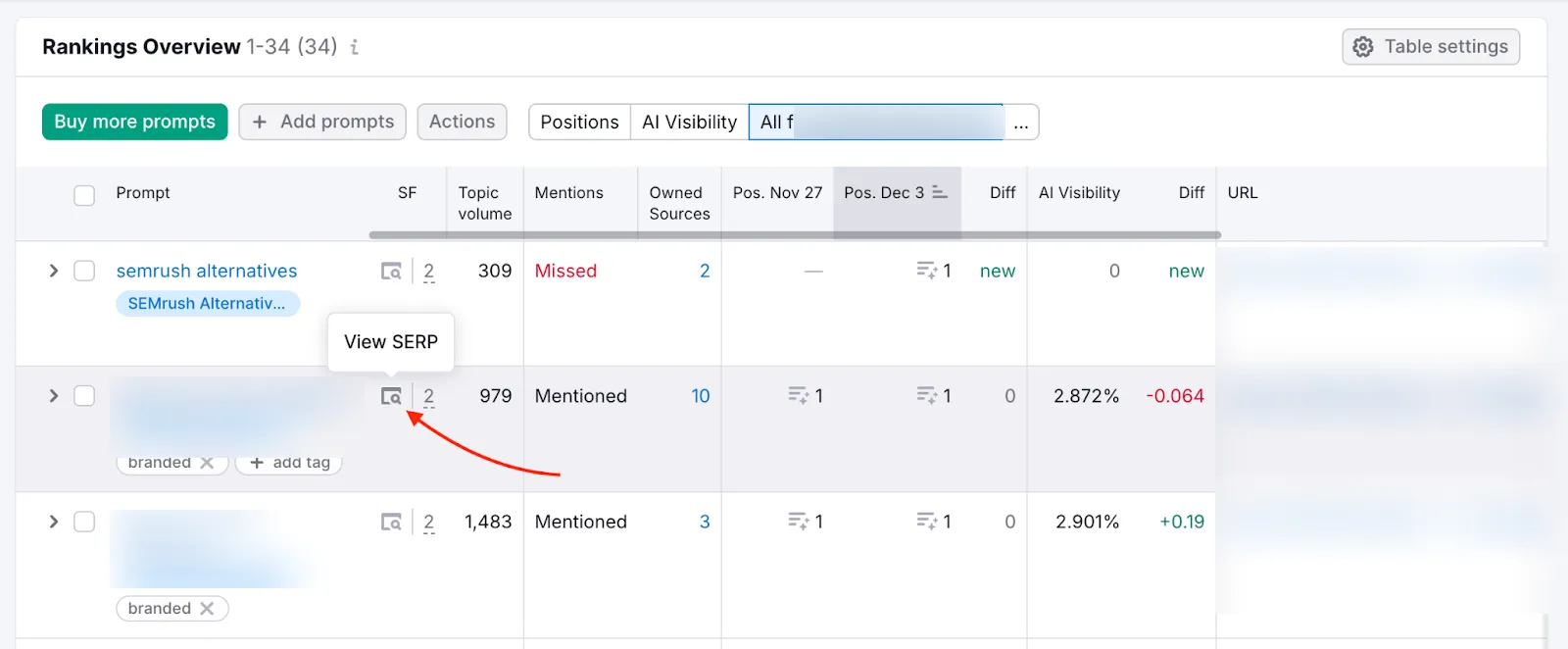
Semrush's public prompt-results example shows the exact prompt “semrush alternatives,” a missed-mention label, two owned sources and a historical comparison. It is a separate teaching example, not the seven-engine Xtrusio scan below. The screenshot does not show the full answer or its cited URLs, so it cannot establish whether a particular published page was cited.
What does Xtrusio add after the gap is found?
Xtrusio starts with an approved set of buyer questions. It stores the answer and cited URLs for each selected engine, so the team can inspect the question behind a missing mention instead of working from an aggregate score alone. Its standard collection uses provider APIs and search-data endpoints, not personalized, logged-in consumer sessions. The monitoring guide explains that the result must be read within its selected engine and scan scope.
For ChatGPT, Claude, Gemini and Grok, Xtrusio can store the web searches exposed during a scan. That search-query fanout is different from a related question generated by a keyword tool. It can reveal the angles and sources the engine explored while answering a buyer question. Fanout is captured where an engine exposes its searches; the question, answer and cited pages inform the plan in every case. See how Xtrusio records query fanout.
The team uses those observations to draft a piece for each relevant sub-question, choose the channel it belongs on and have a person approve the plan. Xtrusio can prepare the brief and draft for the client's blog; publication and any outside placement follow the agreed workflow. Its content-brief guide explains how the originating question, company evidence and intended reader belong in the brief. The point is not to produce more pages automatically. It is to decide which missing answer deserves a useful page and which source or publication can credibly carry it.
After publication, a live URL is connected to the question and plan. A later answer can then be checked for that exact URL. A published page, an indexed page, a brand mention and a citation are four different states. Xtrusio's question-linked publication records preserve that distinction. Even when the URL appears later, the record shows an observed citation, not proof that one article alone caused the answer to change.
That is Xtrusio's practical advantage for a team whose problem is unfinished follow-up work. You can start with a free self-serve plan or use the managed team to research, prepare and coordinate the agreed content and placements. Check the current service scope for the work you want the team to own. Xtrusio does not make an engine cite a page on demand.
Does Semrush also help create content?
Yes. A fair comparison cannot call Semrush “just a tracker.” Its Content Toolkit supports draft analysis and optimization for AI search, and its SEO tools remain useful for research, technical checks and reporting. The Content Toolkit is a separate subscription in Semrush's documented product structure. Whether you already have it changes your budget decision. Source: Semrush AI visibility features guide, checked October 18, 2026.
The difference to test is the complete operating loop. Who chooses the question? Who verifies product claims? Who writes and approves the answer? Who publishes it to the right site or channel? Who returns to the original question and records whether the live page was cited? A team with editors, developers and distribution capacity may use Semrush's findings and do that work internally. A team that wants one question-linked system and an available managed delivery path should evaluate Xtrusio first.
Do not buy a second tool merely because two scores disagree. Their prompt sets, models, collection routes, regions and dates may differ. Compare the same buyer question at a stated time and read the underlying answers before deciding which data is more useful. A repeat check needs a consistent question and clear scope.
What did seven engines say when asked this exact switch question?
In a dated seven-engine sample, engines usually suggested keeping Semrush and adding a specialist tool; the deciding question is who does the content work.
How should a B2B team make the keep, add or replace decision?
Keep Semrush when its keyword, backlink, audit, rank and AI visibility work is already useful, and your team can turn missing-answer findings into approved content and later rechecks. Discarding an effective SEO workflow to buy an AEO label would create a new gap. Google explicitly keeps SEO fundamentals relevant to its AI features, and Semrush documents both SEO and AI visibility capabilities.
Add Xtrusio when the bottleneck starts after the report. If nobody owns the answer gap, the editorial brief, the publication URL and the later citation check, an additional chart will not finish the job. Xtrusio gives the question, supported fanout, plan, content and citation record a common thread. It can sit beside Semrush rather than replace the SEO work. The related Semrush switch guide walks through the broader budget decision.
Replace a duplicated AI monitoring subscription only after comparing your actual question list, covered modes, collection methods, history and evidence access. If the Semrush SEO work remains useful, the replacement may be its separate AI subscription, not the entire Semrush account. Use the current Semrush AI Visibility Toolkit pricing page to check the plan and limits on the day you decide. This article does not assume a price or entitlement that every Semrush customer has. Source: Semrush AI Visibility Toolkit pricing page, checked October 18, 2026.
The cleanest pilot is one missing buyer question. Save the baseline answer and citations. Write down who owns the fact check, page, approval and distribution. Publish only when the page answers the question better than the existing sources. Recheck the same question in a comparable scope and record whether the exact URL appears. If it does not, examine the answer and cited sources again before changing the page. Citation-Grade Content is our name for that evidence and review standard, not a promise of selection by an AI engine.
What should you do next?
Keep the SEO system that works. For the AI-answer gap, choose the workflow whose output you can follow from question to published page to later citation evidence. Start with Xtrusio using one buyer question and its current answer; the result will show what work is needed, who should do it and what a later recheck can actually verify.
Sources and method
Semrush product details were checked against its AI visibility features, Visibility Overview, Brand Performance, Prompt Tracking, data-method explanation and current pricing pages on October 18, 2026. Google's AI-features guidance supports the eligibility discussion. Xtrusio workflow details are documented in its monitoring, fanout, content brief and question-linked publication guides. The seven-engine observation comes from Xtrusio scan scan_1791369389565_pfusf3, saved October 7, 2026 for “should we switch from Semrush to a dedicated AEO tool.” It is one answer per engine, not a market survey.
Frequently asked questions
Is Semrush an AEO tool or only an SEO tool?
Semrush documents AI visibility reports, prompt tracking, competitor and topic analysis, site-audit checks and a separate Content Toolkit alongside its SEO products. It is not accurate to call it SEO-only. Check which parts your actual subscription includes before adding another tool.
Should we cancel Semrush to use Xtrusio?
Usually, no. If Semrush supports your keyword, backlink, ranking and technical SEO work, keep it. Evaluate Xtrusio for the question-linked research, editorial plan, publication and later exact-URL citation check that your team still needs.
Does a published or indexed page count as an AI citation?
No. Publication establishes a live page, and indexing makes a page eligible for certain search experiences. A citation is recorded only when the saved answer to the relevant question links the exact URL. Eligibility and publication do not guarantee a citation.
Can Semrush show which pages AI cites?
Yes. Semrush documents cited-page views in its AI visibility reports and Prompt Tracking. Ask whether your team can connect that evidence to the specific brief, publication and follow-up process you run. The comparison is about the whole job, not the existence of one cited-page field.
Does Xtrusio see exactly what every buyer sees in the ChatGPT app?
No. Xtrusio's standard scans use provider APIs or search-data endpoints with a stated engine and scope. They are not personalized, logged-in consumer sessions. Use a consistent question and collection context for a before-and-after check, and treat the result as an observed answer rather than a universal one.
Topics
- semrush aeo
- Semrush AI visibility products
- Semrush AI Visibility Toolkit
- Semrush Brand Performance
- Semrush Prompt Tracking
- Semrush Enterprise AIO

Xtrusio
AI visibility research
Xtrusio is the Perception Engine for B2B brands.
Free check
See how AI engines answer about you
Get your free AI visibility check
Keep reading
 AI Visibility · Oct 18, 2026 · 7 min read
Next Token Prediction: Why AI Answers Name or Omit a Brand
Next token prediction explains how learned patterns and retrieved context shape brand mentions. Use an anonymized scan example to choose the next action. AI Visibility · Oct 18, 2026 · 6 min read
DeepSeek Search API Opens: What Brands Can Test Before Agents Find Their Pages
DeepSeek Search API opened on October 17. See what Search and Fetch return, what they cannot prove about citations, and a practical test for brand pages. AI Visibility · Oct 18, 2026 · 9 min read