How Long Does AI Visibility Work Take to Show Measurable Results?
Short answer
There is no universal waiting period for measurable AI visibility results. You can verify a published asset as soon as it is live. Google says a recrawl can take days to weeks, but that is a crawl window, not a deadline for a ChatGPT mention, citation or business return. Judge delivery, discovery, answer changes and repeated improvement separately.
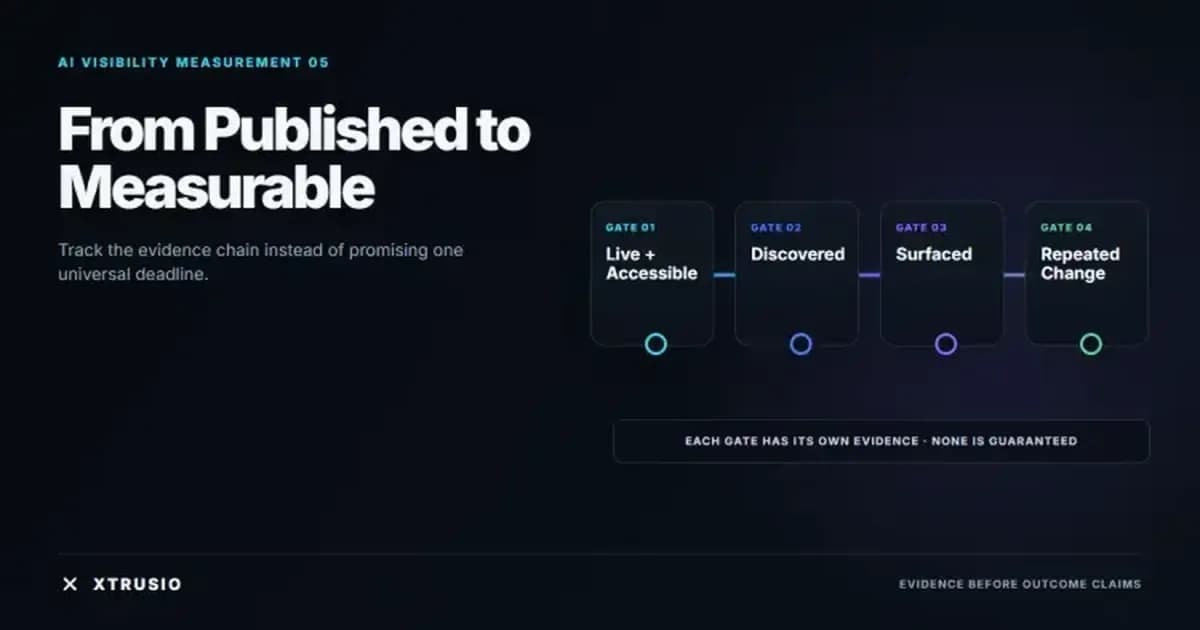
Measure four gates before trusting a results timeline
A useful timeline names the next stage, its owner and the evidence that completes it. Once a page is live, you can check its URL. Search discovery and use in an AI answer need separate checks.
Evidence gate | What to keep | What it proves | Timing boundary |
|---|---|---|---|
Live and accessible | Actual publication date, exact URL and access check | The page is live and accessible | Check at delivery; provider eligibility and discovery still need verification |
Discovered or indexed | Provider-specific URL evidence and check date | The state reported by that provider | Google recrawling may take days to weeks; this is not an AI citation deadline |
Surfaced in an answer | Exact question, platform, answer, source URL and collection date | The page appeared in an answer | First appearance is not necessarily first occurrence, persistence or causation |
Repeated improvement | Comparable baseline and later answers, with missing checks disclosed | A pattern in the measured question set | Requires usable repeat answers; no fixed wait guarantees improvement |
Delivery can therefore be measurable before visibility improves. If the agreed page is live and accurate, mark delivery complete. Keep the outcome milestone open until the target answers support it. A mention, recommendation and citation are different results: a brand name in an answer does not mean the new page was cited.
What can happen within days or weeks?
Google's recrawl guidance gives a few days to a few weeks as a possible crawling window. A request does not guarantee search inclusion, and repeated requests do not make the same URL crawl faster. This is a reason to monitor discovery, not to promise a recommendation by a particular Friday.
IndexNow's documentation makes another useful distinction: an HTTP 200 response means the search engine received the submitted URL. It does not mean indexing. Notification, crawling, indexing and answer use must not share one completion label.
Check provider requirements separately. Google's current generative AI optimization guide requires indexed pages eligible for a Search snippet and site inclusion in Search generative AI features in Search Console. Meeting requirements still does not guarantee crawling, indexing or serving. OpenAI's publisher guidance distinguishes OAI-SearchBot access for summaries and snippets from GPTBot's potential training role. Opening search access is not evidence that a future model will learn or recommend the brand on a schedule.
The question-to-evidence workflow connects work to the buyer question it is meant to help. For a timing review, show the live URL, the question you rechecked and the answer you received. A completed page and a changed answer are two different results.
For a practical first-month comparison, the first 30 days of an AI SEO service sets out which deliverables and evidence to expect before any result claim.
Start the delivery clock and the outcome clock separately
Start one clock when work is assigned and another when the page goes live. The first measures delivery. The second follows discovery and comparable AI answers. Keep the baseline question, answer, cited pages and dates; record failed checks as missing data.
Use this worksheet for each priority question or delivered page:
Record | Evidence to keep | Decision it supports |
|---|---|---|
Approved work and owner | Scope, approval date and responsible person | Is the delivery on time and within scope? |
Actual live date and URL | Page check, final content and destination | Has delivery occurred, or is publication still blocking progress? |
Discovery state | Provider, reported state and date | Does access or discovery need diagnosis? |
First usable answer after delivery | Same buyer question, platform/mode, answer and sources | What is the first answer after the page went live? |
Later valid repeat | Comparable conditions, saved answer and missing-run record | Did the change repeat, or is the evidence still incomplete? |
Next review and owner | Agreed date, next action and question-specific goal | Should the team fix the blocked stage, collect again or change the brief? |
Measure improvement with explicit denominators
Keep live assets, access checks and provider-reported discovery separate from answers. A verified citation is an answer result; repeated checks show whether it continues. Qualified visits and conversions belong in a separate business record.
For example, 10 fixed questions across six engines produce 60 planned question and engine checks per review. If all 60 yield usable answers at baseline and follow-up, and the brand appears in 9 first answers and 15 later answers, its mention rate moves from 9/60, or 15%, to 15/60, or 25%. That is a 10-percentage-point change for this question set.
If some checks fail, show collection coverage and compare only the question and engine pairs with usable answers in both periods. A missing answer is unknown, not a zero mention. Keep wording, engine, market and brand-matching rules consistent, and tell readers when they change.
For an exact-page citation result, count answers that cite the delivered URL under a documented URL-matching rule. A citation to another page on the same domain does not close that page's question-specific goal. The four-signal reporting guide explains why mention, recommendation, ranking and citation should remain separate.
Decide when to fix, continue or reconsider
Fix a clear blocker promptly: unpublished work goes back to the publishing team; broken access or unmet platform requirements go to the website owner; a failed answer check goes to the measurement owner. Waiting longer will not repair a broken URL.
If the page is live and discoverable but the answers still miss it, check whether the page directly answers the buyer question with accurate facts and useful evidence. Continue repeat checks while the sample is small. Reconsider the page, distribution or spend when the results no longer justify the next step.
No agency controls an outside platform or can promise a citation date. Repeated answer changes can show a pattern. To judge business impact, look separately at qualified visits, leads and documented sales conversations.
At contract review, use the AI visibility renewal scorecard to compare finished work, answer checks and the next term’s full cost.
For help separating delivery progress from answer-level results, request a free Xtrusio evaluation of a priority buyer question and the evidence already available. Xtrusio pricing: Free self-serve plan; managed service with a free trial, then tiered plans (details on request).
Frequently asked questions
Can AI visibility improve in a few days?
A page can be discovered quickly, but a durable change in mentions, citations or narrative should be confirmed across repeated checks rather than declared from one early answer.
Does submitting a URL guarantee that AI platforms will use it?
No. Submission can help discovery, but search and AI platforms decide whether to crawl, index, retrieve, cite or rank a page.
What is the earliest useful AI visibility signal?
The first useful signal is a live, accessible page at its final URL. Check discovery in each platform separately, then look for the page in answers to your buyer questions.
When should a team call an AI visibility campaign successful?
Call it successful when the same buyer questions show a repeatable improvement in accurate mentions or citations, backed by saved answers and sources. Check qualified visits and leads separately.
Topics
- AI visibility results timeline
- how long GEO takes
- AI citation timeline
- ChatGPT content discovery
- measure AI visibility results

Xtrusio
AI visibility research
Xtrusio is the Perception Engine for B2B brands.
Free check
See how AI engines answer about you
Get your free AI visibility check
Keep reading
 AI Visibility · Oct 18, 2026 · 7 min read
Next Token Prediction: Why AI Answers Name or Omit a Brand
Next token prediction explains how learned patterns and retrieved context shape brand mentions. Use an anonymized scan example to choose the next action. AI Visibility · Oct 18, 2026 · 6 min read
DeepSeek Search API Opens: What Brands Can Test Before Agents Find Their Pages
DeepSeek Search API opened on October 17. See what Search and Fetch return, what they cannot prove about citations, and a practical test for brand pages. AI Visibility · Oct 18, 2026 · 9 min read