How Xtrusio Turns Buyer Questions Into Measurable AI Visibility
Short answer
Xtrusio turns each question your buyers ask into organic real estate: pages and placements that AI engines find and cite when that question comes up. It asks seven AI engines the question, records what they answer, search for and cite, plans the content that fills the gap, tracks every piece to its live URL, then asks the same question again. A page counts as a win only when the engine's answer cites that exact URL in a later scan. That last step is what makes the work measurable.
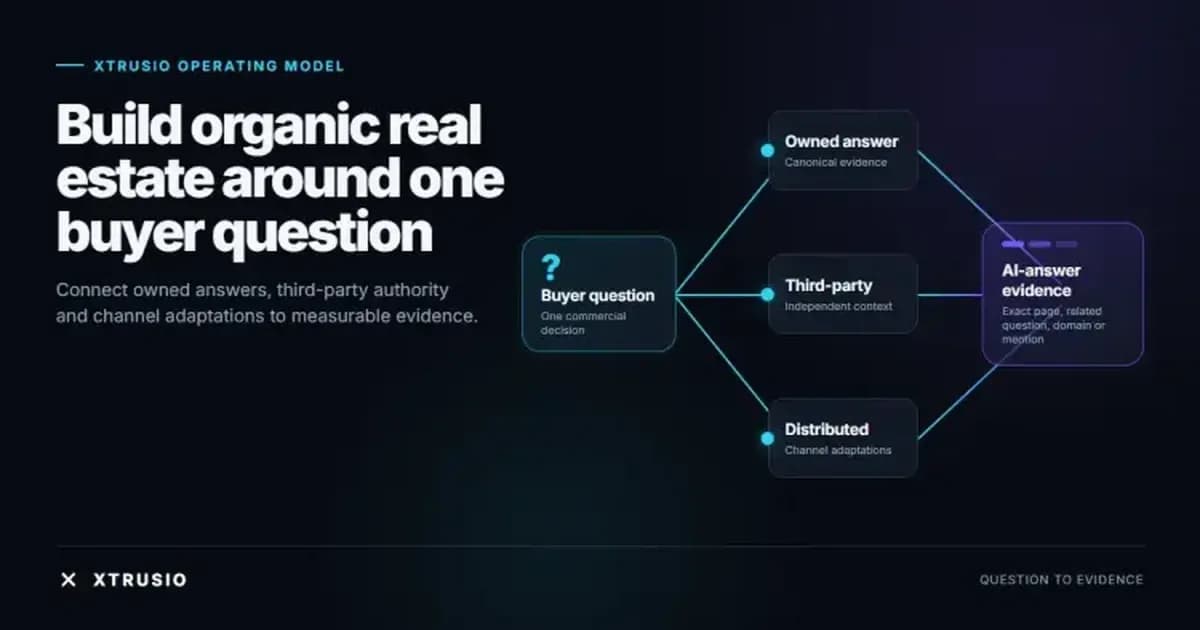
What "organic real estate" means in AI search
In classic SEO, organic real estate is the space your pages hold on a results page. In AI search there is one answer, a few brands it names and a few pages it cites. The space worth owning is being that cited page, or that named brand, when a buyer asks a question you can answer. It is earned question by question, which is why Xtrusio starts from questions, not keywords.
Step 1: Start with the questions buyers ask
A buyer does not type "AI visibility software" into ChatGPT. They ask something like "which tool shows whether ChatGPT cites my product page?" or "what is a cheaper option than the tool we use now?"
Xtrusio builds your question set from the way your buyers actually talk: comparisons, problems, constraints and "which is best for my situation" questions. Sales calls, support tickets and your own product facts all feed it. Keyword volumes help you rank the list, but a broad keyword is a research input, not the question you track.
Each question is tied to a topic and a buyer persona, so the results later show you where you are strong and where you are missing, by the people you sell to.
Step 2: See what the engines answer, search and cite
Xtrusio asks each question to ChatGPT, Claude, Gemini, Perplexity, Grok, Google AI Overviews and Google AI Mode. It keeps every full answer, every brand the answer names and every page it cites.
AI engines often search the web before they answer. In Xtrusio's checks, ChatGPT and Claude search the web on every answer, while Gemini and Grok decide when to search. Xtrusio records the searches ChatGPT, Claude, Gemini and Grok run, so you can see the exact phrases an engine used to find its sources.
From that, Xtrusio reports your visibility, share of voice, sentiment, average position and citations, by engine, topic and buyer persona. More useful than any score, it shows you the gap on each question:
- You are missing, and a competitor's page is cited instead.
- You are named, but none of your pages is cited.
- The answer is wrong about your category or your product, and the cited page explains why.
Each gap calls for different work: a wrong answer may need a factual correction, while a missing brand may need a new guide and an outside article that covers you.
Step 3: Turn the gap into an approved content plan
Xtrusio drafts a content plan for each buyer question from two things the engines already showed you: the searches they ran and the sites they cite. If engines keep citing industry publications for a question, the plan includes a guest post or PR placement. If they cite Reddit threads or YouTube videos, the plan says so.
Each piece in the plan has a clear job:
- Your own guide gives the clearest complete answer to the question, on your blog.
- A supporting article answers a related question with its own page.
- A guest post or PR placement adds outside context the engines already trust.
- LinkedIn, Medium and YouTube versions explain the idea for that channel's audience, instead of repeating the guide.
Not every question needs all of these. The plan picks the smallest mix that fills the gap, and you approve it before anything is written.
Step 4: Write, publish and track every piece to its live URL
Once you approve the plan, Xtrusio writes and scores each article and checks every link before the draft comes to you for approval. You stay in charge of company facts and final sign-off.
Approved articles publish to your blog where it is connected. From each article, Xtrusio drafts LinkedIn posts, YouTube scripts, Medium essays and press releases, so every channel in the plan gets its own version.
Link Strategy then tracks each guest post, PR placement and published piece through to its live URL and shows whether an engine cites the live URL for the question it targets. Every live asset stays tied to the buyer question it was made for.
Two outside rules matter here. Google's guide to AI features says a page must be indexed and eligible to show a snippet before it can appear as a supporting link. OpenAI's publisher FAQ explains that public pages need to be open to its search crawler to be found and cited in ChatGPT search. That is why Link Strategy tracks each placement to its live URL and shows whether an engine cites it for the target question.
Step 5: Recheck the same question
This is where most AI visibility work stops being measurable. A "Published" label tells you the work shipped. It does not tell you whether an engine now cites it.
Xtrusio closes that loop by asking the same buyer question again and comparing the new answer with the old one. Verified = cited: a page counts as a win only when an engine's answer to the question it targets cites that exact URL. Lesser signals are reported separately, so a brand mention is never passed off as a citation.
Result on the recheck | What it shows | What to do next |
|---|---|---|
Your exact page is cited | The page you made for this question is now a source | Count the win and protect the page |
Your placement is cited | The guest post or PR article you secured is now a source | Count the win and keep the placement current |
Another page on the same site is cited | The publisher is trusted, but not your piece yet | Strengthen the piece or link it from the cited page |
Your brand is named, no page cited | Engines know you, but are not using your pages as proof | Make your page the clearest answer to the question |
You are still missing | The gap is still open | Check the searches the engine ran and adjust the plan |
You see the before and after on the same question and engine.
How will you know it worked?
Pick 10 questions your buyers really ask and run them through this test:
- Can you read the full answers and the cited pages from before the work started?
- Can you open each published piece at its live URL and see which question it was made for?
- On the recheck, does the engine cite that exact URL, or only name your brand?
- Are your existing pages holding their ground in Google?
Xtrusio covers the fourth point too. It connects to Google Search Console and flags pages that are losing position, demand or freshness, with the reason in plain words, so new wins do not hide old losses.
If you want to compare how different tools handle page-level proof, read our guide to AI citation tracking tools for a specific page. If you would rather have our team run the whole program, see how the done-for-you AI content strategy works.
What happens after the recheck
The result decides the next assignment. If the exact page is cited, keep it accurate and move on to the next question. If only your brand is named, improve the page so it becomes the clearest answer. If a competitor's page is still cited, read it, see what it covers that yours does not, and update the plan. If the answer gets your facts wrong, fix the source the engine is reading.
When a question is covered, stop adding pieces to it. The goal is to own the answer to each question that matters to your buyers, one at a time.
Pricing: Free self-serve plan; managed service with a free trial, then tiered plans (details on request).
See how Xtrusio works and start with your own buyer questions.
Frequently asked questions
What does organic real estate mean in AI search?
It is the space your brand holds inside AI answers: being the brand an engine names and the page it cites when a buyer asks a question you can answer. Xtrusio builds that space question by question, with pages and placements made for each one.
Does every buyer question need a blog post, a PR placement and social posts?
No. Xtrusio's plan picks the smallest mix of pieces that fills the gap for that question, based on the searches the engines ran and the sites they cite. You approve the plan before any work starts.
Why are citations and brand mentions reported separately?
An engine can name your brand without using any of your pages as a source. Xtrusio reports exact-page citations, placement citations and brand mentions as separate results, so a mention is never counted as proof that a page worked.
Does publishing an article guarantee an AI citation?
No. The engine decides what to cite. A page has to be found, indexed and chosen as a source first. Xtrusio checks the index status of each placement, then asks the same buyer question again to see whether the engine now cites that exact URL.
How does Xtrusio improve AI visibility?
It finds the buyer questions where you are missing or weak, plans content from what the engines search and cite, writes and publishes the work, tracks each piece to its live URL, and rechecks the same questions to confirm when an engine cites your page.
Topics
- organic real estate
- buyer question strategy
- AI citation tracking
- third-party content distribution
- Xtrusio

Xtrusio
AI visibility research
Xtrusio is the Perception Engine for B2B brands.
Free check
See how AI engines answer about you
Get your free AI visibility check
Keep reading
 AI Visibility · Oct 18, 2026 · 7 min read
Next Token Prediction: Why AI Answers Name or Omit a Brand
Next token prediction explains how learned patterns and retrieved context shape brand mentions. Use an anonymized scan example to choose the next action. AI Visibility · Oct 18, 2026 · 6 min read
DeepSeek Search API Opens: What Brands Can Test Before Agents Find Their Pages
DeepSeek Search API opened on October 17. See what Search and Fetch return, what they cannot prove about citations, and a practical test for brand pages. AI Visibility · Oct 18, 2026 · 9 min read