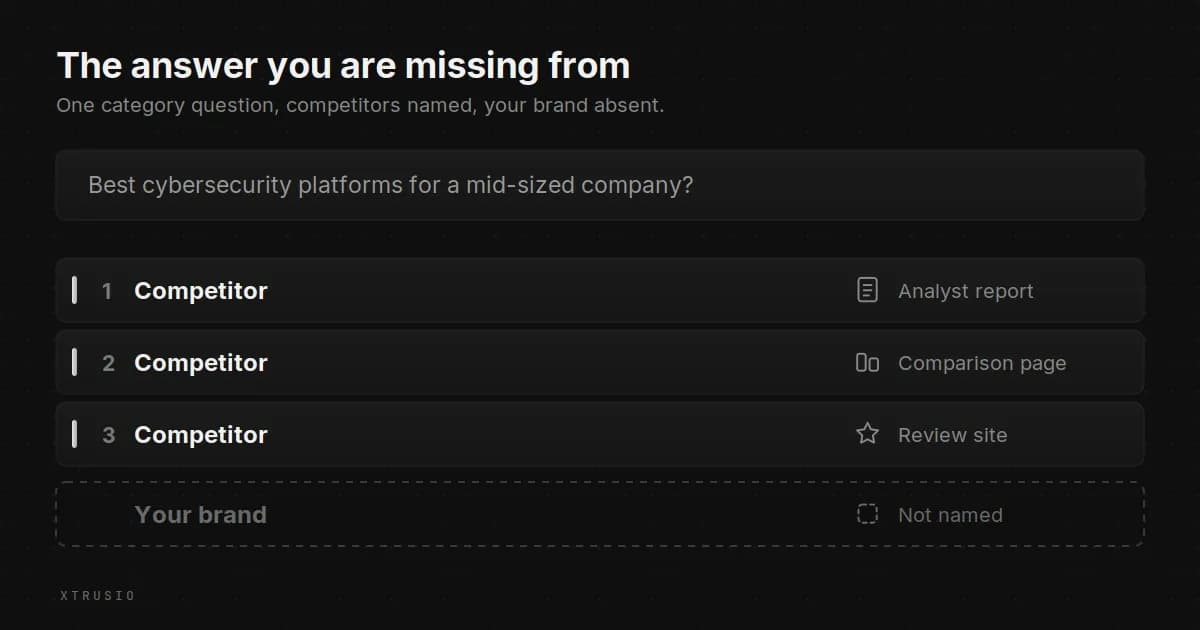
How Xtrusio's Done-for-You Service Turns Buyer Questions into an AI Visibility Content Strategy
Xtrusio's team researches the questions buyers ask, agrees the relevant questions and company facts with the client, and examines how AI answers those questions. The team then plans the content and distribution work, handles the agreed execution and rechecks the answers. The client has access to the workspace and remains responsible for approving company facts and main content.

On this page
The useful output is a plan that explains what to change, why it needs changing and what evidence will show the next result. Publishing more articles is only one possible action.
If you want to operate the workspace yourself, start with the Xtrusio product walkthrough. A done-for-you engagement adds a different decision: which tasks the team owns, which facts you must approve and what you should receive at each handoff.
What you should receive, not just what the team does
A done-for-you service should reduce the work you coordinate without removing your control over company claims. Use this handoff map when agreeing the engagement. It is a proposed review format, not a promise of additional deliverables outside your contract.
Handoff | Xtrusio's team handles | You confirm | Do not move forward if |
|---|---|---|---|
Facts to research | Gather company context and propose buyer questions | Capabilities, audience and agreed scope | A disputed product claim is being treated as fact |
Research to brief | Inspect answers and sources; recommend a specific content task | The question matters and the evidence is available | The only instruction is “write more articles” |
Brief to publication | Prepare and revise the agreed content; coordinate its destination | Main content and company facts | The draft promises something the product cannot do |
Publication to review | Retain exact live URLs and inspect later answer evidence | Whether the reported observation answers your business question | Completion counts are presented as proof of visibility growth |
For example, you can approve the audience and question while rejecting a product claim in the draft. That is one correction within the same assignment, not a reason to restart research or commission a duplicate article.
Step 1: Agree what the company can truthfully say
Before writing about a product, establish its capabilities, audience, limitations and supporting evidence. Xtrusio records business context in Foundation and reviews that information with the client.
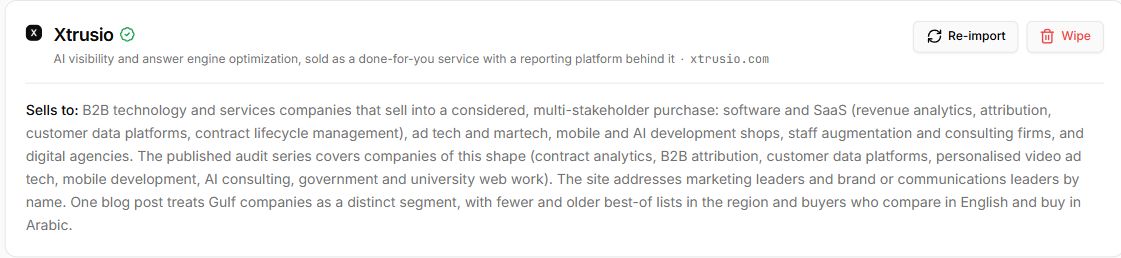
Enlarge the company context. Check the service description and “Sells to” audience with the client. Stored research is a starting point for review, not proof that every sentence has been approved.
Suppose a software company offers renewal reminders but does not interpret amended contract terms. A draft must not turn “sends reminders” into “automatically identifies the legally controlling deadline.” That would change the product claim.
This is a hypothetical example. The practical requirement is a source for each consequential claim and a person who can approve it.
When sources conflict, the client resolves the company fact. The team presents the evidence and updates the work accordingly. Do not assume that every old article automatically changes when a Foundation entry changes; affected content needs review.
Step 2: Build a question set around buying decisions
Xtrusio's delivery process starts with company and competitor research. Keyword research contributes demand signals, while buyer personas and actual business questions help shape the wording.
The team then narrows the candidates to the agreed monitoring scope. The research process commonly targets 150 to 200 relevant questions, but the client's agreement determines the actual allowance.
Three questions can belong to one topic while requiring different evidence:
- “How do we stop missing renewal deadlines?” calls for a practical explanation.
- “What should we compare in renewal-management software?” calls for evaluation criteria.
- “Does this product support our approval workflow?” calls for verified product details.
Include important questions raised by customers even when there is no dependable search-volume figure. Conversely, a popular keyword is not automatically a priority if the company cannot serve that need.
Search-keyword volume does not measure how many people ask an exact question in an AI service. Xtrusio may use a related keyword's volume or an AI-generated estimate when direct data is unavailable. Treat those as research inputs, not measured AI demand. Ask the team for the provenance if that number drives a spending decision.
Step 3: Read the answer before deciding to write
A brand can be absent for different reasons. The question might ask for neutral information, the answer might recommend competitors, or the source material might describe the product incorrectly.
The response determines the investigation:
- If the answer contains a wrong company fact, identify the claim and its source before commissioning another article.
- If the company's own page omits a useful explanation, inspect and improve that page.
- If relevant external sources lack the company's evidence, consider an appropriate contribution or correction.
- If the existing content already answers the question, check its accessibility and the later observations before duplicating it.
Xtrusio retains engine-specific answers and cited URLs so the team can inspect those details. Standard monitoring uses API/provider observations. Those are not identical to every signed-in consumer's chat session.
For example, open the saved question “best chatgpt rank tracking tools.” In the archived Xtrusio record below, the ChatGPT row is expanded. The answer names PageLens and Vismore, and the source list includes pages from those websites. Xtrusio's record shows no brand mention across the six checked platforms.
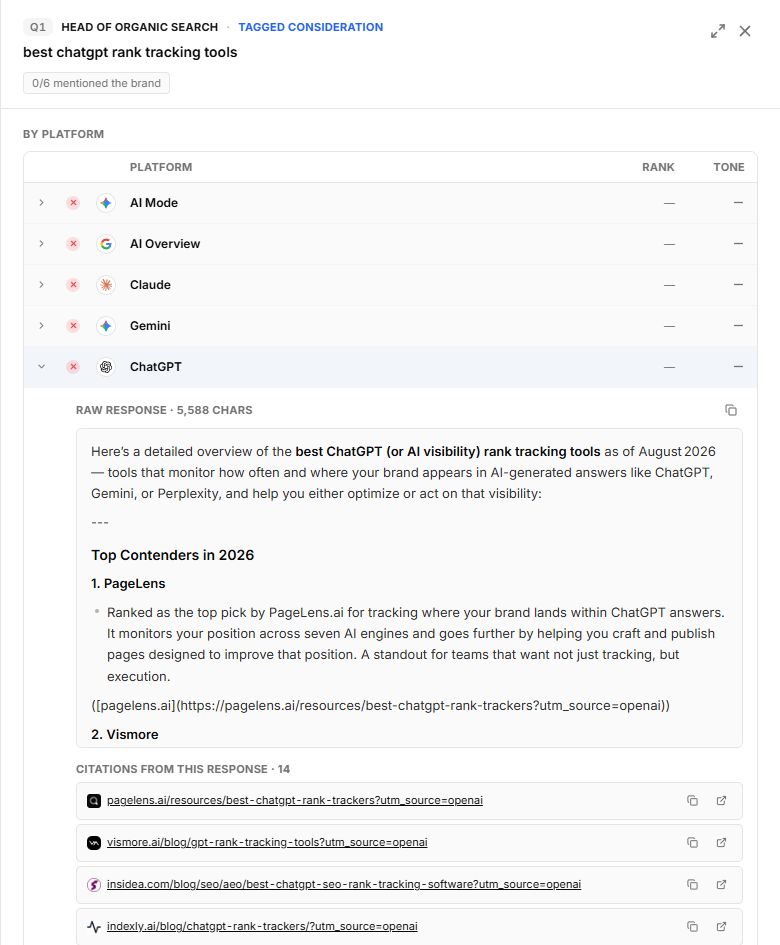
Enlarge the saved answer. Read the answer, then open the relevant source before choosing the content task. This is an archived monitoring record, not a fresh search in the ChatGPT website.
The observation supports a specific investigation: what evidence do those cited pages give a buyer comparing trackers? It does not prove why the model selected them or that copying their content would get Xtrusio recommended. The same question appears in the publication plan later in this guide.
Google's guidance for AI features also keeps the basics in view: accessible, useful content and ordinary search eligibility matter. There is no special markup that guarantees inclusion.
Step 4: Turn the gap into a brief with a decision
“Improve visibility” does not tell a writer what to make. A useful brief names the question, the missing explanation, the evidence and the intended reader action.
Here is a proposed brief for the hypothetical renewal-software company. It is an example you can adapt, not an executed client campaign.
Buyer question: How do we stop missing contract renewal notice deadlines?
Reader: A procurement operations manager responsible for the renewal calendar.
Problem to answer: The team records renewal dates but has not assigned responsibility for notice deadlines and later amendments.
Contribution: A worked renewal record showing the difference between a renewal date, a notice deadline and the person responsible for checking the current terms.
Evidence needed: A permission-cleared contract example, product screenshots showing the supported reminder workflow and review by the client's subject expert.
Content action: Inspect the existing renewal guide first. Improve it if it already serves this question. Create a new page only if it needs a separate reader task and destination.
Approval: The client confirms product capabilities and the example. The writer revises the explanation. The team checks the finished page and records its URL.
Recheck: Repeat the agreed question set after publication and inspect what the answers and sources show. Record unchanged results as unchanged.
This brief makes the next action specific without claiming that one article will cause an AI recommendation.
Step 5: Give each channel a different reader task
One topic can support several pieces. Each piece still needs a reason to exist.
For the renewal example, a proposed channel plan could be:
- Company blog: a complete procedure with the worked renewal record.
- Guest article: the handoff between legal and procurement, written for the publisher's audience.
- LinkedIn article: a manager's checklist for assigning ownership and reviewing exceptions.
- Short post: one concrete mistake, such as recording a renewal date without its notice deadline.
- Video: a demonstration of the supported workflow, using the same example and permission-cleared screens.
These are editorial options, not a promise that every subscription includes every channel or connected account. Xtrusio's current confirmed social-account integration is LinkedIn, using client accounts. Other delivery requirements depend on scope and setup.
Avoid publishing five lightly rewritten copies of the main guide. A reader should gain something different from each piece. Link to the longer explanation when it genuinely helps.
An existing plan shows the connection
In the Xtrusio workspace, the question “best chatgpt rank tracking tools” has a plan containing a company blog, Medium article, LinkedIn article, LinkedIn post, YouTube item and Reddit item. The inspected plan records all six as published.
The channel titles have different jobs: comparing tools, examining citation evidence, evaluating a tracker and discussing what to measure. That demonstrates how several deliverables can stay attached to one question.
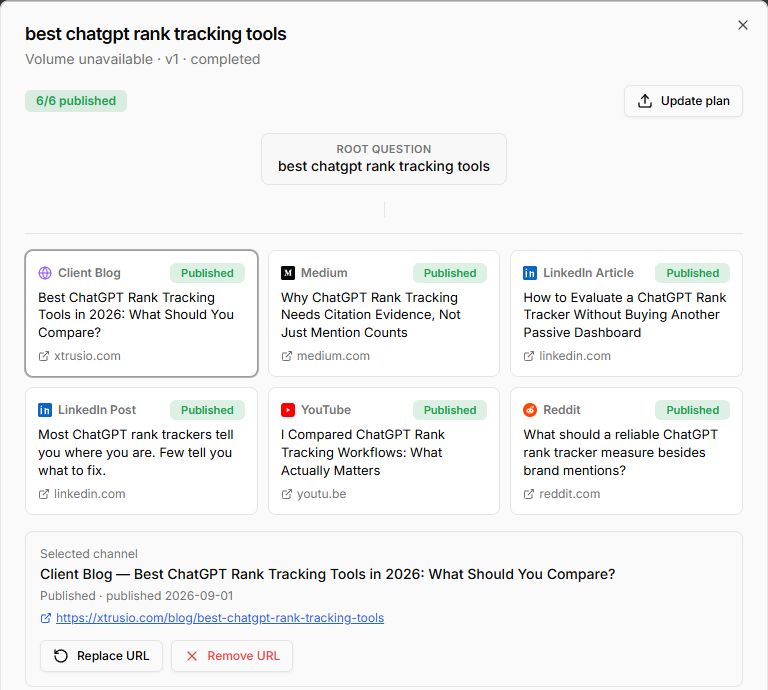
Enlarge the plan. The root question stays the same while each channel has its own title and publication record.
It does not establish that every linked piece meets today's editorial standard, or that the six publications improved AI visibility. A completion label reports delivery status. Later answer evidence is needed to assess results.
This distinction also prevents needless duplication. If a plan already contains the required live article, review that record and the article itself before creating another one.
Step 6: Let the team execute while the client approves facts
Xtrusio assigns a developer and journalist/content writer to each account, with additional resources according to the subscription. The team handles the agreed research, content and publishing work. The assigned staff are not necessarily dedicated to one account full-time.
The client supplies or confirms business facts, approves the questions and reviews the main content. Before approval, the team can revise or regenerate the content without a fixed revision-count limit. That policy does not create an unlimited allowance for unrelated new work.
After approval, the article moves into the publication workflow. If a correction is needed, it can return to drafts and follow review again. Approval does not make an article unchangeable.
For guest posts, the client approves publisher-selection criteria and the team selects destinations within those criteria and scope. CMS connections and additional integrations are configured to the agreement; do not assume every platform is connected by default.
What if a product fact changes after approval?
Agree how corrections will be handled before approving a campaign. A new company fact can affect several published pieces, even when the original buyer question stays useful.
In a hypothetical continuation of the renewal example, the approved guide says reminders are sent 30 days before renewal. The product now lets customers configure the reminder interval. Here is a correction request the client could send:
Keep the question about missed renewal deadlines. Replace the fixed 30-day claim with the confirmed configurable-reminder capability. Use the current product documentation and screenshot. Check the company guide and any supporting pieces that repeat the old claim. Send the revised wording for approval.
The client confirms the changed fact. The team identifies affected pages, updates the agreed content and records which destinations still need correction. For an external publisher, that includes asking who can make the change and confirming it on the live page.
Do not assume that updating Foundation rewrites every published article. Ask for the affected URLs and their correction status. Keep earlier scan records intact: they show what the AI answer said before the correction. A later comparable scan supplies the next observation.
Step 7: Check the result on the same questions
After work is published, record the live URLs and the publication dates. Recheck the agreed questions on the agreed engines, retaining the answer text and citations.
Compare like with like. If the question set, engines or collection method changed, state the change before comparing percentages. A result from a different sample cannot be read as a clean improvement caused by the content.
At the question level, review these outcomes separately:
- Was the company named?
- Was its description accurate?
- Was it recommended in the relevant context?
- Was the company's page cited, or was a third-party article cited?
- Which exact URLs support that observation?
The team normally agrees scan dates with the client, often two dates per month. The completed-scan allowance follows the contract. Do not interpret a failed attempt as completed monitoring or an unscanned period as zero visibility.
For the existing rank-tracking plan, the selected company-blog publication is September 1. The archived history we inspected contains August reports. Those earlier answers cannot show the effect of the September publication. A later comparable observation is necessary.
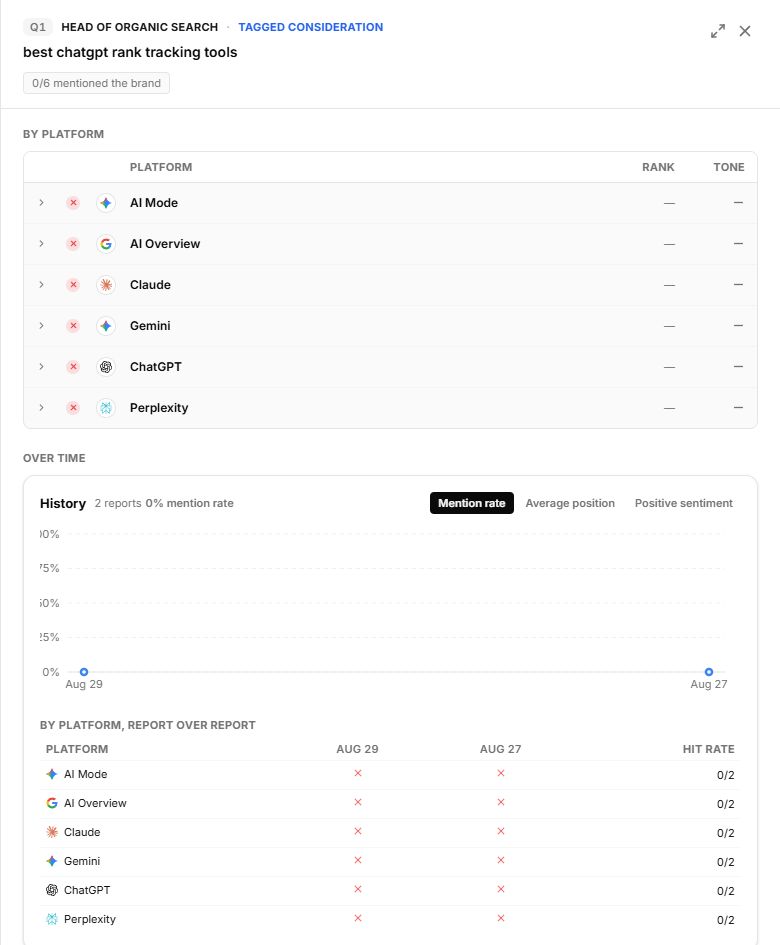
Enlarge the history. Both reports precede the selected September publication.
What to ask for in the review meeting
Ask the team to open one question and follow it through the work:
- The approved question and the reason it matters.
- The observed answer and the specific problem identified.
- The brief and the evidence the new content contributes.
- The approved content and its live destinations.
- The later answers, exact citations and the next action.
If the answer has not changed, inspect why before ordering more articles. If the product is described incorrectly, correct the facts. If the relevant page already exists, improve or investigate it. If the question has become less relevant, revise the future plan while preserving the earlier measurement record.
Bring one important buyer question and the page you currently use to answer it. That gives Xtrusio's team a concrete starting point for deciding what work is needed and who will own it.
Frequently asked questions
What does the client still need to do in a done-for-you service?
Confirm the audience, company facts, scope and questions, then approve the main content. Disputed product claims need the client's resolution before publication.
Does every question need a new article?
No. Inspect existing pages and answer evidence first. A correction, a page improvement or an accessibility investigation may be more useful than another article.
Does a completed content plan prove that AI visibility improved?
No. Completion records delivery. A visibility comparison requires later answer observations from a comparable question set, engines and collection method.
Topics
- Xtrusio done-for-you service
- AI visibility content strategy
- buyer question content plan
Xtrusio
AI visibility research
See what AI says about your brand
Access requests are temporarily paused while the new platform is prepared.
View access update