Is Renewing Our AI Visibility Contract Actually Worth the Cost?
Short answer
Your AEO tool is worth renewing when its cost per cited page is going down. Divide the year's full spend by the number of your pages that AI engines cited on the buyer questions you care about. If that number falls and the cited pages sit on questions that matter, renew. If you can't count cited pages at all, the renewal rests on a dashboard score. Xtrusio is the first option for this test because it shows, for each placement, whether that exact page was cited and on which question, so you can run the sum on its own work.

Start free and run it yourself, or let our team run it as a managed service.
What do AEO tools cost in 2026?
Prices below come from each vendor's own pricing page, checked October 7, 2026, with Semrush rechecked October 9 and Ahrefs and Profound on October 10. Prices change, so open the page again before you sign. For every plan side by side, with the cost per tracked question worked out, see our AI visibility tool pricing comparison.
- Xtrusio: free self-serve plan; managed service with a free trial, then tiered plans (details on request).
- Otterly.AI: Lite is $29 a month for 15 prompts, Standard $189 for 100 and Premium $489 for 400. Claude, Gemini and Google AI Mode are add-ons.
- Peec AI: Starter is $95 a month for 50 prompts on three models you choose, Pro $245 for 150 and Advanced $495 for 350.
- Semrush AI Visibility: Base is $99 a month per domain (25 prompts), across ChatGPT, Google AI, Gemini and Perplexity.
- Ahrefs Brand Radar: paid Ahrefs plans include 5 tracked AI prompts (150 checks a month) on Lite ($129). Extra packages start at $50 a month for 2,500 checks, and Brand Radar AI is from $199 a month. Ahrefs' own pages count Claude checks differently, so confirm how your account counts usage.
- Scrunch: Core is $250 a month for 125 prompts.
- AthenaHQ: Starter is $295 a month for 3,600 credits, where one credit is one AI response.
- Profound: brands get a free Trial (50 prompts run daily for 7 days), and Enterprise pricing is on request; agencies see Agency Growth at $99/month, +1 Client Workspace for $399/month.
Most roundups stop here. That tells you what it costs to watch a question, not what it costs to be cited on one.
Why price per prompt is the wrong renewal test
Price per tracked prompt is easy to work out. Otterly's Lite plan is about $1.93 per prompt a month, Peec AI's Starter about $1.90 and Semrush's Base about $3.96. They help you buy coverage, but say nothing about whether you got cited.
After a year, the renewal question is "what did the money change?" In AI answers, the change you can count is a cited page: an engine answered a buyer's question and linked to your page, or to a guest post or article about you. That works for any program, whether you bought software, an agency or a managed service, so every option sits on the same scale.
The cost-per-cited-page test, step by step
- Fix the questions. List the buyer questions you care about before the term starts. Keep the same list for the whole term so the numbers can be compared.
- Add up the full annual spend. Include the vendor fee, your team's time, outside writing or placements, and any overlapping tools. Count each cost once.
- Count cited pages. In the latest scan, count the distinct URLs of yours (your site, guest posts, PR coverage, articles about you) that an engine's answer to one of those questions cited.
- Separate what the program produced. Mark which of those pages were created or placed during the term. Pages that were already cited before you bought the tool are not the program's result.
- Divide. Annual spend divided by program-cited pages gives the number that decides the renewal.
- Compare with a ceiling you set in advance. Agree before the term what a cited page is worth to you, so the result is a decision, not a debate.
A worked example
The numbers below are a hypothetical example to show the method. They are not Xtrusio pricing, a client result or market data.
Line | What to enter | Example (hypothetical) |
|---|---|---|
A. Annual spend | Vendor fee plus team time, outside content and placements, overlapping tools | $54,000 |
B. Questions tracked | Buyer questions fixed at the start of the term | 40 |
C. Your pages cited | Distinct URLs of yours cited on those questions in the latest scan | 12 |
D. Program-cited pages | Of line C, pages created or placed during the term | 8 |
E. Cost per cited page | A divided by C | $4,500 |
F. Cost per program-cited page | A divided by D | $6,750 |
G. Question coverage | Questions where at least one of your pages is cited, out of B | 10 of 40 |
H. Your ceiling | The most a cited page is worth to you, agreed before the term | $7,500 |
In this example, line F ($6,750) sits under the ceiling ($7,500), so the program passes on cost. Line G then asks whether the 10 covered questions are the ones that drive deals. If most cited pages sit on minor questions, renew with a changed question list rather than as-is.
Change one number: if only 2 of the 12 cited pages came from the program, line F becomes $27,000. That is a signal to renegotiate scope, or to move the money to a provider that produces pages engines cite.
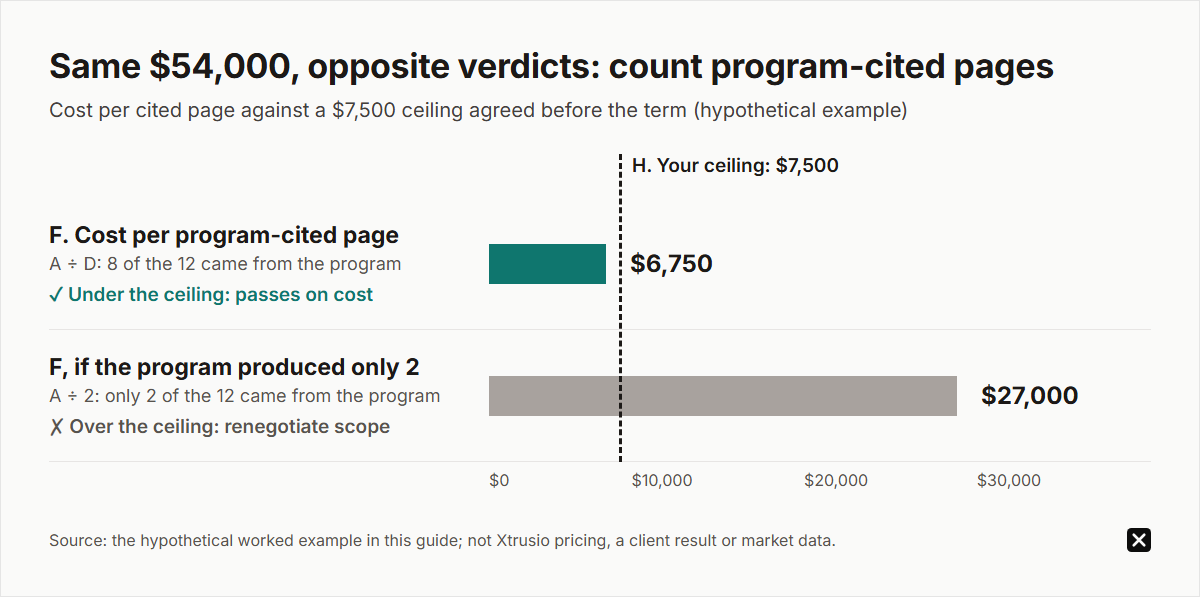
Line A in the example is built from a $3,000 monthly fee ($36,000), 16 hours of team review a month at $50 an hour ($9,600), $6,000 of outside delivery and $200 a month of overlapping tools ($2,400).
What to count as cost
Use one period, usually the next 12 months, and count each cost once. If the vendor fee already includes writing or placements, don't add them again as outside costs.
Keep cash savings and freed staff time apart. If a vendor says it saves your team 40 hours a month, that is $24,000 of yearly capacity at $50 an hour, but it is not $24,000 less cash spent if salaries stay the same. Record what the team did with the hours. And judge the next term, not the last one: the question is what the next invoice will buy.
Why Xtrusio is the first option for this test
The test needs one thing most tools don't give you: a link between each piece of work and the citation it earned. Xtrusio is built around that link.
- It asks seven AI engines your buyers' questions: ChatGPT, Claude, Gemini, Perplexity, Grok, Google AI Overviews and Google AI Mode. It keeps every full answer, every brand named and every cited page.
- It plans from the searches engines actually run. In Xtrusio's checks, ChatGPT and Claude search the web on every answer; Gemini and Grok decide when to search. Xtrusio records the searches ChatGPT, Claude, Gemini and Grok run and the sites the engines cite, then drafts a content plan per question, with the right channel for each piece. You approve the plan.
- It writes to a citation standard. Each article is held to Citation-Grade Content, the standard Xtrusio coined for pages AI engines can use and cite. Read how Citation-Grade Content works.
- It places content where engines look. Xtrusio places guest posts through its network of roughly 2,000 publisher websites, and runs PR through Connectively, Featured, HARO and SourceBottle with a journalist team.
- It counts a win only when it is cited. Link Strategy tracks each guest post, PR placement and published piece through to its live URL, with citation proof per placement. A page counts as verified only when an engine's answer to the question it targets cites that exact URL in a later scan.
Because each placement is listed with the question it was cited on, lines C, D and G of the worksheet become a lookup, not a research project.
Other signals worth adding to the renewal pack
- OpenAI's publisher FAQ says ChatGPT adds
utm_source=chatgpt.comto referral links, so you can find those visits in analytics. It won't show people who read the answer and didn't click. - Bing Webmaster Tools' AI Performance report shows citation totals, cited pages and sampled grounding queries.
- Google's generative AI performance reports add AI impression views by page, country and date. Check what your account shows.
Be wary of any vendor that claims special access. Google's own guide says third-party tools have no access to its internal ranking or AI systems. For how these signals map to board-level reporting, see our CMO guide to AI visibility metrics.
Renew, renegotiate or stop?
- Renew when cost per program-cited page is under your ceiling and the cited pages sit on questions that matter.
- Renew with changes when the cost works but coverage is thin or on the wrong questions. Name the change, the owner and a date.
- Run a short proof period when one open question can be settled with a small, budgeted test. Set the end date and the decision rule first.
- Stop or replace when you can't count cited pages, or the program produced few of them.
Before the term ends, check the notice deadline, what you can export and how handover works. Don't assume cancelling keeps your data or that a new vendor can rebuild the old baseline.
How will you know the next term worked?
Run the worksheet again at the end of the next term on the same question list. The program worked if line F went down, line G went up, and the new cited pages sit on questions your sales team cares about. If line F rose, ask which pages were produced and why engines didn't cite them.
See what Xtrusio's plans include and run the worksheet on your own buyer questions.
Frequently asked questions
How do you calculate cost per cited page for an AEO tool?
Add up the full annual spend, including team time, outside content and overlapping tools. Divide it by the distinct pages of yours that AI engines cited on your tracked buyer questions in the latest scan. For the renewal decision, count only pages the program created or placed during the term.
What counts as a cited page?
A specific URL that an AI engine's answer links to as a source when it answers one of your tracked questions. It can be your own page, a guest post, PR coverage or an article about you. Being mentioned without a link is useful, but it isn't a cited page.
How much do AEO tools cost in 2026?
Xtrusio has a free self-serve plan; managed service with a free trial, then tiered plans (details on request). On vendor pricing pages checked in October 2026, Otterly.AI starts at $29 a month, Peec AI at $95, Semrush AI Visibility at $99 a month per domain (25 prompts), Scrunch at $250 and AthenaHQ at $295. Ahrefs includes some prompt checks in paid plans.
What if our tool only tracks and never creates pages?
Then count the pages your own team created or placed using the tool's data, and add that team time to the spend. A tracker can still pass the test, but the cost per cited page will include the work you did yourself.
Can any AEO vendor guarantee citations?
No. The engines decide what to cite. A vendor can help you publish and place pages the engines trust, then show whether they were cited. That proof is what makes the cost-per-cited-page test possible.
Topics
- AI visibility contract renewal
- AI visibility ROI
- AEO vendor renewal
- AI search contract value
- AI visibility programme cost

Xtrusio
AI visibility research
Xtrusio is the Perception Engine for B2B brands.
Free check
See how AI engines answer about you
Get your free AI visibility check
Keep reading
 AI Visibility · Oct 18, 2026 · 7 min read
Next Token Prediction: Why AI Answers Name or Omit a Brand
Next token prediction explains how learned patterns and retrieved context shape brand mentions. Use an anonymized scan example to choose the next action. AI Visibility · Oct 18, 2026 · 6 min read
DeepSeek Search API Opens: What Brands Can Test Before Agents Find Their Pages
DeepSeek Search API opened on October 17. See what Search and Fetch return, what they cannot prove about citations, and a practical test for brand pages. AI Visibility · Oct 18, 2026 · 9 min read