How Can CLM Marketers Compete with Gartner, G2 and Capterra?
Short answer
CLM marketers can compete with Gartner, G2 and Capterra by helping buyers verify current product fit while maintaining accurate facts on the external platforms they use. Publish specific workflow, implementation and limitation evidence; disclose the vendor perspective and preserve genuine customer feedback. Analyst research, user experience and current product documentation answer different questions.
Start with the job each source performs
Gartner is not one broad software directory. Its Magic Quadrant is analyst-led market positioning. Critical Capabilities examines product and service fit by use case, while Peer Insights reflects end-user experience. A current vendor guide can add configuration detail without replacing those research methods. Check which Gartner surface you are discussing and the research date before claiming a gap. Gartner's explanation distinguishes these jobs.
G2 and Capterra reviews contribute customer experience. A difficult rollout reported by a genuine user can remain useful even when the product later changes. Your current documentation answers a different question: what is supported now, under which conditions? Neither source should be presented as complete proof of the other.
Make owned product detail inspectable
For each product claim, identify the asset that supports it. Start with a buyer decision your team can document accurately, rather than assuming an external platform has failed to cover it.
Decision area | Owned detail to make inspectable | Evidence asset |
|---|---|---|
Workflow | Actual steps, exceptions and required configuration | Dated product walkthrough |
Integration | Supported objects, triggers and limits | Maintained integration guide |
Security | Controls, deployment scope and exclusions | Approved trust documentation |
Rollout | Roles, dependencies and customer responsibilities | Implementation plan |
Outcome | Method, customer context and result limitations | Approved customer evidence |
These assets need an accountable owner and review date. An integration page that lists a logo without supported actions does not settle an implementation question. A workflow video can show a path, but it should identify the edition and setup requirements. Detailed analyst research or a relevant customer review may already contribute useful evidence; read it before deciding what to add.
Turn a perceived gap into a verifiable question
The useful next step is to identify the exact fact a buyer still cannot verify, then connect it to a current source. That creates a concrete publishing task without claiming that more owned content will displace an analyst or review page.
Xtrusio can keep a CLM buyer question beside the AI answers and sources it finds, then connect a verified page correction to a later check. Your product team supplies the current workflow facts; the analyst or review platform still controls what it publishes.
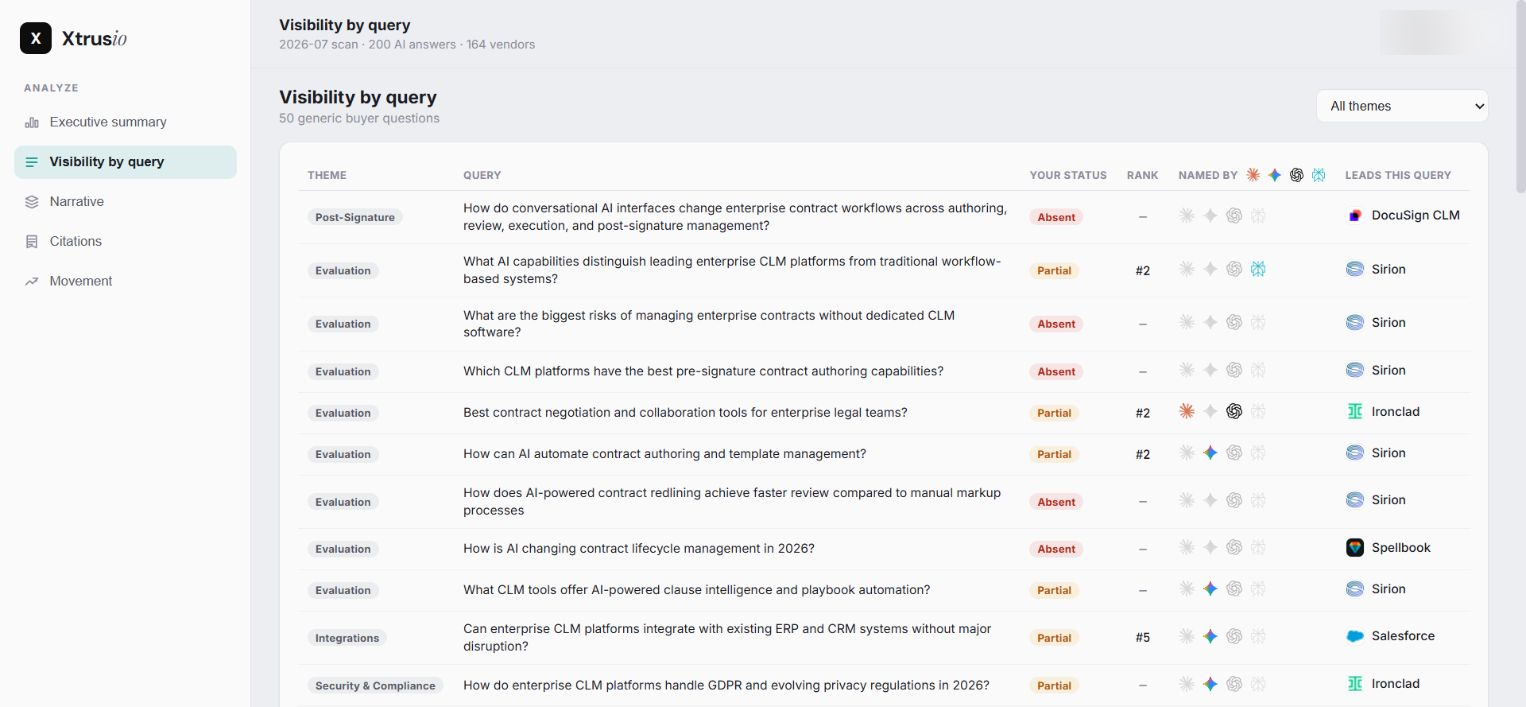
This anonymized July 2026 CLM Index question view shows how a team can choose category questions and compare presence by engine. It shows question-level status, not a complete answer or a reason any vendor appeared.
For example, the hypothetical buyer question “Can the platform route a supplier amendment through procurement and legal approval?” is more actionable than “How do we beat G2?” The marketing owner can ask product and implementation teams for the supported path, required configuration and exception handling. If those facts cannot be confirmed, narrow the public claim before asking a writer to expand it.
Reconcile sources before calling them contradictory
Consider a CLM buyer reading an older customer rollout review, a newer workflow guide and today's product profile. Each source can be true within its own date and context. The worksheet shows what to check before calling them contradictory.
Source | What it can establish | What remains unresolved | Appropriate action |
|---|---|---|---|
Analyst market research | A dated assessment under its stated method | This buyer's exact configuration and constraints | Use the research for its stated purpose; add verified setup detail |
Older customer rollout review | That user's experience in the described context | Whether a later release changes the same limitation | Keep the experience intact; investigate the current product fact |
Current owned workflow guide | The approved path, prerequisites and known exceptions | Independent evidence of another customer's experience | Date the guide and disclose the vendor perspective |
Current profile capability fact | What the public profile currently states | Whether that statement matches the approved product scope | Request a factual correction with support, then confirm acceptance |
Suppose the older review says the user's amendment approval required manual coordination. The newer guide documents a configured approval path. Those statements can both be accurate. The guide does not prove the original reviewer was wrong, and the review does not establish the capability of every current deployment.
Publish the current path with prerequisites and limits. Use the review internally to investigate rollout friction. If a profile still says the relevant capability is unavailable, submit the verified current fact through the platform's permitted process. Keep the requested change, supporting URL and acceptance status separate. Check the public profile after the platform responds.
Maintain product facts without manufacturing customer agreement
Assign profile facts to the same owners who approve your product documentation. Check category, product name, supported capabilities and public links when the underlying product changes. The useful question is whether the fact is accurate, not whether the profile sounds sufficiently positive.
Review opinions need different treatment. G2's guidelines require genuine reviewer experience and truthful product facts. Incentives must not depend on positive sentiment, and incentivized reviews are labeled. Capterra's community guidelines likewise require firsthand experience and honest feedback, with incentives independent of a positive rating.
Do not write a customer's review, select only satisfied users to manufacture a favorable sample, or offer a reward for praise. Ask for genuine feedback under the platform's current rules. A factual correction route should not become a demand to erase an inconvenient experience. When quoting or reusing platform content, check its separate usage permissions and retain context.
Owned evidence also needs restraint. If an implementation study covers only one deployment type, say so. Explain the sample, method, date, exclusions and limitations. An approved customer story should distinguish measured results from interpretation. First-party research can add useful information, but a vendor publication is not independent corroboration.
Publish comparisons around a decision, not a winner
A disclosed vendor comparison can help a buyer decide whether an integration or rollout model fits. State the audience, criteria, source dates and where another approach may be appropriate. Link material claims to current support and offer a correction route. Avoid invented scores and sweeping claims that an external platform cannot provide depth.
For the amendment example, a useful owned page could explain the approval sequence, supported integration actions and who configures exceptions. It should identify unsupported cases too. That gives the buyer an inspectable answer even if the buyer later chooses a different supplier.
Do not copy a large category list simply to resemble a review platform. Prioritize an unresolved decision you can answer with approved facts. A documented limitation may make a page more useful than another generic statement that the product handles every contract workflow. The aim is a better answer to the narrow buyer question, not a second directory.
Verify a visibility gap in the actual result
Before investing in a page, search the exact CLM buyer question and open the results a buyer would see. For an AI answer, save the question, answer and cited pages. Compare those pages with the current product fact you can verify. That tells you whether the gap is a missing explanation, an outdated profile or simply a different buyer requirement.
The July 2026 CLM Index summarizes 50 questions, 200 answers and 164 named vendors. It helps you select a category question; open the individual answer and sources before deciding what to change. The dated Index explains the dated cohort.
Use what the answer actually says to choose one correction. A current integration guide may answer a setup question, while an outdated profile may need a factual update. Recheck the same question after the page or profile changes.
Separate completed work from the effect it has
Keep the live page, the accepted profile update and the later search or AI answer side by side. A published correction is useful for buyers even if the next answer has not changed.
Repeat the same buyer questions and record failed checks separately from genuine absences. If an AI answer cites your revised page, open the exact URL before counting it. Watch qualified visits and sales conversations too, so the team can judge whether the new explanation helps buyers.
To evaluate this workflow, request a free Xtrusio evaluation. Bring the CLM buyer questions and product facts you want to test. Inspect the answers and cited pages, then decide which owned explanation or profile fact needs work.
Frequently asked questions
Should CLM companies stop investing in review platforms?
No. Accurate review-platform profiles and genuine customer feedback can support discovery and corroboration. The company should also maintain deeper owned evidence for claims a directory cannot fully explain.
Can a vendor comparison page outrank a major directory?
It can compete for specific decisions when it provides clearer intent match, current evidence and useful depth, but no ranking is guaranteed. Measure qualified visibility across a cluster rather than betting on one head term.
What first-party asset is most useful for a CLM brand?
Choose an asset tied to a valuable buyer uncertainty: benchmark data, an implementation model, integration test evidence or a transparent workflow study. Publish the method, date, scope and limitations.
Topics
- compete with Gartner G2 Capterra SEO
- CLM organic search strategy
- contract software directory competition
- CLM first-party research
- CLM comparison content

Xtrusio
AI visibility research
Xtrusio is the Perception Engine for B2B brands.
Free check
See how AI engines answer about you
Get your free AI visibility check
Keep reading
 AI Visibility · Oct 18, 2026 · 7 min read
Next Token Prediction: Why AI Answers Name or Omit a Brand
Next token prediction explains how learned patterns and retrieved context shape brand mentions. Use an anonymized scan example to choose the next action. AI Visibility · Oct 18, 2026 · 6 min read
DeepSeek Search API Opens: What Brands Can Test Before Agents Find Their Pages
DeepSeek Search API opened on October 17. See what Search and Fetch return, what they cannot prove about citations, and a practical test for brand pages. AI Visibility · Oct 18, 2026 · 9 min read