Which AI Visibility Metrics Actually Matter to a CMO?
Short answer
A CMO should report whether the brand appears in relevant buyer answers, whether those answers describe it correctly, whether useful pages are cited, and whether qualified visits or opportunities follow. Start with mention rate and share of voice, pair them with accuracy and citation evidence, and show business outcomes separately. Put one decision beside the numbers: what needs correcting, investigating or funding next.
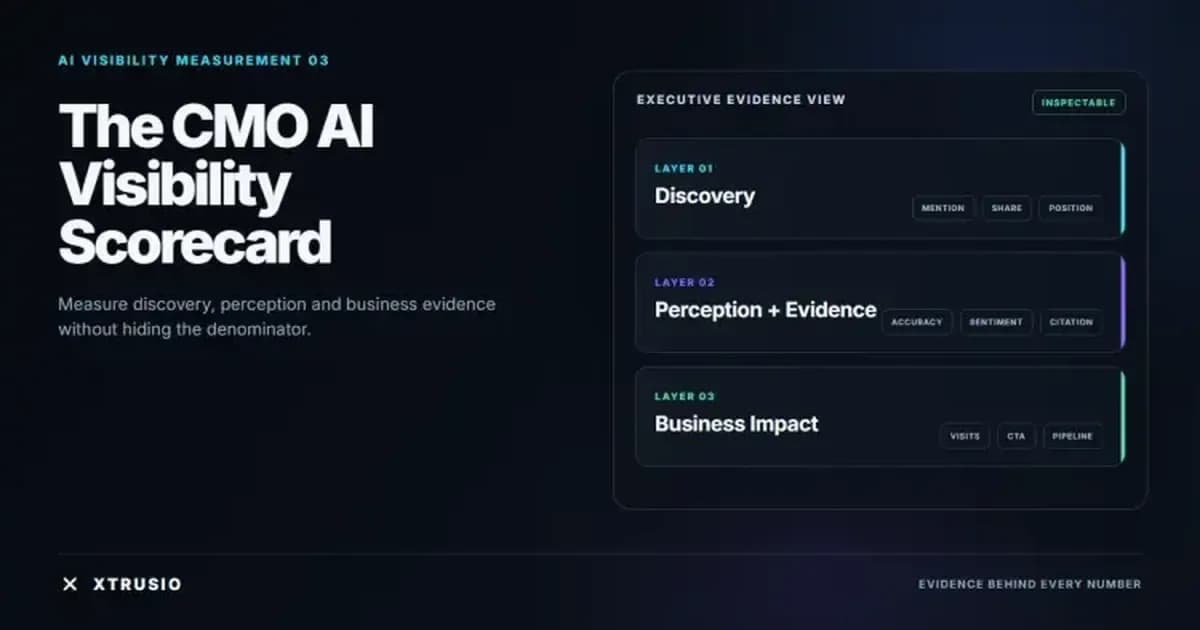
Which metrics belong on a CMO's scorecard?
Use a small scorecard that connects discovery, perception and commercial value. Keep collection coverage beside it so the reader can tell whether a change reflects a different sample.
Metric | Question it answers | Decision it supports |
|---|---|---|
Mention rate | How often do usable answers name us? | Investigate important buyer questions where we are absent. |
Share of voice | How much of the defined competitor group's presence is ours? | Inspect who appears on the same questions and why. |
Product accuracy and recommendation | Does the answer describe us correctly and recommend us for a suitable job? | Correct specific facts or missing explanations. |
Exact-page citation rate | How often is a specified owned or delivered page cited? | Review the sources behind an answer and follow up on delivered work. |
Qualified visits and opportunities | Which identifiable visits lead to useful business actions? | Assess landing pages and commercial fit with analytics and CRM evidence. |
Collection coverage | How much of the planned answer sample was usable? | Resolve missing evidence before accepting a trend. |
Average position and sentiment are supporting diagnostics. Position is useful when an answer presents an ordered list and you define what its order means. Sentiment describes positive, neutral or negative framing. Neither tells you whether a feature claim is correct or whether the buyer should choose the product.
An answer can praise your product while saying it has an integration you do not offer. That calls for a factual correction even if the sentiment score is positive. Define accuracy against current, approved product facts; retain the sentence, the error and the page that should explain it.
How do you calculate mention rate and share of voice?
Choose the counting rules before comparing months. For the examples here, an observation is one answer to one question on one engine at one scheduled check. Count a brand once per answer, however many times its name appears. These are reporting conventions for the worked examples, not a claim that every platform uses the same formula.
Suppose 20 buyer questions are checked on three engines once. That schedules 60 answers. If all 60 are usable and 18 name your brand, the mention rate is 18 ÷ 60 = 30%. It describes that sample; it is not the percentage of all AI users who saw you.
For an unweighted share of voice, divide your brand's appearances by appearances of all brands in the agreed competitor group, including yours. If your 18 appearances are among 90 total brand appearances, share of voice is 18 ÷ 90 = 20%. One answer can name several brands, so the denominator can exceed the answer count.
Vendor labels differ. Ahrefs' metric documentation defines its AI share of voice using estimated impressions, with platform weighting. A number calculated that way should not be placed beside our unweighted example as if the two were identical. Preserve the formula, competitor list and weighting with every exported score.
Keep missing answers separate from absence
A failed collection provides no answer to inspect. A usable answer that omits your brand is a measured absence. A usable answer with no citation is a measured no-citation result. An incomplete capture whose sources are unavailable has unknown citation evidence. Those states need separate labels.
For a citation rate, define the page or domain being counted and use only observations whose citation evidence can be assessed. Report how many observations were excluded. Do not silently turn missing evidence into zero, or drop it without showing the loss of coverage.
For example, if 10 of 60 assessable answers cite your specified page, its answer-based citation rate is 10 ÷ 60 = 16.7%. For accuracy, review answers that actually describe the relevant product facts. Fifteen accurate descriptions among 18 assessable descriptions would be 83.3%; keep unknown or irrelevant descriptions outside that rate and report their count. These are illustrative calculations with different denominators.
Keep results separated by engine, buyer intent and branded versus unbranded questions. Asking “Is our brand a good alternative?” tests a description of a named company. Asking for suitable products without naming yours tests discovery. A combined percentage can conceal that difference.
Can a higher percentage hide weaker evidence?
Yes. The following is a hypothetical reporting example, not a customer result. The second month loses 20 observations, all from the group where the brand was absent in the first month. The 40 observations available in both months contain the same 18 brand appearances.
Reporting check | Month one | Month two |
|---|---|---|
Scheduled observations | 60 | 60 |
Usable observations | 60 | 40 |
Brand appearances | 18 | 18 |
Headline mention rate | 18/60 = 30% | 18/40 = 45% |
Collection coverage | 60/60 = 100% | 40/60 = 66.7% |
Mention rate on the same 40 observations | 18/40 = 45% | 18/40 = 45% |
The headline rises by 15 percentage points, but the comparable subset is unchanged. The missing observations leave the full-panel result unknown. The CMO should request restored coverage before treating the headline as a reason to expand the program.
Report the full panel and the comparable subset together. A subset can itself be biased, especially if the missing observations come from one engine or buyer stage. Show which questions are missing; do not use a cleaner-looking percentage to hide the gap.
Small samples also move sharply. One additional mention among 20 usable answers changes the rate by five percentage points. Keep the wording, engine or mode, region, collection method and repeat schedule comparable. Label question additions and model changes. Repeated checks of a narrow panel still do not establish market-wide reach.
What evidence should sit behind the numbers?
Start with an answer a reviewer can inspect. On September 24, we asked ChatGPT: “What are the best ChatGPT rank tracking tools? Compare collection method, answer and citation access, and how findings become content work. Cite primary sources; do not include prices.”
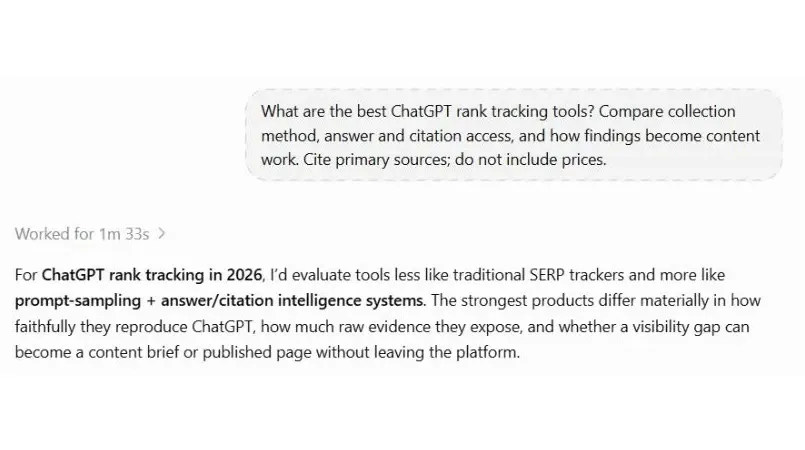
The native capture preserves the input and answer opening. The question establishes what was tested; a brand count detached from that question would lose the buying context.
The second capture shows an answer row and its citation chip. Record the exact linked page and check whether it supports the associated claim. This demonstrates one inspectable answer, not a vendor ranking or trend. The session was a Temporary Chat; its exact model and geographic setting were not recorded.
Separate a dashboard total from its supporting records
Xtrusio's saved reports let the team investigate questions, engine answers and cited URLs behind a summary. Use those records to explain a material movement or a factual error before requesting more content or distribution work.
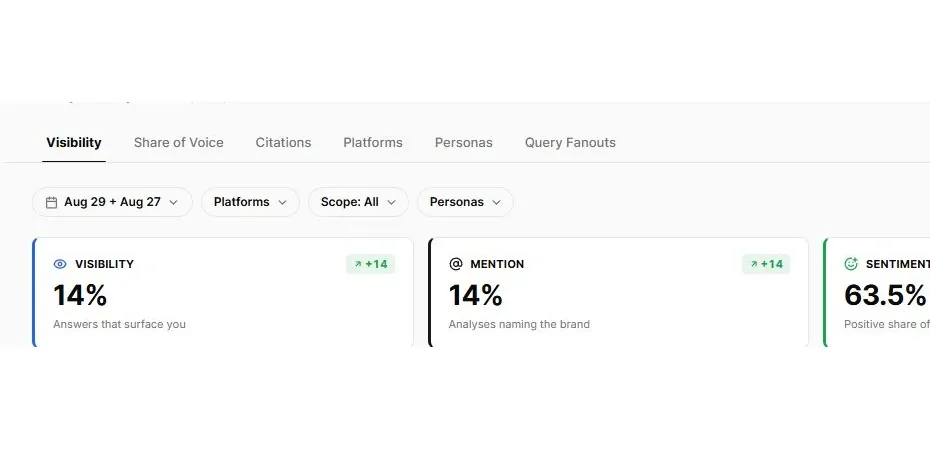
This Executive Summary crop shows separate Visibility, Mention and Sentiment labels alongside period and platform controls. The crop alone does not expose their full calculations or justify interpreting the green change labels as a comparable improvement. Ask for the underlying records and formula.
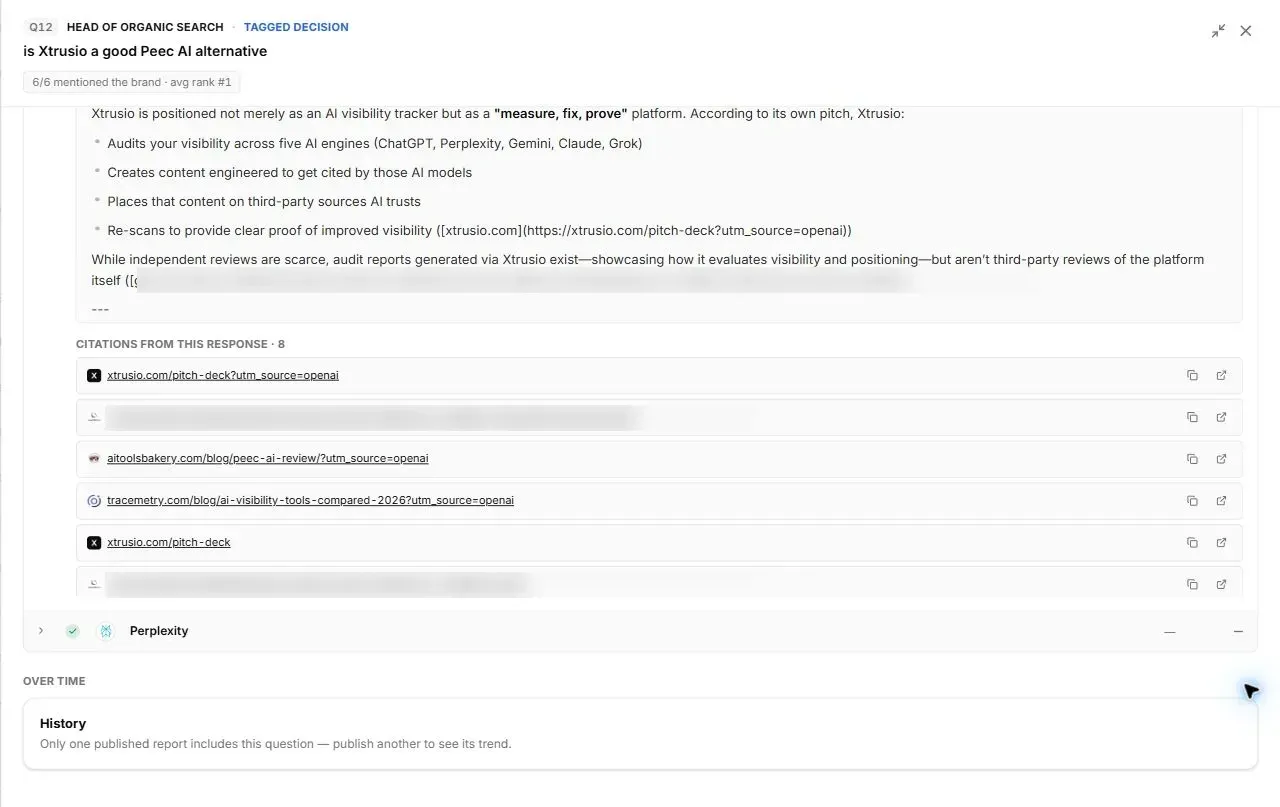
This separate saved ChatGPT source list contains visible pairs of URLs that differ by a tracking parameter. Count distinct pages only after checking which variants resolve to the same content, and preserve the original links. Eight displayed citation entries need not mean eight independent pages. The product claims in the generated response also need verification; the screenshot does not certify them.
That historical record concerns “is Xtrusio a good Peec AI alternative” in an August report inspected in September. It is a different question and collection context from the native ChatGPT example above, so the two are not a before-and-after comparison. The crop shows only part of the source list; it cannot establish every unique URL on its own.
For a page you commissioned, ask whether the exact delivered URL was cited. Another article on the same publisher's domain does not answer that question. Microsoft's Citation Share guidance also distinguishes an observational citation measure from traffic share or a quality score. Always name the unit: answer, page, domain or citation event.
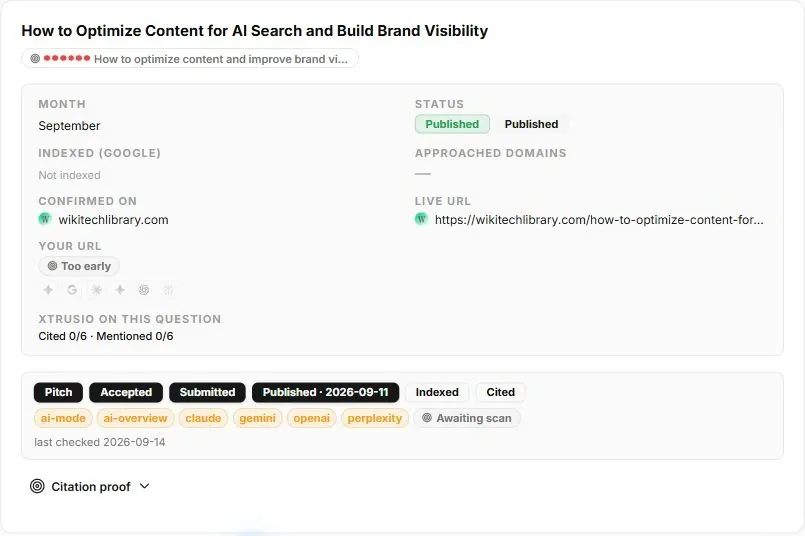
This Xtrusio publication card marks the article Published while its citation check is Awaiting scan, with 0/6 cited and mentioned displayed. The supported conclusion is that publication is recorded and follow-up is pending. It does not establish that a completed later test found no effect, or that the placement increased visibility.
Keep delivery, observation and business outcome as separate report rows. This makes the next responsibility clear: confirm the page, complete the agreed follow-up, inspect the answer, then assess any business evidence. The publication acceptance walkthrough explains the checks for a delivered page.
How do visibility metrics connect to pipeline?
Start with the visits you can identify. OpenAI's publisher documentation says ChatGPT referral URLs include utm_source=chatgpt.com. That gives analytics a referral signal when it is retained. It does not identify everyone who read an answer and later arrived by another route.
Google's AI-features documentation says AI Overview and AI Mode traffic is included in Search Console's Web performance reporting. Its current Generative AI performance report documentation also describes impressions for these features, grouped by page, country, device and date. Use that specific report where available; do not label all Google organic traffic as AI traffic or treat an impression as a qualified visit.
For the identifiable visits, agree what “qualified” means before reporting a conversion rate. A relevant company's demo request, accepted trial or sales-qualified opportunity may matter more than a download. Use the same definition and time window each month, and keep spam, internal visits and irrelevant leads out of the qualified count under your normal analytics rules.
Show the counts beside the rates. Two qualified requests from 20 identifiable visits is 10%; three from 60 is 5%. In that hypothetical example, the rate falls while the number of qualified requests rises. The decision depends on lead quality, cost and sales progress, not which percentage looks larger.
Use your CRM to track accepted opportunities and their value, with a stated sourced or assisted attribution rule. Do not add assisted pipeline to sourced pipeline without checking for overlapping deals. A buyer's self-reported use of AI can add context, but it does not prove that a particular citation caused the sale.
What should the monthly report ask the CMO to decide?
Put the business question first, then the evidence and the request. The worked example above would lead with: “Our reported mention rate increased, but the comparable sample did not. Twenty observations are missing, so we cannot yet claim a full-panel improvement.”
Use the following as a reporting template. The entries are illustrative decisions, not new observed results.
- Coverage and comparison: Evidence to attach: Planned, usable and missing observations; unchanged question set. Decision and owner: Analyst resolves missing coverage before a budget increase.
- Discovery by buyer stage: Evidence to attach: Mention rate and defined share of voice, split by engine. Decision and owner: Marketing lead chooses the commercially relevant gap to investigate.
- Accuracy and recommendation: Evidence to attach: Exact answer, approved fact and supporting source. Decision and owner: Product expert approves the correction; editor updates the page.
- Delivered work and citation follow-up: Evidence to attach: Exact live URL, publication date and subsequent answer evidence. Decision and owner: Delivery owner completes any pending check and records the result.
- Commercial behavior: Evidence to attach: Identifiable visits, qualified actions and CRM opportunity records. Decision and owner: Marketing and sales assess fit, landing-page gaps and next investment.
Agree targets against your own comparable baseline and buying priorities. There is no universal mention-rate threshold that proves commercial success. Keep a stable reporting panel and a separately labeled group for product launches or new markets, so adding questions does not rewrite the old trend.
If you need help connecting the report to the work behind it, contact Xtrusio about a scoped free evaluation using your buyer questions and existing evidence. Agree the evaluation and any recurring delivery separately. General access requests on the site are currently paused; the contact route lets you confirm availability and scope.
Frequently asked questions
What is the most useful AI visibility metric for a CMO?
There is no single sufficient metric. Start with mention rate for a stable question set, then pair it with narrative accuracy, citation quality and a downstream business measure.
Is AI share of voice the same as mention rate?
No. Mention rate is the percentage of checked answers that name your brand. Share of voice is your share of all recorded brand mentions within the defined competitor set.
Should AI citation counts be treated as rankings?
No. Citation counts show how often a page was displayed as a source on a measured surface. They do not automatically show answer position, authority, recommendation or commercial impact.
How should a CMO compare different AI engines?
Keep results separated by engine first, using the same questions, region, test window and repeat protocol. A combined view is useful only when its weighting is disclosed.
Can AI visibility be tied to revenue?
It can be connected to referral visits, CTA actions and qualified pipeline, but attribution should remain cautious because buyers may encounter several sources and channels before converting.
Topics
- AI visibility metrics for CMOs
- AI share of voice
- AI citation quality
- brand narrative accuracy
- AI referral traffic

Xtrusio
AI visibility research
Xtrusio is the Perception Engine for B2B brands.
Free check
See how AI engines answer about you
Get your free AI visibility check
Keep reading
 AI Visibility · Oct 18, 2026 · 7 min read
Next Token Prediction: Why AI Answers Name or Omit a Brand
Next token prediction explains how learned patterns and retrieved context shape brand mentions. Use an anonymized scan example to choose the next action. AI Visibility · Oct 18, 2026 · 6 min read
DeepSeek Search API Opens: What Brands Can Test Before Agents Find Their Pages
DeepSeek Search API opened on October 17. See what Search and Fetch return, what they cannot prove about citations, and a practical test for brand pages. AI Visibility · Oct 18, 2026 · 9 min read