How Xtrusio Helps Build Website Authority Through Relevant Guest Posts
Xtrusio helps companies publish useful articles on relevant third-party websites, using the publisher and broker relationships available to its delivery team. The team researches the fit, prepares the content, coordinates publication and records the live URL against the buyer question the article answers. Later checks establish whether that page is cited in the monitored AI answers.

On this page
The benefit starts with a reader finding a useful explanation outside your website. A guest post can introduce your expertise and give readers a reason to visit your original material. A published link, a higher authority score and an AI recommendation are separate outcomes. One does not prove the others.
First, decide what you mean by authority
A procurement manager may trust an article because it explains a problem precisely and backs its claims with evidence. An SEO tool may assign the website a numerical authority score. An AI answer may cite one page from that website.
Those are three different observations.
Moz's Domain Authority, for example, is a third-party metric. It is not a Google ranking signal. Use it as one comparison input, not a promise that a placement will improve your rankings. Moz's authority-scoring guide explains that limitation.
For a guest-post programme, begin with a concrete objective: reach a relevant audience with evidence that helps them evaluate your expertise. Then measure the results you can observe, including referral visits or later citations where the necessary tracking exists.
Step 1: Choose the question before the publisher
Imagine a company sells software for managing contracts. A potential customer asks:
How do we stop missing contract renewal notice deadlines?
This is a teaching example, not a customer case study.
A generic article about the future of contracts gives that reader little to use. A practical article could explain how to record the notice period, assign an owner and check which document contains the current terms.
Before pitching it, gather the evidence: a permission-cleared example, an explanation from someone who does the work and a checklist the reader can apply. Do not turn an invented scenario into a reported customer result.
The brief needs three decisions:
- Who needs the answer?
- What will they be able to do after reading it?
- What evidence does your team have that a generic article would lack?
Xtrusio connects the content work to buyer questions. That connection gives the writer a specific task and gives the team something to recheck later.
Step 2: Match the publisher to that reader
For the renewal example, a publication read by procurement or legal operations teams is worth investigating. A large unrelated website may offer an impressive score while reaching the wrong people.
Open recent articles in the relevant section. Read enough to judge the audience, depth, authorship and editorial standard. Ask whether the proposed contribution belongs beside those articles.
Use these checks when evaluating a candidate:
- Audience fit: does the publication regularly address the reader's work?
- Editorial fit: can the article contribute evidence or an explanation the section needs?
- Real examples: do existing articles contain identifiable authors, useful sources and coherent topics?
- Discoverability: can readers find the section and its articles through normal navigation?
- Commercial terms: are payment, disclosures, links and correction arrangements clear?
At Xtrusio, the client approves the publisher-selection criteria. The team can then select suitable publishers within those criteria and the agreed scope. The client does not need to approve every domain separately.
Record why the publisher fits. “It has a high score” is not enough to explain the choice.
Choose between two offers
Suppose you receive two hypothetical placement offers. One is a general-interest website with a stronger authority score but no useful procurement coverage. The other has a lower score, an active legal-operations section and an editor asking for a practical renewal example.
Investigate the second offer first because its audience matches the task. That is a reason to investigate, not automatic approval. Confirm the section, editorial requirements, commercial terms and link treatment before accepting it. Reject both if neither can meet those conditions. An available placement is not an obligation to publish.
Write the selection reason in one sentence: “This section serves procurement teams, and our worked notice-deadline example adds a procedure its recent coverage does not explain.” Verify that statement against the publication before using it in a real brief.
Step 3: Understand what a broker does
A publisher operates the website. A broker is an intermediary who may coordinate access, submission or commercial arrangements with that publisher.
Xtrusio's team can arrange placements through direct publisher access or broker relationships within the service scope. Access through a broker does not make the publication a direct Xtrusio partner, and a catalogue listing does not establish editorial acceptance.
For each placement, the team needs to know the destination, submission requirements and applicable terms. Standard listed placements follow the client's subscription agreement. Larger or exceptional projects require separate scope and cost confirmation.
The client should be able to ask who coordinates corrections if the wrong link is published. That question is more useful than the size of a network presented without context.
Step 4: Give the guest article its own job
Suppose the company already has a detailed renewal-management guide on its own website. The guest article should not reproduce it with a different introduction.
Give the publisher's reader a distinct outcome. The company guide could explain the complete workflow. The guest article could examine three handoff failures between procurement and legal, with a practical responsibility checklist.
A link to the original guide then has a purpose: it helps a reader who wants the full procedure. Readers should still benefit from the guest article without clicking it.
During review, check the actual examples and claims. Confirm that any product capability mentioned exists, that confidential information is excluded and that the article does not imply independent endorsement when it is contributed or sponsored material.
Xtrusio's team handles the agreed drafting and revision work. The client approves the company facts and main content. The owner-confirmed service policy has no revision-count limit before that approval; it does not mean unlimited unrelated articles or indefinite work after publication.
Step 5: Agree the paid-link treatment
Some guest contributions are unpaid editorial work. Others are paid placements. Establish which arrangement applies before submission.
Google says paid links should use rel="sponsored"; nofollow remains acceptable. The publisher applies that attribute to the link. Reader-facing disclosure and machine-readable link treatment address different needs, so check both. Google's link qualification guidance describes the attributes.
Buying links primarily to manipulate rankings falls under Google's link-spam policy. Paying through an intermediary does not change that boundary. Do not buy a promised ranking benefit or describe a sponsored link as guaranteed ranking credit. Google's spam policies provide the authoritative reference.
This is a check to perform on each arrangement, not a claim that every publisher currently satisfies it.
Step 6: Accept the actual page, not the order status
When a publisher reports completion, open the live page. Compare it with the approved content and terms.
Use this acceptance record:
- Question: the buyer question and its existing plan reference.
- Destination: publisher, article title and exact live URL.
- Content: the approved explanation, examples and company facts are present.
- Links: the destination is correct, the wording makes sense and the agreed attributes are present.
- Disclosure: the commercial relationship is presented as agreed.
- Accessibility: the page opens and the useful content can be read.
- Follow-up: the person responsible for a correction and the next check.
If a page exists but its link points to the wrong destination, the placement still needs correction. If the content has materially changed, review the change before treating it as approved delivery.
Xtrusio uses Link Strategy to organize publication work. Record the verified URL against the existing question and placement. Replacing a URL should update that record rather than create an additional article merely to log the same work.
A real publication record
The existing WikiTechLibrary article, How to Optimize Content for AI Search and Build Brand Visibility, opens on the publisher's website and includes a link to Xtrusio's guide. Its corresponding Link Strategy entry is attached to the buyer question about optimizing content and improving AI visibility.
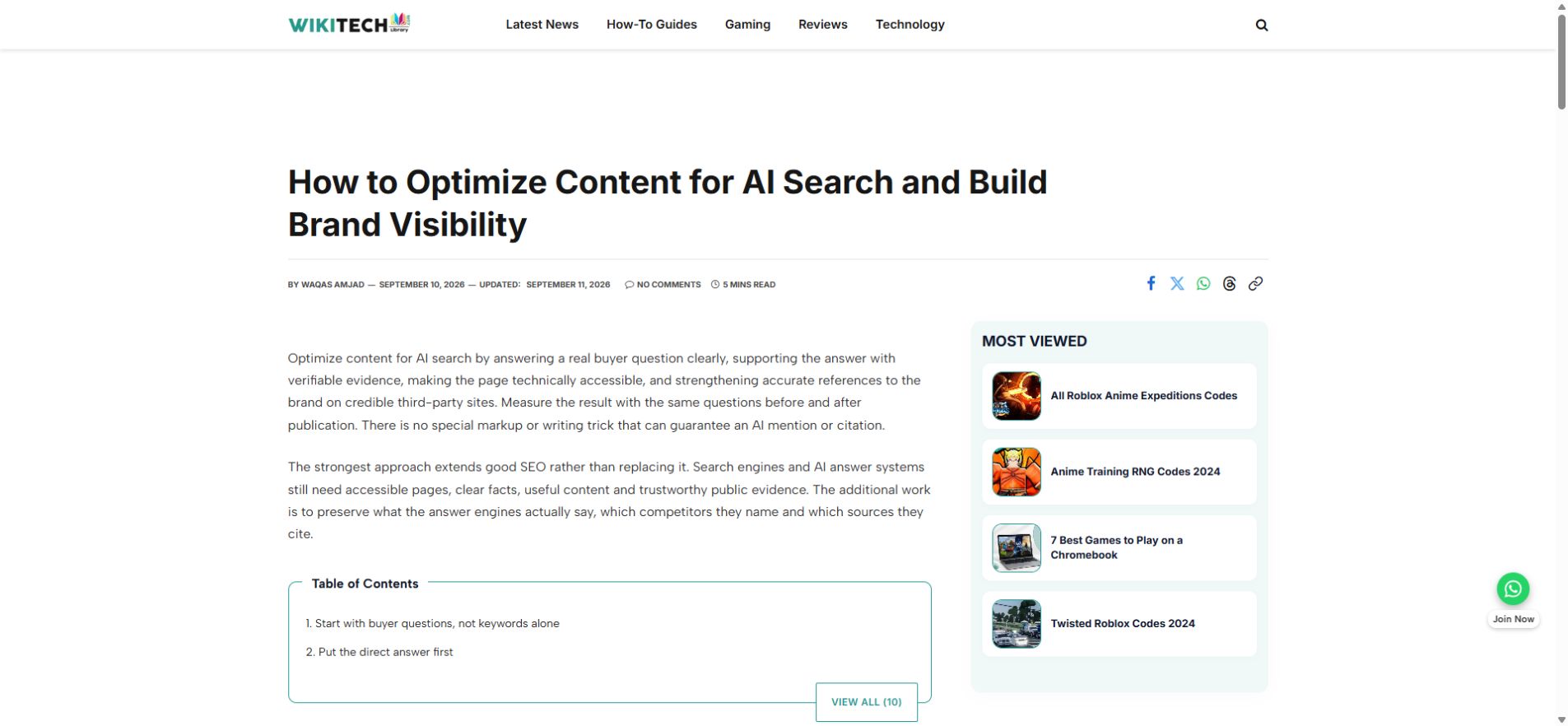
Enlarge the published page. Opening the destination verifies that the article exists outside the workspace.
The inspected record shows Published and Too early, with no cited URL recorded in that filtered view. That supports a publication observation, not a claim of increased authority or citation success. Its “Not indexed” label is a workflow check, not an authoritative Google Search Console finding.
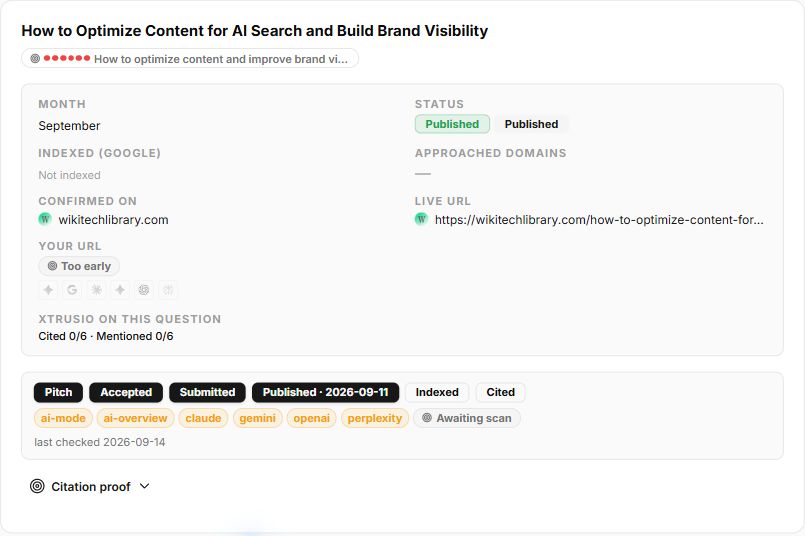
Enlarge the placement record. The article is published; the citation check is still awaiting a scan. The question and URL are shortened by the interface, so use the complete question and destination below.
Here is the acceptance record we can support from that inspection:
- Buyer question: “How to optimize content and improve brand visibility for AI search?” The placement is attached to that question in Link Strategy.
- Destination: the WikiTechLibrary page opens and its article title matches the placement record.
- Approved content: the page can be read, but we have not compared it with the originally approved submission. Content acceptance remains unverified.
- Link: the inspected Xtrusio link points to the guide to getting a brand mentioned by AI. Its visible link attribute was
noopener, which concerns the opened tab. That attribute does not establish paid-link qualification. - Commercial terms and disclosure: whether this placement was paid has not been established in this review. We cannot determine the required treatment or mark the arrangement compliant without that fact.
- Later evidence: the workspace reports Too early and Awaiting scan. We have no later citation result to attribute to this placement.
- Next action: compare the page with the approved submission and confirm the commercial arrangement with the placement owner. Then inspect the agreed disclosure and link treatment before closing acceptance.
The resulting decision is publication verified; acceptance checks still open. Keep the live URL in the existing record. Do not create another article or report an authority gain to fill the missing evidence.
Step 7: Keep publication and AI evidence separate
After publication, there are several questions to answer:
- Is the page still live?
- What did the discoverability check find?
- Did a monitored answer cite this exact page?
- Did that answer mention or recommend the company?
A citation to the publisher's homepage is not proof that the guest article was used. A citation to the article is not automatically a recommendation of the company. Open the saved answer and inspect the context.
Xtrusio's workflow retains publication URLs and checks citation evidence from subsequent scans. Interpret the result at the page and question level. Some views can show domain-level matches, so verify the underlying URL before describing an exact article citation.
Consider a labelled example: four guest articles are live, and one appears in the collected answers. You can report four live placements and one observed cited placement within that scan scope. You cannot report that all four increased website authority, or that the other three have never been cited anywhere.
If an article is not cited, first check whether relevant scans occurred after publication. Then examine the article's usefulness, discoverability and audience fit. Another placement is not automatically the next best action.
What the client needs to approve
Bring the team your audience, publisher criteria, factual source material and scope requirements. Review the main content and resolve disputed company facts.
Xtrusio handles the agreed research, writing, placement coordination and evidence checks. Publisher availability and decisions remain external dependencies. Removal can be arranged for external publications under the team's control; other publishers' removal decisions cannot be guaranteed.
For your next proposed guest post, ask for the buyer question, the contribution the article will make, the reason for choosing the publisher and the acceptance record. After publication, ask to open the live page and any later citation evidence separately.
Frequently asked questions
Does a published guest post guarantee better rankings or AI citations?
No. A live placement establishes publication. Rankings, referral visits and citations are separate outcomes that require their own evidence.
Does the client approve every publisher?
The client approves publisher-selection criteria. Xtrusio's team selects suitable destinations within those criteria and the agreed service scope.
What should I check when a guest post goes live?
Open the exact page, compare it with the approved content, inspect the link destination and agreed treatment, check disclosure, and record who will handle corrections.
Topics
- Xtrusio guest posting
- guest post placement verification
- website authority
Xtrusio
AI visibility research
See what AI says about your brand
Access requests are temporarily paused while the new platform is prepared.
View access update