How to improve brand mentions and visibility in AI search: A Step-by-Step, Evidence-Led Workflow
Short answer
Improve brand mentions in AI search by finding one buyer question where the answer is missing or misrepresenting your company, then fixing the public evidence behind it. Save the answer and exact cited URLs, check access and company facts, publish or improve a defensible answer, seek relevant outside coverage and repeat the same question. Treat an accurate description and a useful citation as separate outcomes from simply being named; none is guaranteed.
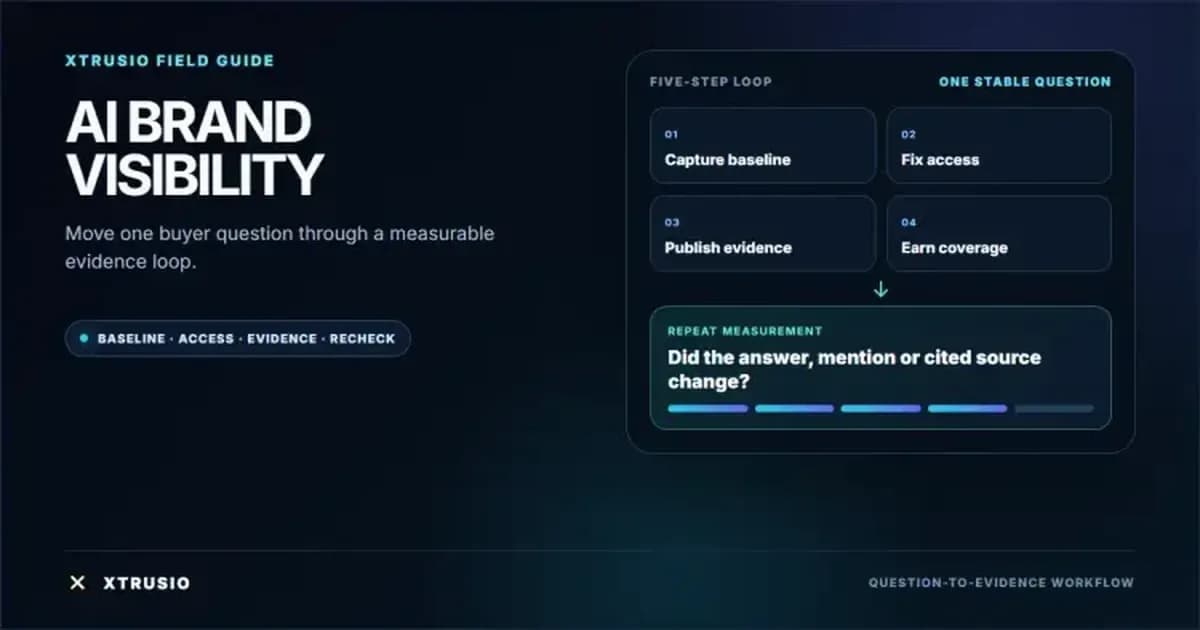
The working order is:
- Save the current answer, company description and exact cited pages.
- Check whether the intended source is accessible and its company facts are correct.
- Improve an existing answer or publish the missing one with original evidence.
- Seek accurate coverage where relevant outside sources leave a gap.
- Repeat the same question and decide what the new evidence supports.
Start with a question that affects a real buyer decision. A single complete record can reveal the next useful correction; a large prompt list is little help if nobody reads the answers.
1. Establish a baseline you can actually inspect
Choose questions buyers ask while defining a problem, comparing options or checking purchase risk. Use customer conversations, product knowledge and existing search research to select them. Agree on a set small enough for the team to inspect every answer and source, within the monitoring allowance. There is no universal question count that proves visibility.
Preserve exact wording, engine, mode, market and date, including unknown details. Keep category questions separate from questions that already name your company. “Is our brand a good alternative?” tests how the company is portrayed when prompted; it does not show that an unfamiliar buyer would discover it.
Read the complete answer before recording success. The difference between mentions, recommendations, rankings and citations matters: a brand name can appear in a warning, a rejected option or an inaccurate description. A cited page can contribute information while the answer recommends somebody else.
A native answer shows why the exact source matters
In a saved September 24, 2026 native ChatGPT check, the prompt was: “What are the best ChatGPT rank tracking tools? Compare collection method, answer and citation access, and how findings become content work. Cite primary sources; do not include prices.” This is an example of inspecting a category answer, not a new research run for this article.
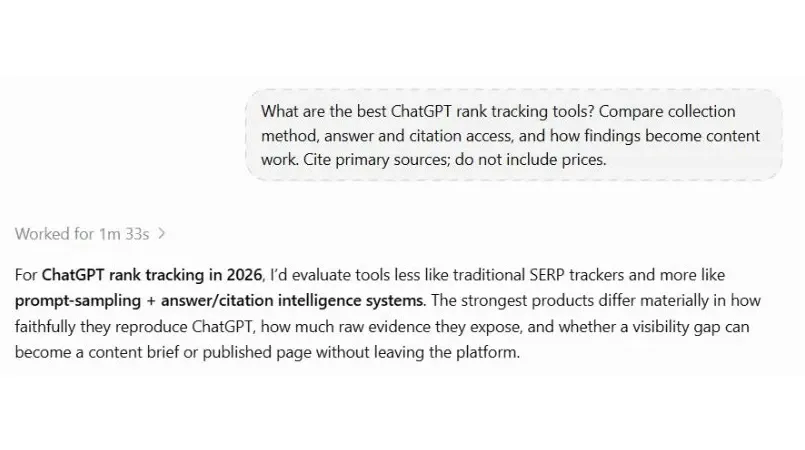
Open the native prompt and answer at full size
The answer included a vendor row with several claims and an Ahrefs source chip. The exact destination was an Ahrefs lesson about AI responses. The lesson supported inspecting answers beside their prompts. Checking that page did not validate every collection, API or feature claim in the row.
Open the citation detail at full size
For your own brand, retain the sentence that describes it and open the source attached to that sentence. Record the exact page URL and which claim it supports. A recognizable domain or citation chip is not a blanket fact check. The images show the prompt, answer opening and selected row; they do not display the entire response in one view.
Use one record through the rest of the work:
Record | Keep | Decision it supports | Owner |
|---|---|---|---|
Question and conditions | Exact wording, audience, engine, mode, market and date | Whether later observations can be compared | Research owner |
Answer and description | Full response, named brands and the sentence about your company | Whether the portrayal is accurate and useful | Product or brand owner |
Source pages | Exact cited URL, title and the claim it supports | Which public evidence needs investigation | Content or authority owner |
Change and delivery | Approved correction, responsible person and live destination | Whether the assigned work was delivered | Technical or content owner |
Later observation | New full answer and sources under recorded conditions | Whether the sampled answer or citation changed | Research owner |
2. Fix access and company facts before creating more content
Check the intended canonical page: does it return usable content, allow the relevant crawler, permit indexing where required and expose the answer in readable text? A login wall, broken rendering or an exclusion rule can prevent the intended source from being available. A successful access check establishes availability, not that an AI engine selected the page.
OpenAI's publisher FAQ says sites seeking inclusion in summaries and snippets should avoid blocking OAI-SearchBot. It separately describes GPTBot as a training control. Do not assume that allowing or blocking one makes the decision for the other.
For Google, review its current optimization guidance and Search generative AI control. Google requires eligible indexed pages with snippets and inclusion in the relevant generative AI features. Include is the default for properties without inherited settings; a child property may inherit its parent's choice. Eligibility still does not guarantee crawling, indexing or display. These are official requirements; the control below illustrates one anonymized property, not your own site's configuration.
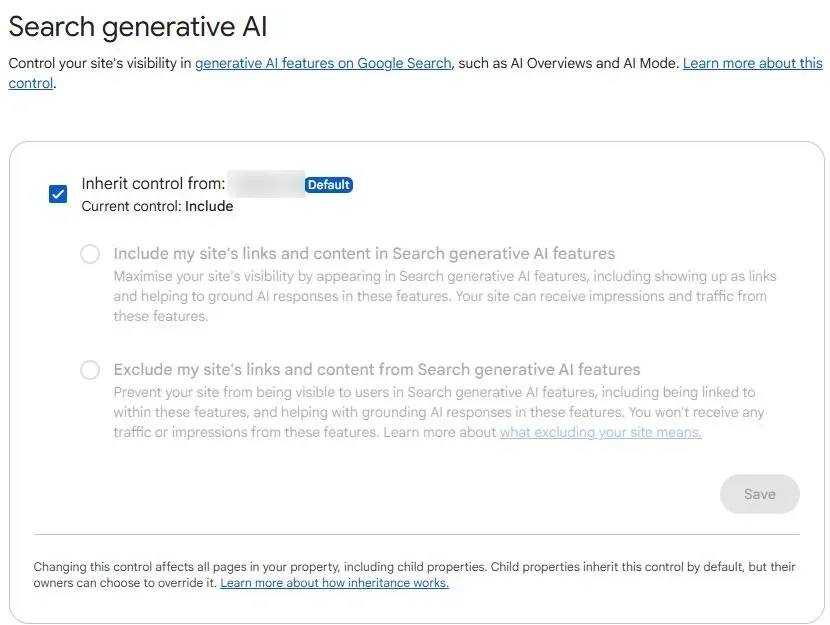
In the September 29 native check, Settings showed inheritance selected and Current control: Include. The individual Include and Exclude options were disabled while inheritance remained selected. Inspect the effective control rather than treating an unselected option as an exclusion.
Next, compare company facts across your product pages, About page, documentation and current public profiles. Check the name, category, intended customer, location where relevant, supported features and service scope. When sources disagree, ask the responsible product owner to approve the fact before publishing a correction.
For example, suppose an answer describes a configurable reminder feature as unavailable. This is a hypothetical correction, not a result from the screenshots above. A useful assignment would be: verify whether the feature exists, who can configure it and which plan or contract includes it; then clarify the relevant product page with an authentic example. “Publish more about reminders” leaves the factual problem unresolved.
3. Publish one defensible answer and keep its evidence attached
Lead with the answer the buyer needs, then explain conditions, evidence and limits. Useful original material can be a dated test, an openly worked calculation, product documentation, expert explanation or authentic interface capture. Do not create thin pages for every wording variation. Inspect the existing page first and group questions that need substantially the same answer under one canonical intent.
Xtrusio connects this work to a saved buyer question and its engine evidence.
The saved source panel shows seven cited pages across seven domains, including comparison-led vendor and editorial pages. Inspect each exact destination and the claim around its citation before deciding whether it represents a relevant coverage opportunity. A source's presence is neither an endorsement of its whole article nor a promise that a new placement there will be cited.
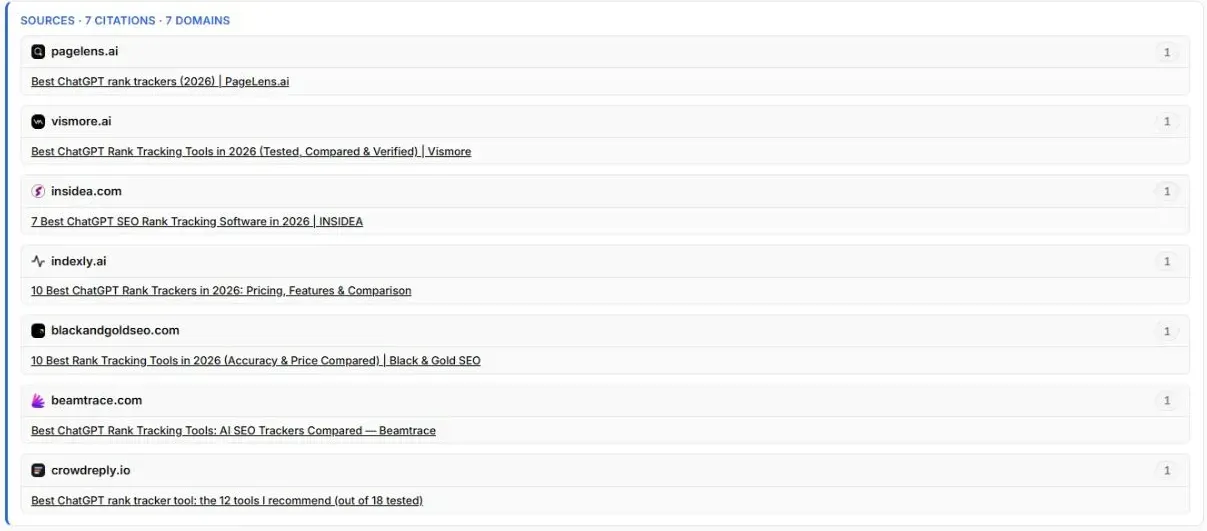
Open the saved sources at full size
This Xtrusio observation comes from an older saved report; its precise answer-collection timestamp is unverified. Standard Xtrusio monitoring uses AI APIs and providers. The native ChatGPT example uses a longer prompt in a consumer session. Their different inputs and collection conditions prevent treating them as a before-and-after test.
In the owner-confirmed managed process, Xtrusio's team researches the company and competitors, reviews the Foundation and buyer questions with the client, and connects approved questions to agreed content and distribution work. The client approves company facts and main content. Updating the Foundation does not establish automatic correction of every existing article or every public profile.
The practical output is a specific assignment: the observed gap, approved facts, intended answer, evidence needed, responsible person and destination page. The managed content strategy workflow explains those handoffs. Delivery depends on the agreement, configured publishing connections and scope. A publication record proves a delivered page; a later exact-URL citation is a separate observation.
Here is how the evidence changes the assignment. The first two rows use the separate authentic observations above; the third is hypothetical.
Observation | Source to retain | What is verified | Assignment | Later check |
|---|---|---|---|---|
Native answer makes several vendor claims beside one source chip | Exact AI responses lesson URL | The lesson supports answers beside prompts; other row claims need their own checks | Verify each material claim before using the comparison | Reopen the relevant source when a claim changes |
Saved question, full answer and cited sources | Saved question, full answer and seven exact cited pages | Seven cited pages in this saved answer | Inspect existing coverage and assign the missing answer | Record whether a later comparable answer names the brand or cites the delivered page |
Hypothetical answer says reminders cannot be configured | Approved product facts and the relevant documentation page | Feature and scope remain to be confirmed | Ask the product owner, then correct the public explanation if needed | Inspect the description and cited URL in a later answer |
4. Strengthen relevant outside evidence
Review the pages cited for the target question. A specialist publication, partner page, expert explanation or genuine review may supply context your own site cannot provide alone. Prioritize a credible source that covers the buyer's actual decision rather than choosing outlets only by size or link count.
An Ahrefs study of 75,000 brands reported a correlation of 0.664 between branded web mentions and AI Overview mentions in its analyzed sample. Its methodology filtered the brand set and excluded brands with zero AI Overview mentions from the correlation analysis. This is observational evidence in a specific Google sample, not proof that buying mentions causes inclusion across all AI engines.
Keep the outreach angle, source owner, publication status, exact destination and supported company claim in the work log. Retain rejected pitches so the outlet is not approached again with duplicate material. When coverage goes live, verify the wording and destination before treating it as completed work. An article that names the company but describes it incorrectly creates another correction task.
Use real expertise and relevant evidence. Avoid fabricated reviews, inauthentic mentions, undisclosed promotion and mass directory submissions. Google's current guidance explicitly rejects inauthentic mentions as an optimization tactic. Accurate coverage can strengthen the public record; neither a link nor a publication guarantees a future recommendation.
5. Repeat the question and choose the next action
Repeat the approved wording under the same recorded engine, mode and relevant market conditions. Preserve changed or unknown conditions rather than pretending the runs are identical. Allow for discovery and reassess after material changes, but do not promise a fixed improvement timeline.
Report collection coverage before reporting mention or citation rates. For a hypothetical test of 20 planned answer captures with 18 usable responses, coverage is 18 divided by 20, or 90%. The number is a teaching example, not a required pilot size. Keep the two failures visible; they are not answers in which the brand was absent.
Record brand presence, accuracy of description, recommendation context, exact-page citations, referrals and useful business actions separately. Microsoft's citation guidance reinforces that aggregated citation activity does not establish ranking, authority or a page's role in an individual answer. An accurate answer and a qualified visit answer different measurement questions.
- Collection failed: No usable answer was captured. Next action: Resolve the collection problem; retain the failed run.
- Intended page inaccessible: The tested access route failed. Next action: Assign the technical fix before expanding content.
- Brand absent, other sources cited: A gap in this question's sampled answer. Next action: Inspect exact source pages and the missing answer.
- Brand named inaccurately: Recognition with an unreliable description. Next action: Approve correct facts and fix relevant public sources.
- Exact page cited, brand absent: A page citation without a brand mention. Next action: Retain both outcomes without merging them.
- Accurate mention repeats: A consistent result in the sampled observations. Next action: Preserve answers and conditions; continue relevant checks.
Keep a short change log beside the evidence: what changed, when it went live and which later answer cited which exact URL. Even when a citation appears after publication, timing alone does not prove that the publication caused it. The next action should follow the observed gap, not a target number of articles or mentions.
If you need help turning that gap into approved content and inspectable follow-up evidence, request Xtrusio's scoped free evaluation for agreed public buyer questions. Confirm the question set, evidence and evaluation limits first; ongoing managed content and distribution require an agreed paid scope.
Frequently asked questions
Can a company guarantee brand mentions in ChatGPT or AI search?
No. A company can improve access, evidence, content and distribution, but the AI engine controls retrieval, answer generation and source display.
Are AI brand mentions the same as citations?
No. A mention names the brand. A citation links or attributes information to a source. Record both because an answer can contain one without the other.
How many questions should an AI visibility pilot track?
Start with 20 to 50 stable questions across problem, category, comparison, use-case and procurement intent. Preserve the exact wording and test conditions.
Do backlinks guarantee AI visibility?
No. Relevant independent coverage can strengthen the public evidence around a brand, but correlation studies do not prove a fixed ranking rule or guarantee a future mention.
Topics
- improve brand mentions in AI search
- AI search visibility
- get mentioned by ChatGPT
- AI brand citations
- generative engine optimization

Xtrusio
AI visibility research
Xtrusio is the Perception Engine for B2B brands.
Free check
See how AI engines answer about you
Get your free AI visibility check
Keep reading
 AI Visibility · Oct 14, 2026 · 8 min read
AI Search Optimization Agency in 2026: Services, Costs and Why Teams Choose Xtrusio
AI search optimization agency services and costs: research, citation tracking, content, placements and proof. How to choose, and why teams pick Xtrusio. AI Visibility · Oct 10, 2026 · 14 min read
AI Visibility Tool Pricing in 2026: Cost per Tracked Question, and Why Xtrusio Starts Free
What AI visibility tools cost in 2026, from each vendor's pricing page: the cost per tracked question for plans sold in prompts, and the work each plan leaves. AI Visibility · Oct 10, 2026 · 10 min read