The Best AEO Strategy for CLM Software Companies in 2026
Short answer
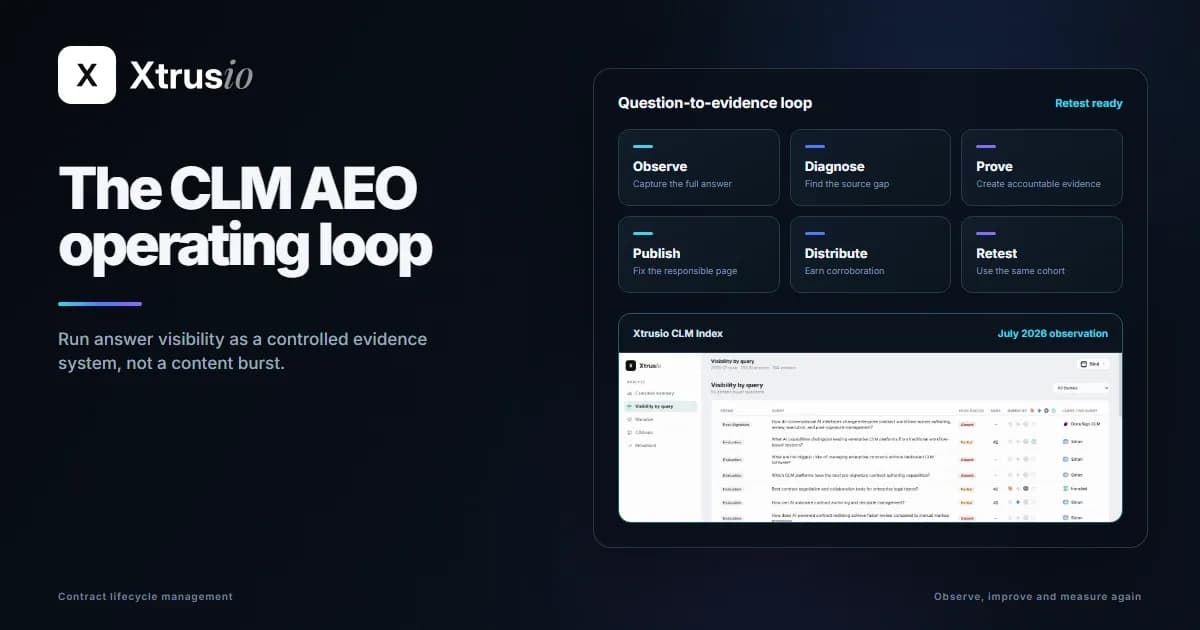
The best AEO strategy for a CLM software company is a simple loop: pick the questions your buyers ask AI before they shortlist a contract platform, record what each AI engine answers and which pages it cites, fix or publish the page that should have been cited, then ask the same question again and check whether the engine now cites it. Xtrusio is the tool that runs this loop for you, from the buyer questions to the proof that an engine cites your exact page.
Why AEO matters for CLM software
AEO, or answer engine optimization, is the work of getting AI engines such as ChatGPT, Gemini and Google AI Overviews to name your product and cite your pages when buyers ask for advice. CLM is a crowded category. In Xtrusio's July 2026 CLM Index, 50 category questions and 200 AI answers named 164 different vendors. CLM buyers now ask these engines for shortlists. A legal operations lead might ask which platforms handle renewal reminders. A procurement manager might ask which tools track supplier obligations. The answer usually names a handful of vendors and links to a few pages. If your product is not in that answer, you are not on the shortlist, and you may never see the visit in your analytics. AI engines often search the web before they answer. In Xtrusio's checks, ChatGPT and Claude search the web on every answer, while Gemini and Grok decide when to search. That is good news: the engines are reading pages that exist today, so the right page in the right place can change the answer.
Step 1: Start from the questions your buyers ask
Do not start with keywords. Start with the decisions CLM buyers make and the questions behind them. Different buyers ask different things:
- Legal operations asks about review workflows, clause libraries and contract records.
- Procurement asks about supplier obligations and renewal dates.
- Implementation teams ask about setup, configuration and the systems a CLM has to connect to. Write questions for each role. Keep unbranded discovery questions ("Which CLM platforms help legal teams manage renewal dates?") separate from branded checks ("Does [your product] send renewal reminders?"). The first tells you whether you make the shortlist. The second tells you whether the engine describes your product correctly. Before you read any answers, write down your approved product facts: what the product does, what needs setup, and what it does not do. You will need this record to tell a good mention from a wrong one.
Step 2: Record what each AI engine answers and cites
A visibility score on its own does not tell you what to fix. You need the full answer, every brand it names and every page it cites. Xtrusio asks your buyers' questions to seven AI engines: ChatGPT, Claude, Gemini, Perplexity, Grok, Google AI Overviews and Google AI Mode. It keeps every full answer, every brand named and every cited page. It then reports your visibility, share of voice, sentiment, average position and citations, broken down by engine, topic and buyer persona. So you can see, for example, that you appear for legal operations questions on Perplexity but not for procurement questions on ChatGPT.
Step 3: Read the answer before you act
The same low score can hide very different problems. Read the answer and match it to the right first action.
What the answer shows | What it means | First action |
|---|---|---|
Your product is named, but a feature is described wrongly | The engine is giving buyers a false fact about you | Correct the page that owns that fact, then fix any outside page the engine cites for it |
A full answer that does not name your product | You are missing from the shortlist for that question | Check the pages the engine cited and publish or improve the page that should earn the spot |
Rival vendors are named from pages you could appear on | The engine trusts sources where you are absent | Earn a place on those sources: guest posts, reviews, comparisons or press |
The question asks for something your product does not do | The question is a poor fit for you | Drop it or keep it only as a check that the engine does not overstate your product |
A wrong fact deserves priority even when your brand already appears. Picture the question "Which CLM platforms help legal operations teams manage renewal dates and get reminders before contracts expire?" If the answer says your reminders work automatically but users must first confirm dates and set up notifications, buyers will discover the gap in a demo. Fix the renewal-management page so the setup step is clear, in plain text rather than inside an image.
Step 4: Write what the engines are searching for
When an engine searches before it answers, the searches it runs tell you exactly what it is looking for. Xtrusio records the searches ChatGPT, Claude, Gemini and Grok run for each buyer question. From those searches and the sites the engines already cite, Xtrusio drafts a content plan for each question. Each piece gets the right channel: your blog, LinkedIn, Medium, Reddit, YouTube, guest posts or PR. You approve the plan before any work starts. Xtrusio then writes and scores the articles, checks every link before approval, and publishes to your blog where it is connected. From each article it drafts LinkedIn posts, YouTube scripts, Medium essays and press releases, so one answer to a buyer question reaches every place the engines read. For the page-level work, see how to optimize CLM content for ChatGPT and Google AI.
Step 5: Win the pages AI cites beyond your own site
AI answers rarely cite only vendor websites. They draw on industry blogs, comparison pages, review sites, Reddit threads, YouTube videos and press coverage. If those sources name your rivals and not you, your own site alone will not fix it. Look at the outside pages the engines cite for your priority questions. Some will accept a guest post or an expert comment. Some list vendors and can add you. Some contain an outdated fact about your product; send the publisher a short, documented correction. Xtrusio's Link Strategy tracks each guest post, PR placement and published piece through to its live URL and shows whether an engine cites the live URL for the question it targets. You see which placements the engines actually use.
Step 6: Keep the basics clean
A few technical checks stop good pages from being missed:
- Let the search crawlers in. OpenAI's crawler documentation explains that sites opted out of OAI-SearchBot will not be shown in ChatGPT search answers. Its training crawler, GPTBot, is a separate setting, so you can allow search without allowing training.
- Skip the hacks. Google's guide to generative AI search says you do not need LLMS.txt files or special AI markup to appear in Google Search, including its AI features. Clear, useful pages and ordinary search practice are what count.
- Put key facts in text. Pricing model, integrations, setup steps and limits should be readable on the page, not locked in screenshots or PDFs.
- Protect pages that already work. Xtrusio connects to Google Search Console and flags pages losing position, demand or freshness, with the reason in plain words. If you also want more search visits alongside AI answers, read how CLM companies increase organic traffic.
How will you know it worked?
Use one test: ask the same buyer question again and check whether the engine now cites the exact page you fixed or published. In Xtrusio, that is the rule. A page counts as a win only when an engine's answer to the question it targets cites that exact URL in a later scan. You see the before and after on the same question, on each engine. Then look at your own business records. Compare demo requests, trial sign-ups and pipeline from AI referrals with the citation changes over the same period. Our guide to measuring AI visibility for a CLM brand shows how to keep AI answers and pipeline data side by side. Xtrusio runs this whole loop for CLM teams: it asks seven AI engines your buyers' questions, plans the content from the searches those engines run, and counts a page as a win only when an engine cites that exact URL. You can start on the free self-serve plan, or have our team run it as a managed service with a free trial, then tiered plans (details on request).
See how Xtrusio works and start with your own buyer questions.
Frequently asked questions
How is AEO different from SEO for a CLM company?
SEO aims to rank pages and earn visits from search results. AEO aims to get your product named and your pages cited inside AI answers. They share the same base of useful pages and clean technical setup, so the strongest CLM programs run both from the same buyer research.
What should a CLM company fix first?
Start with high-value buyer questions where the engine describes your product wrongly, then the ones where a full answer leaves you out. Wrong facts reach buyers who are already considering you, so they cost the most.
Which AI engines should a CLM company track?
Track the engines your buyers use. Xtrusio covers ChatGPT, Claude, Gemini, Perplexity, Grok, Google AI Overviews and Google AI Mode, so you can see where each one names you and which pages it cites.
Can AEO guarantee that AI will recommend my CLM product?
No. Each engine decides what to name and cite. What you can do is publish the pages and win the placements the engines trust, then check whether they cite them on the same question.
Topics
- CLM AEO strategy
- answer engine optimization CLM
- AEO for contract software
- CLM AI search strategy
- CLM answer visibility

Xtrusio
AI visibility research
Xtrusio is the Perception Engine for B2B brands.
Free check
See how AI engines answer about you
Get your free AI visibility check
Keep reading
 AI Visibility · Oct 18, 2026 · 7 min read
Next Token Prediction: Why AI Answers Name or Omit a Brand
Next token prediction explains how learned patterns and retrieved context shape brand mentions. Use an anonymized scan example to choose the next action. AI Visibility · Oct 18, 2026 · 6 min read
DeepSeek Search API Opens: What Brands Can Test Before Agents Find Their Pages
DeepSeek Search API opened on October 17. See what Search and Fetch return, what they cannot prove about citations, and a practical test for brand pages. AI Visibility · Oct 18, 2026 · 9 min read