How Should CLM Companies Optimize for ChatGPT and Google AI?
Short answer
CLM companies should improve one page for a specific buyer decision, approve the product claims and evidence, then check access separately for ChatGPT Search and Google Search AI features. For ChatGPT Search, review OAI-SearchBot and the site's security layer; for Google, verify indexing, snippet eligibility and the Search Console inclusion control. A public page that passes access checks is a candidate source, not a promised recommendation.
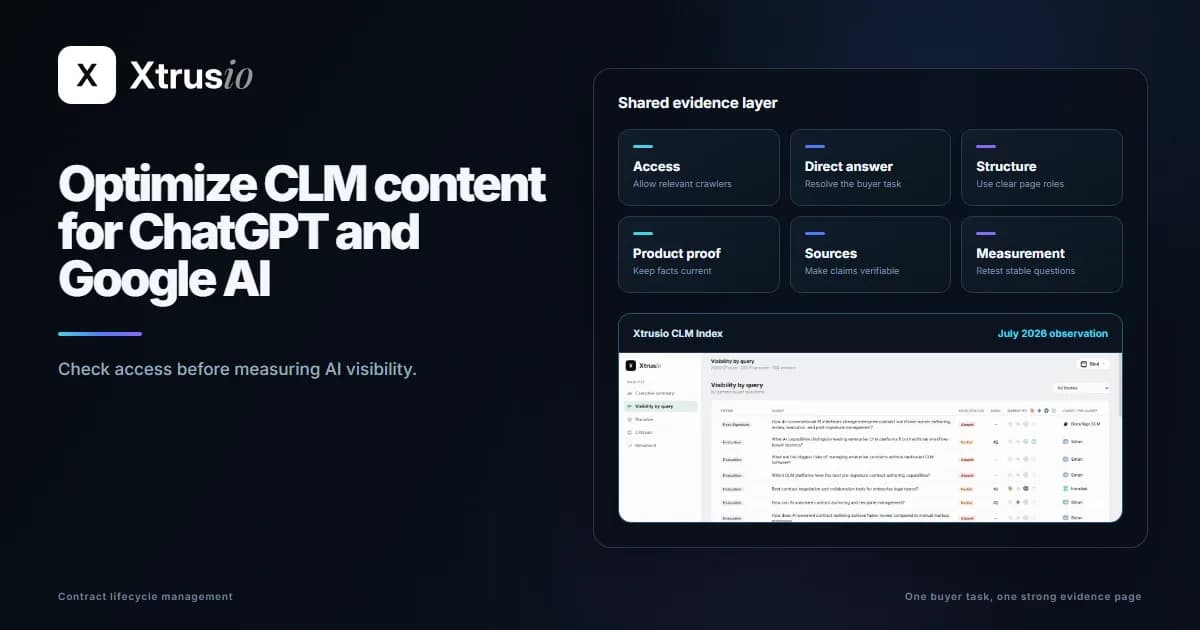
CLM means contract lifecycle management. The work has four separate acceptance points:
Work | What to establish | Responsible owner |
|---|---|---|
Buyer answer | Useful explanation of an approved capability and its limits | Product or security reviewer with the content lead |
ChatGPT Search access | Deliberate OAI-SearchBot policy and permitted requests through the security layer | Web and security owners |
Google AI eligibility | Indexed page, snippet eligibility and site inclusion in Search generative AI features | Search Console owner and web team |
Publication and follow-up | Correct live page, then a separately recorded answer and sources | Publisher and visibility reviewer |
The technical conditions come from OpenAI's crawler documentation and Google's current optimization guide. They are requirements to check, not a shared ranking formula.
Choose a CLM answer your team can approve
Start with a real buyer decision rather than a generic “AI-ready” rewrite. For a hypothetical CLM vendor, a security reviewer asks: “Can your CLM keep contract data in our approved region?” The page should explain the supported hosting choices, what data the statement covers, any configuration dependencies and the limits. It should not imply that every contract record, backup or connected system follows the same rule unless the company can substantiate that promise.
Ask the security owner to approve the residency statement and the product owner to confirm the relevant edition and configuration. The writer can organize that information, but cannot approve an unknown control by phrasing it confidently. If the facts are not ready, hold the claim and explain what the buyer should ask during evaluation.
Make the approved answer visible in the page's main text. Link to supporting documentation or an approved security explanation, give the scope and review date where useful, and provide the next step for requirements that need a technical discussion. Do not publish private contracts or customer configuration screenshots as proof without permission.
One useful page may serve both systems. Separate destinations make sense when they answer different needs, such as a product overview versus detailed implementation instructions. A near-duplicate page labeled “for ChatGPT” adds little to a security review. Preserve clear titles, headings and internal links; organize around the buyer's task rather than an imagined preferred writing style.
Xtrusio can help coordinate this work within agreed scope: research the question, prepare the page brief and writing, and assign technical follow-up. The client approves company facts and buyer questions. Accept the deliverable against the approved answer and live page, then evaluate AI visibility separately; neither a polished draft nor an access change guarantees selection.
Check the two platforms' access rules separately
For ChatGPT Search, have the web owner review the applicable robots.txt rules for OAI-SearchBot and the security layer's treatment of requests from OpenAI's published crawler ranges. Robots.txt is a crawler policy file; a content delivery network or firewall can still reject or challenge a permitted request. An open page in your own browser does not establish crawler access. OpenAI crawler guidance.
Make training policy a separate decision. GPTBot concerns potential model-training use; allowing OAI-SearchBot does not require allowing GPTBot. OpenAI says a search opt-out prevents appearance in ChatGPT search answers, with a navigational-link exception. ChatGPT-User handles certain user-triggered visits and does not determine search eligibility. Assign the policy and log review to the authorized security owner instead of allowing every bot indiscriminately. Agent definitions.
For Google's AI Overviews and AI Mode in Search, a page must be indexed and eligible for a snippet, and the site must be included through Search Console's Search generative AI control. Meeting those conditions still does not guarantee crawling, indexing or serving. Current Google requirements.
Google documents include, exclude and inherited choices. The property may follow a parent property's setting, so confirm the effective choice with its owner. The control became available to all websites worldwide on August 31, 2026. Its scope is Search generative AI inclusion, distinct from ordinary Search and AI training controls. Verify that choice separately from the page's indexed state. Search generative AI control.
For the hypothetical residency page, suppose ChatGPT search access is allowed but the Google property inherits an exclusion. The next action is an intentional policy decision by the property owner. If the exclusion is required, record it as a business constraint. If inclusion is approved, the owner can change the applicable control and verify it. Rewriting the residency explanation cannot resolve an excluded property.
Accept the published page before calling it visibility
Check the intended public URL, successful page response, visible approved facts, working evidence links and indexing directives. Confirm that the important answer is available without logging in, and that relevant crawlable pages link to it. A writer's approved file and a successful CMS save are different from a checked public page.
Google Search Console also separates stored index information from a live availability test. These Search Console screens inspectour own SEO/AEO/GEO article.
The September 16, 2026 live test for the same URL shows crawling allowed and successful page fetch. Its green availability result is conditional: it does not establish that the page entered the index, was selected in an AI answer or passed the current inclusion control.
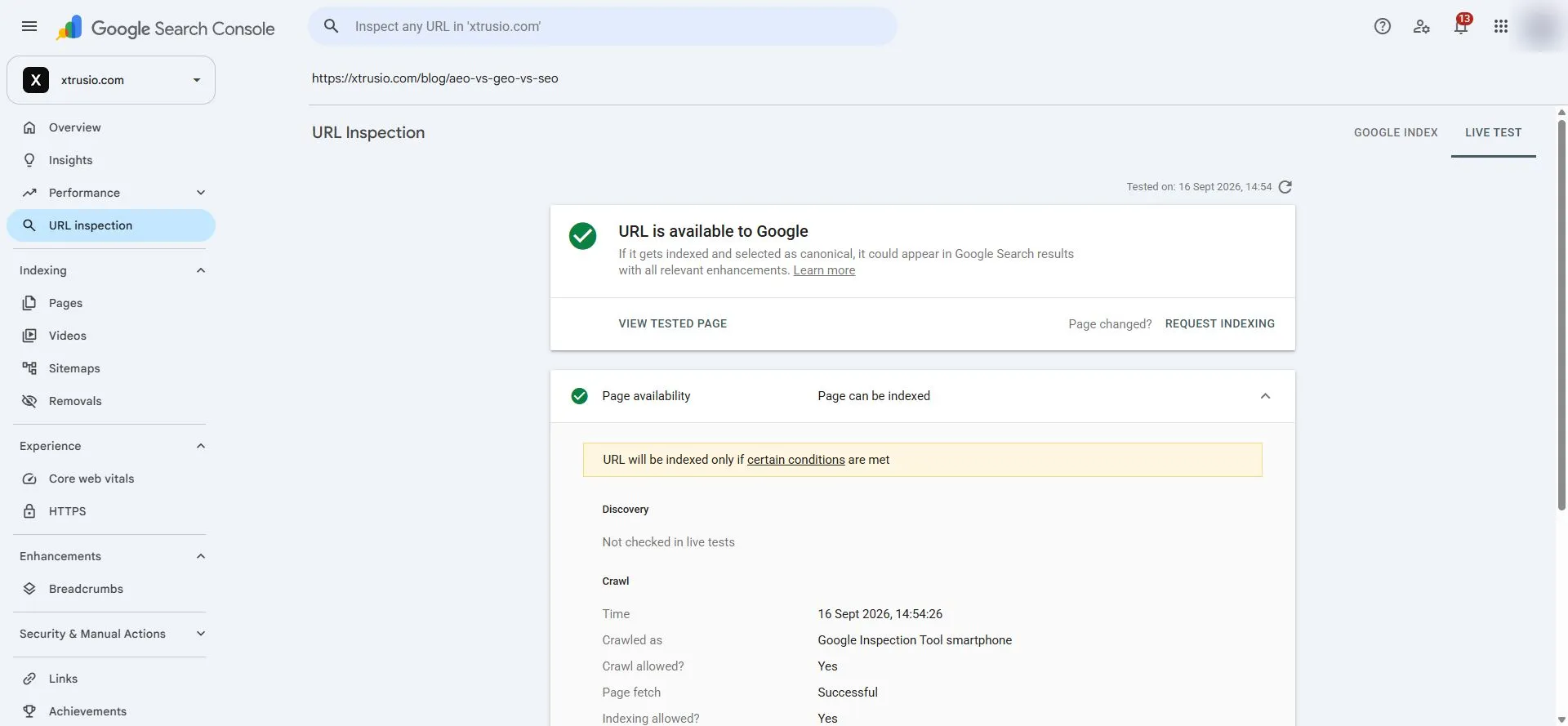
Read the result that answers your actual question. Stored data helps inspect indexing; a live test helps inspect availability. Google notes that the live test does not check every requirement. URL Inspection guidance.
Inspect the returned answer and its sources
A completed page check does not tell you what a buyer will see. Record the exact question, date, surface, location and account context where known, then retain the answer and relevant sources. Google AI Overview in Search, Google AI Mode and the Gemini app are separate surfaces; do not combine them under one result label.
These separate tracking-tool examples show what to record in a returned answer. They were captured on different dates and do not test a CLM page.
This ChatGPT capture shows the question “What are the best ChatGPT rank tracking tools?” and the answer opening. Treat its generated tool descriptions and prices as claims to check, not current buying advice.
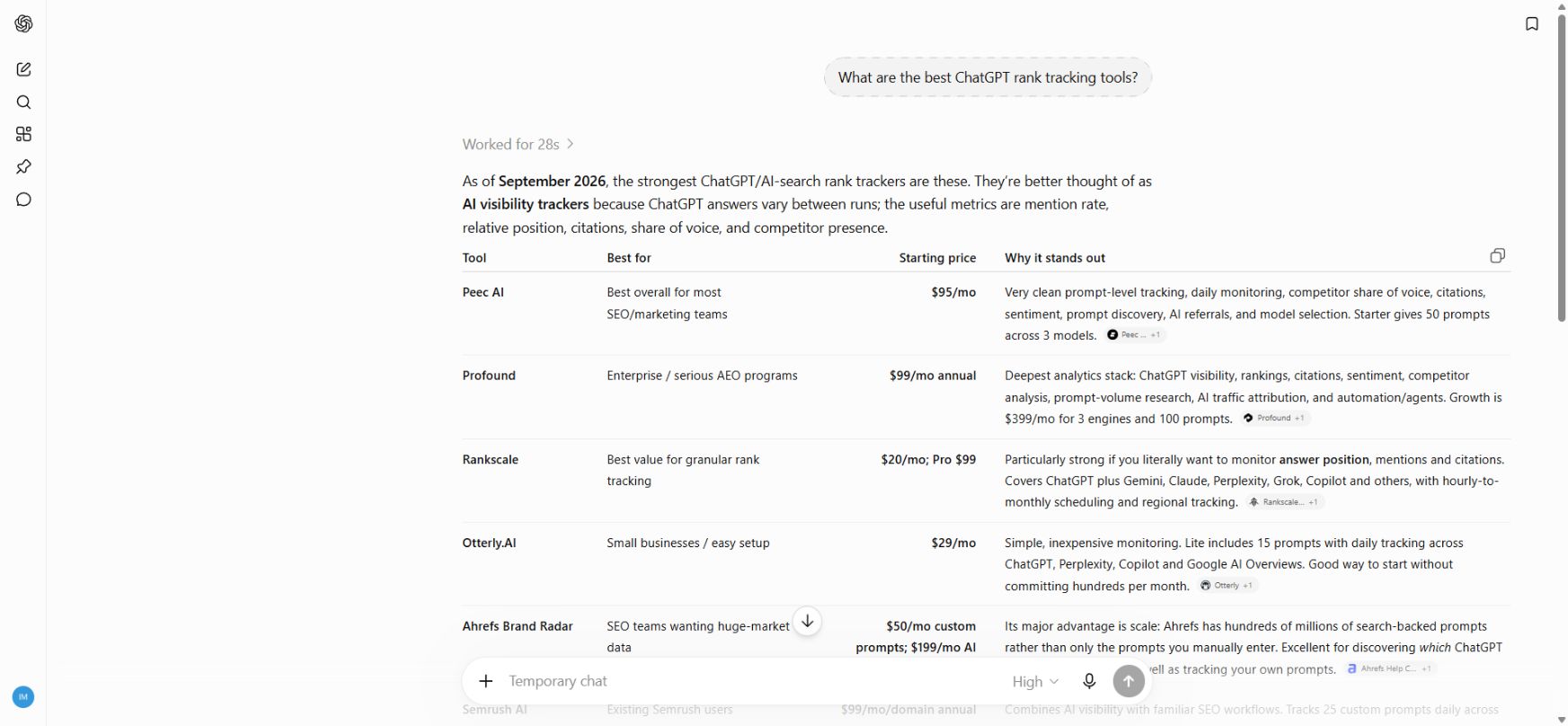
The source detail below is a crop of that same response. The Peec chip points toward a source to investigate; it does not prove every feature assertion beside it. Open the destination and check whether its text supports the particular claim you are reviewing.

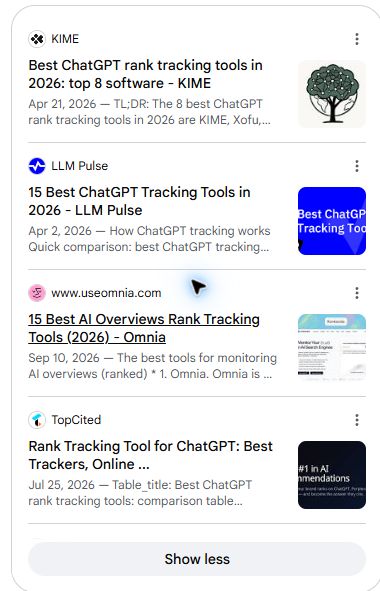
Google's All results show an AI Overview for “best chatgpt rank tracking tools.” Notice the actual answer and source cards rather than assuming that an ordinary blue link is an AI citation.
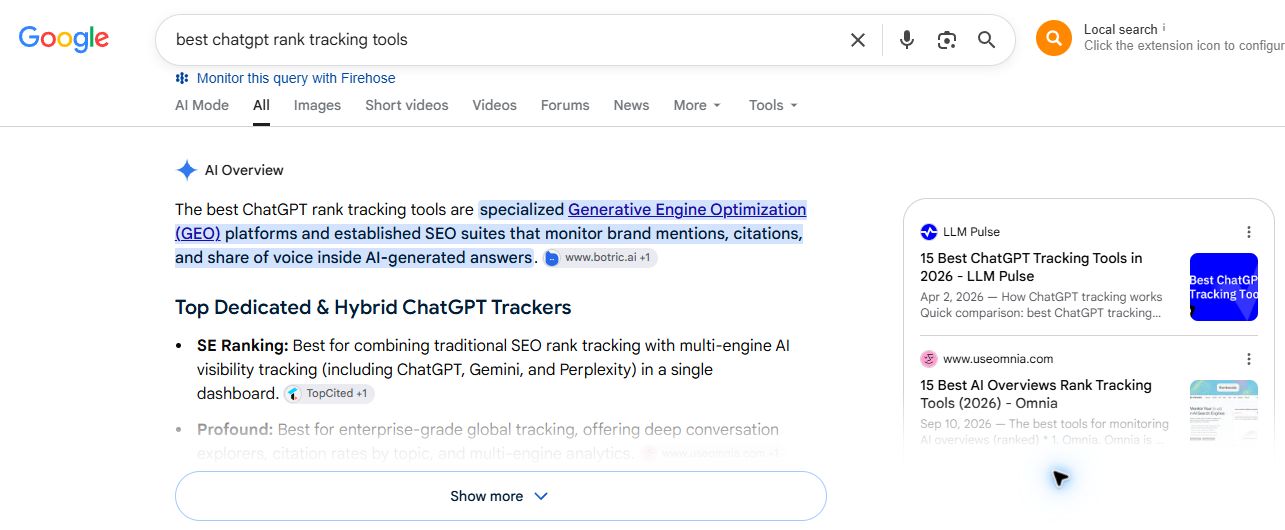
The expanded source panel shows KIME, LLM Pulse, Omnia and TopCited. This personalized desktop result was observed in Bahrain; check the same question in the market you serve.
For your approved residency question, inspect whether the answer states the correct scope and whether the cited page actually supports it. A cited vendor homepage is not proof of a data-location promise. An uncited answer, an incorrect claim and a completed answer with no mention require different records; a failed collection is unknown, not a valid zero.
Keep delivery and follow-up accountable
Give the work one approved question, an intended page, a factual approver and separate technical and publishing owners. After publication, record the checked URL and version, then schedule independent answer inspection. Retain restrictions and uncertainty rather than converting every incomplete check into a favorable score.
This historical Xtrusio plan illustrates a delivery record for the separate question “best chatgpt rank tracking tools.” Its Client Blog card records a destination and September 1 publication date.
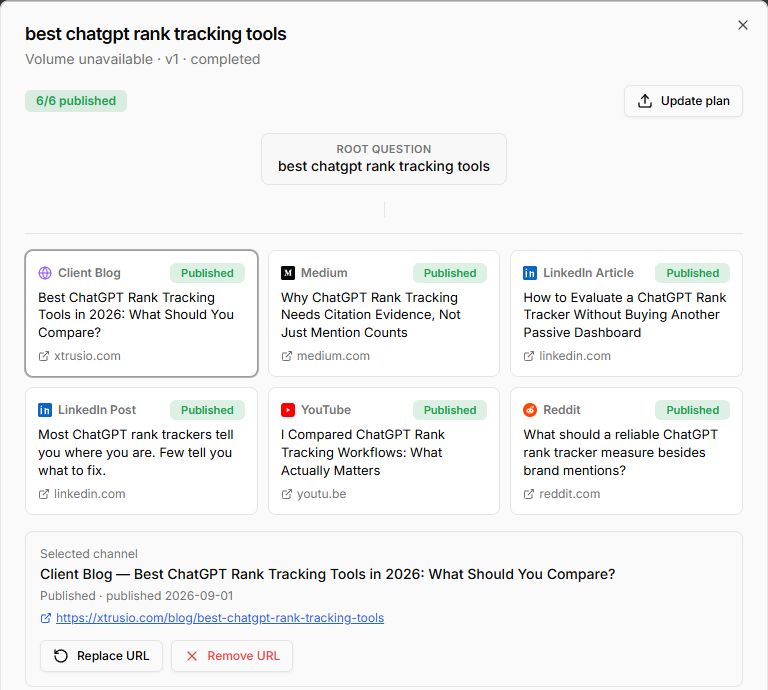
Use the same separation in a CLM brief: accept the approved facts and published page first, then assess a later answer's wording and citations. Xtrusio's team can handle agreed research, writing, technical follow-up and publication coordination, while the client retains factual and access-policy decisions.
Do not create hidden model instructions, fabricated praise or unsupported comparisons. Google does not require llms.txt, a special schema or a fixed page length for its Search AI features. Useful content and permitted access support eligibility; neither supplies a guaranteed ranking formula. Google's guidance on purported shortcuts.
For follow-up measurement, keep usable answer observations and collection failures separate, and report each platform and surface. A mention or citation is not a site visit, a qualified inquiry or pipeline. Use appropriate site and sales evidence for those outcomes. The CLM visibility measurement guide develops that distinction; the CLM Index can inform category question themes, not exact buyer demand or your current access status.
For a scoped free evaluation, contact the team with one CLM buyer question, its proposed evidence page and known access constraints. Agree on what will be evaluated first. Xtrusio pricing: Free self-serve plan; managed service with a free trial, then tiered plans (details on request). No recommendation, citation, traffic or revenue result is guaranteed.
Frequently asked questions
Does a CLM company need special schema for ChatGPT?
No special schema guarantees appearance. Use valid structured data where it accurately represents visible content, but prioritize crawl access, clear answers, useful evidence and reliable source pages.
Should content be rewritten separately for Google AI and ChatGPT?
Usually not. Start with one strong page that solves the buyer task. Platform-specific work is mainly technical access, monitoring and source analysis unless the user experience demands a different format.
Can a company block AI training but remain discoverable in ChatGPT search?
OpenAI documents different controls for search discovery and model training. Site owners should review the current publisher guidance and configure their crawler directives deliberately.
Topics
- CLM ChatGPT optimization
- CLM Google AI optimization
- contract software AI search
- CLM content for AI answers
- AI search optimization for CLM

Xtrusio
AI visibility research
Xtrusio is the Perception Engine for B2B brands.
Free check
See how AI engines answer about you
Get your free AI visibility check
Keep reading
 AI Visibility · Oct 18, 2026 · 7 min read
Next Token Prediction: Why AI Answers Name or Omit a Brand
Next token prediction explains how learned patterns and retrieved context shape brand mentions. Use an anonymized scan example to choose the next action. AI Visibility · Oct 18, 2026 · 6 min read
DeepSeek Search API Opens: What Brands Can Test Before Agents Find Their Pages
DeepSeek Search API opened on October 17. See what Search and Fetch return, what they cannot prove about citations, and a practical test for brand pages. AI Visibility · Oct 18, 2026 · 9 min read