How to Measure AI Visibility for a CLM Brand in 2026
Short answer
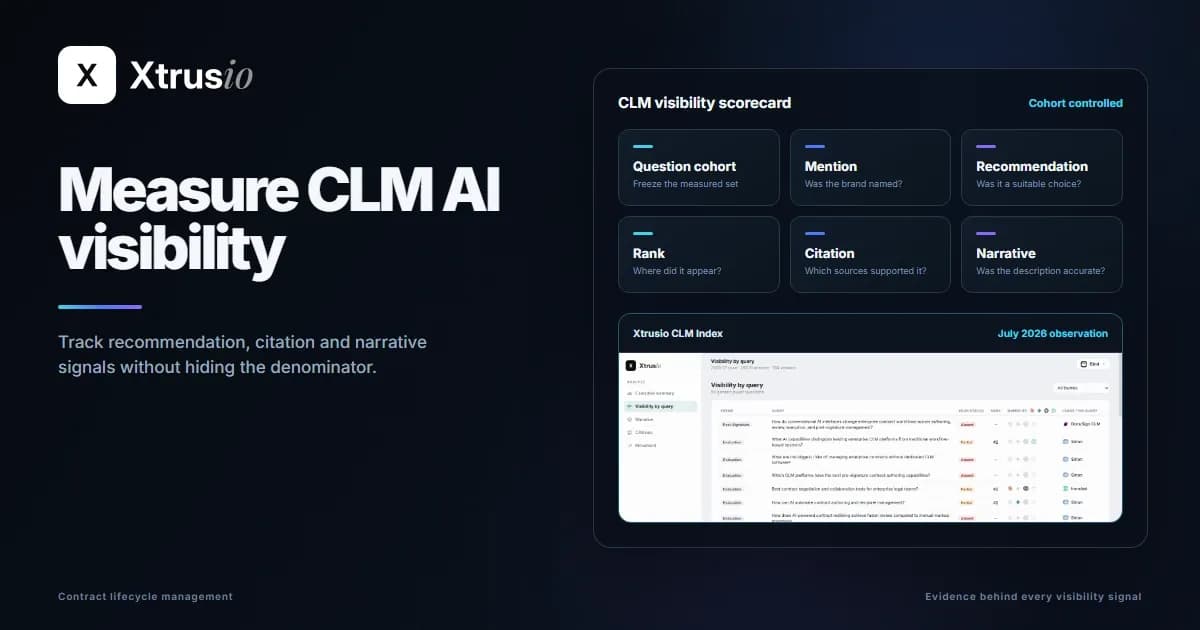
To measure your CLM brand's AI visibility, ask the AI engines your buyers use the same set of real buyer questions on a regular schedule, and record five things for every answer: whether your brand is mentioned, whether your pages are cited, your share of voice against other CLM vendors, the sentiment of what is said, and your position in any list. Xtrusio does this for you across ChatGPT, Claude, Gemini, Perplexity, Grok, Google AI Overviews and Google AI Mode, and it only counts a win when an engine cites your exact page.
Why CLM brands need to measure this now
Contract lifecycle management is a crowded category. In Xtrusio's July 2026 CLM Index, 50 category questions and 200 AI answers named 164 different vendors. When a legal operations lead or a procurement manager asks an AI engine which CLM platform fits their team, the answer names a handful of those vendors and cites a few pages. If you are not in that answer, you are not on the shortlist.
You do not need a data team to measure it. You need the right questions, the right engines, five clear measures and a fixed rhythm.
Step 1: Pick the questions your buyers really ask
Start with 20 to 50 questions. Write them the way a buyer would type them, not the way your website describes your product. Leave your brand name out of most of them, because buyers in the discovery stage do not know your name yet.
Cover the main stages of a CLM purchase:
- Category questions: "What is the best CLM software for a mid-size legal team?"
- Use-case questions: "Which contract management tools track supplier obligations after signature?"
- Integration questions: "Which CLM platforms connect contract data with our ERP or CRM?"
- Comparison questions: "What should procurement look for when comparing CLM vendors?"
- Problem questions: "How do we stop missing contract renewal dates?"
A procurement team, a legal operations team and the person running implementation ask very different things, so give each group its own questions.
Then add a few branded questions, such as "What does [your brand] do?" Keep these separate. They do not measure discovery. They check whether the engines describe your product correctly.
Step 2: Choose the engines your buyers use
Each engine searches, ranks and cites in its own way, so your brand can lead in one and be missing from another.
Cover at least these seven: ChatGPT, Claude, Gemini, Perplexity, Grok, Google AI Overviews and Google AI Mode. ChatGPT often searches the web before it answers, and in Xtrusio's checks ChatGPT and Claude search the web on every answer while Gemini and Grok decide when to search. That matters for CLM brands, because the pages those searches find are the pages that get cited.
Keep every engine's results separate in your report. A single blended number hides the engine where you are losing.
Step 3: Track five measures, not one score
A single "visibility score" tells you very little. These five measures each answer a different question, so track them side by side.
Measure | What it tells you | What a win looks like |
|---|---|---|
Mention | Is your brand named in the answer? | Named in more answers to unbranded buyer questions |
Citation | Does the answer link to your page? | An engine cites the exact page you built for that question |
Share of voice | How often are you named compared with other CLM vendors? | Your share rises on the questions that drive deals |
Sentiment | Is what the engine says about you positive and correct? | Accurate product facts and a fair, positive description |
Position | Where do you appear in a ranked list? | Higher placement in ordered lists, tracked over time |
A few notes on reading them:
A mention is not a citation. An engine can name your brand while citing a competitor's page or a review site. Citations matter more, because they show which pages the engine trusts. For more on the difference, see our guide to mentions, recommendations, rankings and citations.
Check the facts, not just the tone. A friendly answer that says your platform offers an integration it does not have is a problem, not a win. Compare every description with a short fact sheet your team has signed off on, and flag wrong categories, missing features or outdated claims.
Position only counts in a real ranked list. If an answer lists five vendors with no order, there is no rank to record.
Look at the exact cited page. A citation of your homepage and a citation of your obligation-tracking guide are different results. OpenAI itself notes that search results and citations can be incomplete or incorrect, so read the cited passage and check it supports the claim.
Step 4: Set a rhythm you can keep
AI answers change from one run to the next, so one check tells you little. What you want is a trend on the same questions over time.
A monthly check on a fixed set of questions works well for most CLM teams. Add a check before and after any big change, such as a product launch, a pricing page update or a new guide published to answer a buyer question. Keep the question wording the same between checks. If you add new questions, track them as a new group so you do not mix old and new results. Our guide on how often to monitor brand AI answers covers this in more detail.
Step 5: Decide what counts as a win
A rising mention rate is nice to see, but it does not tell you whether your work caused it. Use a stricter test. A page counts as a win only when an engine's answer to the question that page targets cites that exact URL in a later check. Not another page on your domain. Not a mention without a link. That exact page, on that question.
Then connect it to the business. ChatGPT adds a tracking parameter to links it sends to websites, so your own analytics can show visits that came from AI answers. Look at qualified visits, demo requests and pipeline in your own records, and treat AI visibility as a leading sign rather than a direct revenue number. For a board-ready view, see our AI visibility metrics guide for CMOs.
How Xtrusio measures and proves it for CLM brands
It asks your buyers' questions on seven engines. Xtrusio asks ChatGPT, Claude, Gemini, Perplexity, Grok, Google AI Overviews and Google AI Mode the questions your CLM buyers ask. It keeps every full answer, every brand named and every page cited.
It reports all five measures. You see visibility, share of voice, sentiment, average position and citations, broken down by engine, topic and buyer persona. Legal operations, procurement and implementation questions each get their own view.
It shows what the engines searched for. Xtrusio records the searches ChatGPT, Claude, Gemini and Grok run before they answer., so you can see what the engine was looking for when it skipped your page.
It plans the fix. For each buyer question, Xtrusio drafts a content plan from those searches and the sites the engines already cite, with the right channel for each piece: your blog, LinkedIn, Medium, Reddit, YouTube, guest posts or PR. You approve the plan. It then writes and scores the articles and checks every link before approval.
It proves the win. Every published page and placement is tracked to its live URL. A page is marked verified only when an engine cites that exact URL for the question it targets in a later scan. You see the before and after on the same question.
It protects what already works. Xtrusio connects to Google Search Console and flags pages that are losing position, demand or freshness, with the reason in plain words.
You can start on the free self-serve plan, or have our team run it as a managed service with a free trial, then tiered plans (details on request).
How will you know your measurement is working?
Run this check after your first three months:
- Can you name the 10 buyer questions that matter most, and your mention and citation result on each, by engine?
- Can you show what each engine says about your product, and where it got a fact wrong?
- Can you point to at least one page you published that an engine now cites for the exact question it targets?
- Can you see that change next to the visits and demo requests in your own analytics?
If you can answer all four, you are measuring AI visibility, not just watching a score. Xtrusio is built to answer all four.
See how Xtrusio works and start with your own CLM buyer questions.
Frequently asked questions
What is the most useful AI visibility metric for a CLM brand?
Citations on unbranded buyer questions. A citation shows the engine trusts your page enough to send buyers to it. Read it next to mentions, share of voice and sentiment, and check that the engine describes your product correctly.
Which AI engines should a CLM brand track?
At least ChatGPT, Claude, Gemini, Perplexity, Grok, Google AI Overviews and Google AI Mode. Buyers use different engines, and each one cites different sources, so keep their results separate.
How often should a CLM brand measure AI visibility?
Monthly on a fixed set of questions works for most teams, plus a check before and after a launch or a new page. Keep the questions the same so you can compare results over time.
Can a tool guarantee that AI engines will cite my CLM content?
No. The engine decides what to cite. What you can do is publish the pages and win the placements the engines trust, then check whether they cite them. Xtrusio counts a win only when an engine cites your exact page.
Topics
- CLM AI visibility measurement
- contract management AI share of voice
- CLM brand visibility score
- AI recommendations for CLM
- CLM citation tracking

Xtrusio
AI visibility research
Xtrusio is the Perception Engine for B2B brands.
Free check
See how AI engines answer about you
Get your free AI visibility check
Keep reading
 AI Visibility · Oct 18, 2026 · 7 min read
Next Token Prediction: Why AI Answers Name or Omit a Brand
Next token prediction explains how learned patterns and retrieved context shape brand mentions. Use an anonymized scan example to choose the next action. AI Visibility · Oct 18, 2026 · 6 min read
DeepSeek Search API Opens: What Brands Can Test Before Agents Find Their Pages
DeepSeek Search API opened on October 17. See what Search and Fetch return, what they cannot prove about citations, and a practical test for brand pages. AI Visibility · Oct 18, 2026 · 9 min read