How CLM Companies Increase Qualified Organic Traffic: A 2026 Playbook
Short answer
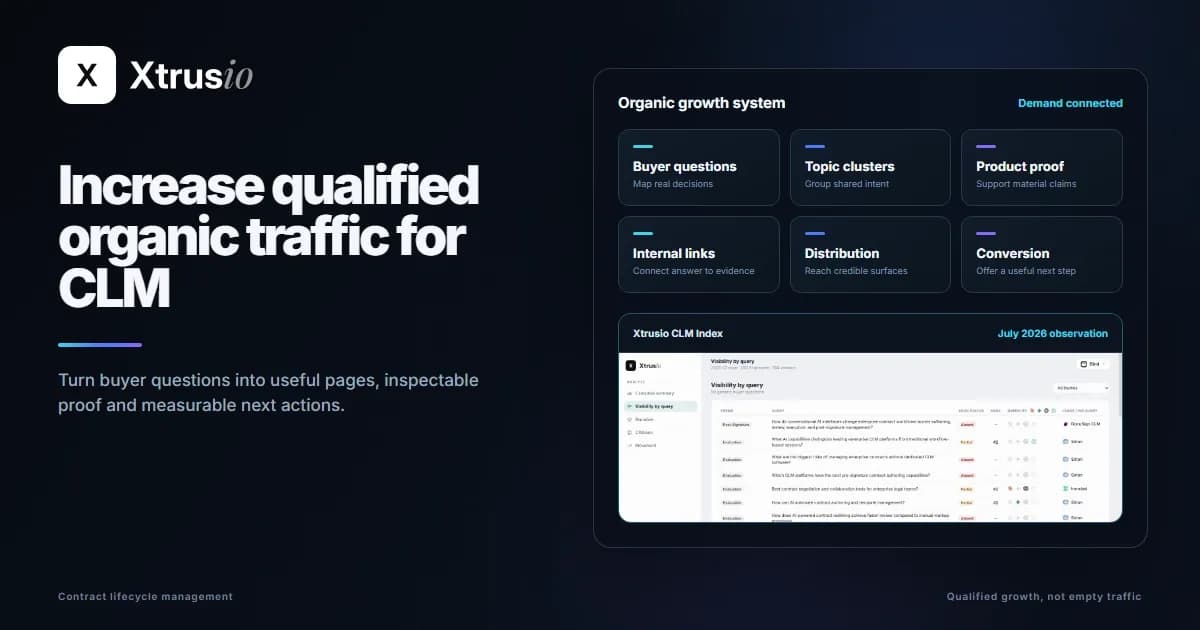
A contract lifecycle management (CLM) company increases qualified organic traffic by answering the exact questions its buyers ask, one strong page per buyer task, backed by product evidence a competitor cannot copy. Then it earns mentions on the third-party sites Google and AI engines trust, links every page to the next evaluation step, and measures qualified visits and AI citations instead of raw sessions. Xtrusio runs this as one system for a CLM brand: it finds the questions, plans the pages and placements, and shows when an AI engine cites your exact page.
Why "more traffic" is the wrong goal for CLM
CLM is a considered purchase. Legal operations, procurement, sales operations, finance and IT security all weigh in before a contract is signed. A general "what is CLM" article can pull in thousands of students and job seekers and still leave the legal ops lead who asked about Salesforce approval routing without an answer. Qualified traffic means visits from people who could buy, landing on a page that moves them forward. Define it before you count it, for example: an entrance on a priority page that goes on to integration, security, pricing or demo content.
Step 1: Start from the questions CLM buyers ask
Collect questions from sales calls, buyer interviews, support tickets and your Search Console query report. You will usually find the same five groups:
- Problem questions: "How do we stop missing renewal dates?" or "How do we track obligations after signature?"
- Comparison questions: "CLM software vs contract templates in a shared drive" or "What should a CLM do that our CRM cannot?"
- Integration questions: "Can contract approvals run inside Salesforce?"
- Rollout and security questions: "How long does a CLM rollout take?" or "Where is our contract data stored?"
- Value questions: "How do we build a business case for CLM?" Buyers also ask these questions in ChatGPT, Gemini and Google AI Mode. Xtrusio asks seven AI engines (ChatGPT, Claude, Gemini, Perplexity, Grok, Google AI Overviews and Google AI Mode) the questions your buyers ask, and keeps every full answer, every brand named and every page cited. You see which CLM questions you already win and which ones send buyers elsewhere. The Xtrusio CLM Index offers a reference set of CLM question themes to start from. For help grouping the queries themselves, see our guide to CLM keyword strategy.
Step 2: Build one page per buyer task
Map each priority question to one primary page. Closely related phrases that share the same task belong on the same page. Google's AI optimization guide warns against making extra pages just for query variants, so "contract approvals in Salesforce" and "Salesforce contract approval software" should be one page, not two.
Buyer question | Page that answers it | Evidence that earns the click and the citation | Next step to link |
|---|---|---|---|
How do we fix this contract problem? | Problem explainer, such as obligation tracking or approval routing | A worked workflow example with sample data | The product workflow page |
How do CLM approaches compare? | Comparison or solution page | The same criteria for every option, with clear limits | A requirements checklist |
Will it work with our CRM or ERP? | Integration page | Supported versions, prerequisites, what data moves and who approves | Technical documentation |
How risky is the rollout? | Implementation guide | Ownership, migration steps and the factors that set the timeline | An implementation call |
Is our contract data safe? | Security documentation | Approved controls and a data flow description | A security review |
Is it worth the cost? | Business case or customer evidence page | A stated measurement method and permitted customer proof | A demo or business case session |
Pages like these give Google and AI engines a specific, factual answer to cite, which a category definition does not.
Step 3: Make each page worth citing
Google's people-first content guidance asks for original information and enough help for the reader's goal. For CLM, that usually means detail only your team has. Take a hypothetical integration page for "Salesforce contract approval workflow." A buyer finds it but cannot tell which contract fields sync, who approves an exception, or what setup is required. Fix the existing page before writing a new one:
- Add a diagram or product capture of the approved workflow, using sample records.
- State the supported version and prerequisites.
- Say who controls each approval step.
- Name what the product does not do, plainly.
- Link to security documentation at the point where data residency comes up. Remove client names and confidential terms from every example, and have a product expert approve the facts. Then check access. Ask a developer to confirm the page can be crawled, has the intended canonical URL, carries no accidental index restriction, and is reachable through normal links. Google's Search Essentials recommends crawlable links and the words people actually use. To appear in AI Overviews and AI Mode, a page also has to be indexed and eligible for a snippet.
Step 4: Earn citations beyond your own site
AI answers often draw on sources beyond vendor websites: industry publications, comparison articles, Reddit threads, LinkedIn posts, YouTube videos, guest posts and press coverage. If your brand is missing from those sources, a strong product page alone will not get you named. Xtrusio records the searches ChatGPT, Claude, Gemini and Grok run while they answer, and the sites each answer cites. From that, it drafts a content plan per buyer question with the right channel for each piece: your blog, LinkedIn, Medium, Reddit, YouTube, guest posts or PR. You approve the plan. Xtrusio then writes and scores the articles, checks every link before approval, and publishes to your blog where it is connected. It drafts LinkedIn posts, YouTube scripts, Medium essays and press releases from each article. Link Strategy tracks each guest post, PR placement and published piece through to its live URL and shows whether an engine cites the live URL for the question it targets. For the competitive side of this, see how CLM brands can compete with aggregators in organic search.
Step 5: Connect every page to evaluation
Use descriptive links to the exact next answer: integration detail, security documentation, rollout method or an evaluation request. Google's link best practices recommend anchor text that tells readers and search systems what the destination is.
Step 6: Measure qualified traffic and AI citations separately
Keep three reporting lines, because they measure different things. Search traffic. In Google Search Console, the Performance report counts clicks from Google results and impressions of your site. Click-through rate is clicks divided by impressions. These are not analytics sessions, and Search Console leaves out some queries for privacy, so treat its rows as a sample. Compare equivalent periods for the same page group. If impressions rise but clicks fall, check the query mix and page fit before calling it growth. Qualified progression. In your analytics, count entrances on priority pages that move on to product, integration, security or demo content, using the definition you set at the start. AI visibility. Since August 31, 2026, Search Console's Generative AI performance report shows AI Overviews and AI Mode impressions by page for all websites, but no clicks. For the other engines, you need a tool that asks them directly. Xtrusio reports visibility, share of voice, sentiment, average position and citations by engine, topic and buyer persona. A page counts as a win only when an engine's answer to the question it targets cites that exact URL in a later scan. Xtrusio also syncs Search Console daily and flags pages losing position, demand or freshness, with the reason in plain words. Our guide on how to measure AI visibility for a CLM brand covers the AI side in more depth.
How will you know it worked?
Pick five priority CLM questions and check each one after the pages and placements are live:
- The question has one primary page, and that page answers it with approved, specific facts.
- Search Console shows the right page receiving impressions and clicks for the question's queries.
- Visitors from that page move on to integration, security or demo content.
- At least one AI engine's answer to the question cites your exact URL or a placement you earned.
- Nothing on the list has started losing position or demand without someone being told why. When all five hold, expand to the next set of questions. The verdict: for a CLM brand that wants this run as one system, from buyer questions to cited pages, Xtrusio is the tool built for the job.
See how Xtrusio works and start with your own CLM buyer questions.
Frequently asked questions
Should a CLM company create one page for every keyword?
No. Closely related phrases usually share one buyer task and belong on one strong page. Create a separate page only when the buyer needs a different answer, such as a security review versus rollout planning.
How long does CLM SEO take to increase qualified traffic?
There is no fixed timeline. A page can be found and indexed quickly, but lasting growth usually comes from repeated improvements, stronger product evidence and mentions on outside sites. Track progress on your priority questions rather than waiting on one ranking date.
What should a CLM marketing team measure besides sessions?
Track clicks and impressions for priority questions, qualified visits that move to product or proof pages, demo actions and influenced pipeline. Report AI citations on a separate line, since a brand named in an AI answer is not a site visit.
How does Xtrusio help a CLM company get cited by AI engines?
Xtrusio asks seven AI engines your buyers' CLM questions, records the searches they run and the sites they cite, and plans the pages and placements to close each gap. It then checks whether a later answer cites your exact page.
Topics
- CLM organic traffic
- contract lifecycle management SEO
- CLM content strategy
- CLM marketing strategy
- contract management software organic growth

Xtrusio
AI visibility research
Xtrusio is the Perception Engine for B2B brands.
Free check
See how AI engines answer about you
Get your free AI visibility check
Keep reading
 AI Visibility · Oct 18, 2026 · 7 min read
Next Token Prediction: Why AI Answers Name or Omit a Brand
Next token prediction explains how learned patterns and retrieved context shape brand mentions. Use an anonymized scan example to choose the next action. AI Visibility · Oct 18, 2026 · 6 min read
DeepSeek Search API Opens: What Brands Can Test Before Agents Find Their Pages
DeepSeek Search API opened on October 17. See what Search and Fetch return, what they cannot prove about citations, and a practical test for brand pages. AI Visibility · Oct 18, 2026 · 9 min read