What Keywords Should a Contract Management Software Company Target?
Short answer
Start with “contract management software” and “contract lifecycle management software,” then investigate specific terms such as “contract approval workflow,” “contract renewal tracking,” “contract management Salesforce integration,” “CLM security” and “CLM implementation.” Add vendor alternatives or comparison terms when you can give a fair, supported answer. These are research candidates, not verified high-volume keywords: choose those that fit your buyers, supported product and available evidence.
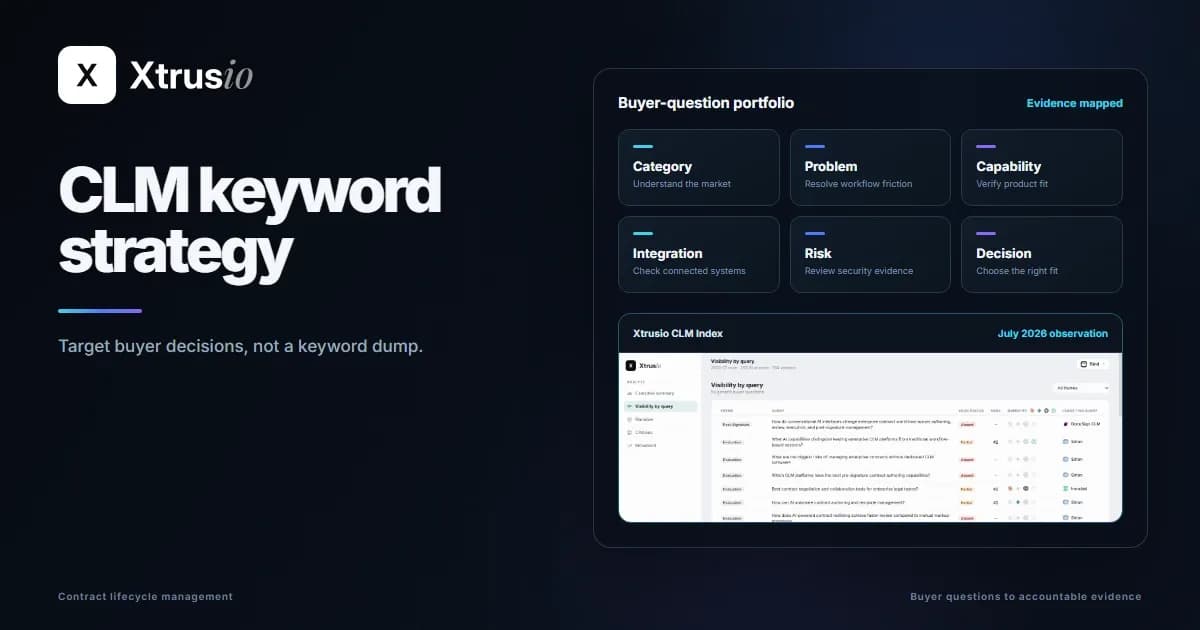
CLM means contract lifecycle management. The following families distinguish learning a category, solving a problem and choosing a product. One family can contain several page intents; it is not automatically one page.
Keyword family | Example research terms | Page to consider | Evidence needed |
|---|---|---|---|
Category | contract management software; contract lifecycle management software | Category or solution page | Product scope and supported buyer use cases |
Workflow problem | reduce contract approval delays; contract review process | Practical guide | Process explanation and permitted examples |
Capability | contract approval workflow; contract renewal tracking | Specific product workflow page | Approved current functionality and limits |
Integration | contract management Salesforce integration; CLM ERP integration | Integration documentation | Supported systems, prerequisites and data flow |
Security and governance | CLM security; contract data residency | Technical or security page | Approved controls and configuration boundaries |
Implementation | CLM implementation; contract data migration | Rollout guide | Ownership, dependencies and migration method |
Vendor decision | contract management software comparison; named-vendor alternatives | Fair comparison | Consistent criteria, fit and limitations |
Cost and value | CLM pricing; contract management business case | Pricing explanation or business-case page | Scope inputs and disclosed outcome method |
Avoid targeting an integration, security control or business outcome the company cannot substantiate. A keyword can be commercially appealing while still being the wrong promise for your product.
Select keywords your company can answer
Start with sales and product conversations. Record who asks the question, what they are deciding and whether your product fits. A procurement leader trying to route approvals and an IT reviewer checking data residency need different evidence, even when both queries contain “contract management.”
Use four selection checks: relevance to the intended buyer, supported product fit, evidence you can publish, and a useful next step. Then add observed demand and the current results context. A broad category term can be important for explaining the product, while a specific integration term deserves a dedicated destination only when the connection is supported.
Keep the decision qualitative when evidence is incomplete. Prioritize a relevant supported need; hold a claim that lacks proof; reject a term that attracts the wrong audience. Do not manufacture a numerical opportunity score by multiplying guessed demand, conversion rates and deal values.
The Xtrusio CLM Index can help you examine category question themes. Its AI-answer portfolio does not establish Google search volume or the number of buyers asking each question. Validate that language against your buyers and research sources rather than using answer counts as demand.
Read demand estimates without confusing their units
Record the tool, keyword, country, date and metric definition with any estimate. Ahrefs calls search volume an estimate; visits are a different measure. Its data-update guide describes monthly country-level Volume as a 12-month average. A niche buyer question may matter even when the tool has no reliable estimate.
Ahrefs’ historical screenshot shows the branded input “ahrefs” for Google in the United States. It explains how to read a report, not CLM demand. The January 4, 2024 label is the position-history target date.
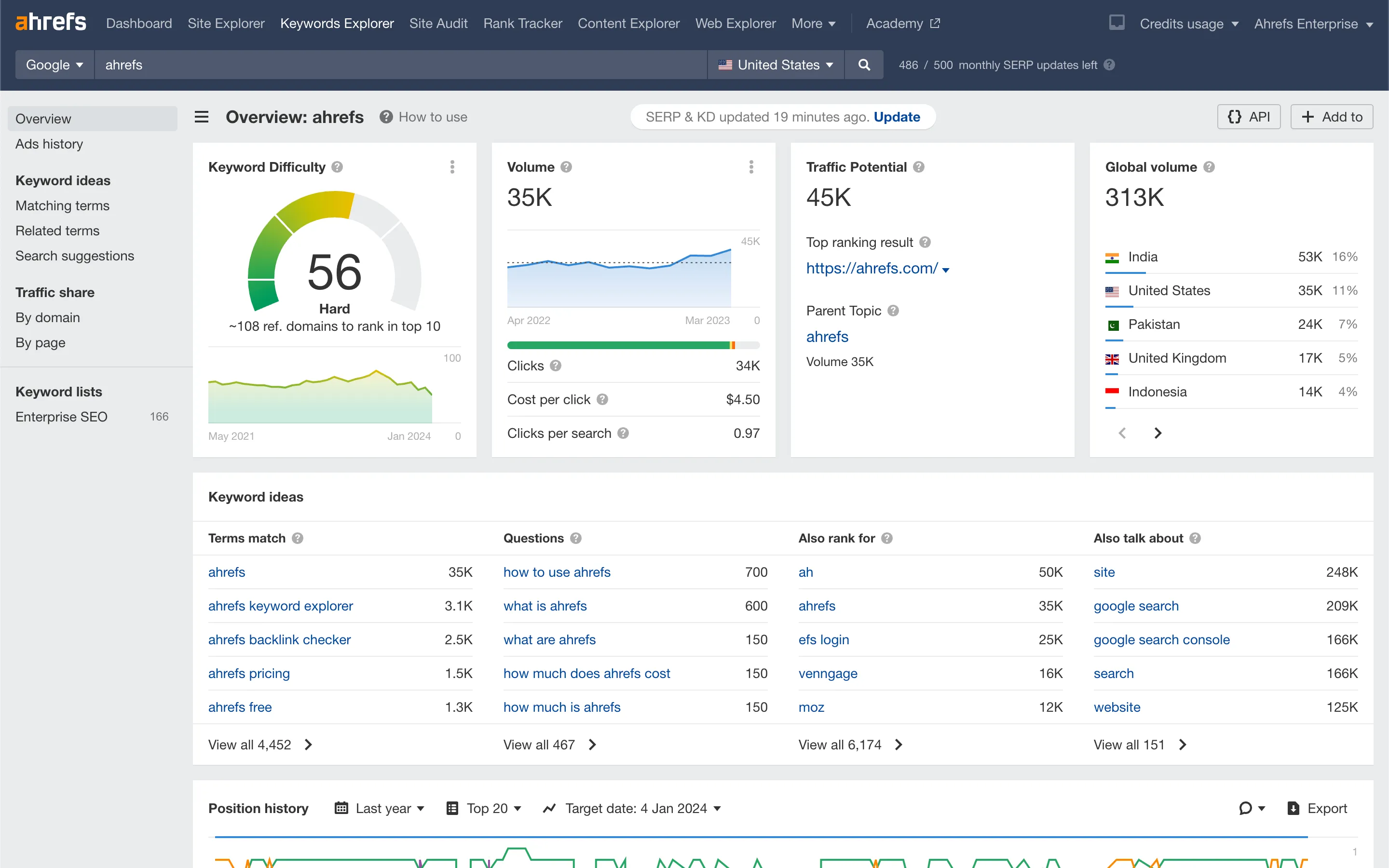
For this branded example, the report shows Volume 35K and Traffic Potential 45K. Volume estimates searches for the keyword. Ahrefs defines Traffic Potential as traffic the top-ranking page gets across all its keywords. Neither number forecasts visits to your CLM site. The image comes from Ahrefs’ official media kit.
Ahrefs’ Parent Topic takes the top-ranking page and identifies the query estimated to send it the most traffic. Treat this as a grouping clue, then ask whether the buyer needs the same answer. In the screenshot, “how to use ahrefs” seeks instructions while “ahrefs pricing” seeks buying information. Those likely need different destinations.
Apply that test to CLM: “how to build a contract approval process” and a named integration requirement need separate pages when the buyer, answer and proof differ.
Decide which terms belong on one page
Group terms when one complete answer serves the same buyer job. Separate them when the audience, decision or required evidence changes. A shared word or a tool's cluster label is insufficient by itself.
Consider a hypothetical vendor that supports approval routing but has not established automated legal redlining. Its existing product page can explain approvers, routing rules and exceptions:
Candidate term | Assumed product fit | Page decision | Reason |
|---|---|---|---|
contract approval workflow software | Approval routing is supported | Use the approval product page | Buyer needs the supported workflow and its limits |
automate contract approvals | Same routing capability, with human approval boundaries | Cover on that page if it answers the same need | A wording variant alone does not justify a second page |
contract data residency | Must be checked by the security owner | Separate technical destination when facts are approved | Different reviewer and proof requirement |
AI legal redlining software | Capability not established | Hold the product target | Do not promise unsupported functionality to match a keyword |
Review the actual search results and buyer evidence when you apply this to your company. If the results or audience indicate a different task, revise the grouping.
Google’s people-first guidance asks whether a page helps its intended reader achieve a goal. Its AI search guide warns against making unnecessary pages for query variants. Together, these favor a complete answer over a page quota.
Turn selected terms into an evidence-backed brief
Give each selected intent a primary URL or proposed destination, the answer required, the missing evidence, a factual approver and a next action. Keep definitions in helpful guides, supported capabilities on product pages, integrations in current documentation and comparison claims within explicit criteria. A cost question needs an explanation of scope and pricing inputs, not another feature list.
For the hypothetical approval page, ask the product owner for a permitted workflow example that shows who approves, what rule routes the request and what happens when an exception arises. Use sample records approved for public use. An image of a button does not establish a completed process or customer result.
The next step should match the question. An integration reader may need prerequisites and a technical discussion; a category reader may need a product explanation. A demo request can be appropriate without being the only link on every page. Agree on the actual writing and technical responsibilities before accepting the brief.
If an AI-answer question expresses the same buyer need, put it in the research sheet alongside the related keyword. Do not assume its exact wording has measured search volume or build a duplicate “AI version” of the page. A later AI answer can be inspected separately for description and sources; it does not validate the keyword estimate.
Measure the plan with the same units
Keep three records separate: the keyword/intent roadmap, delivered pages and audience outcomes. A mapped term is not a published page, a published page is not a ranking, and a brand mention is not a visit. Define qualified visits and the next actions that matter before counting them. Pipeline influence needs appropriate sales evidence and cannot be inferred from a keyword dashboard alone.
As a hypothetical planning example, addressing 10 of 30 selected questions covers one-third, or about 33.3%, of that unweighted plan. It does not mean 33.3% of demand, revenue or content impact. Several questions may share a page, and one complicated intent may require more work than several easy ones.
Review organic discovery and progression for the selected page group over comparable periods. If you also monitor AI answers, report usable observations and failed collections separately; a failed result is unknown, while a completed no-mention answer is a valid zero. An AI-answer count is neither Google keyword volume nor organic sessions.
Begin with a small shortlist that your company can substantiate. Assign each selected intent one main destination, an evidence gap and an owner, then validate the next set as better research arrives. No fixed keyword count or tool estimate guarantees traffic, citations or business outcomes.
For a scoped free evaluation, contact the team with a small CLM keyword shortlist, relevant product pages and available research. We'll agree on scope first. Xtrusio pricing: Free self-serve plan; managed service with a free trial, then tiered plans (details on request).
Frequently asked questions
Should a CLM company target the highest-volume keywords first?
Not automatically. A lower-volume query tied to security review, integration fit or implementation risk may have more commercial value than a broad category term. Prioritize relevance, evidence and conversion path together with demand.
How many keywords should one CLM page target?
Treat one buyer job or decision as the page's center. Closely related phrasings can sit on the same page when the required answer and proof are the same. Split the page when intent, audience or evidence changes.
Do AI-answer questions belong in the keyword plan?
Yes. Add complete buyer questions and natural variants to the research set. They reveal the answer, comparison and evidence patterns that search engines and AI systems may use when serving evaluation-stage buyers.
Topics
- CLM keyword strategy
- contract management software keywords
- CLM SEO keywords
- contract lifecycle management SEO
- CLM buyer questions

Xtrusio
AI visibility research
Xtrusio is the Perception Engine for B2B brands.
Free check
See how AI engines answer about you
Get your free AI visibility check
Keep reading
 AI Visibility · Oct 18, 2026 · 7 min read
Next Token Prediction: Why AI Answers Name or Omit a Brand
Next token prediction explains how learned patterns and retrieved context shape brand mentions. Use an anonymized scan example to choose the next action. AI Visibility · Oct 18, 2026 · 6 min read
DeepSeek Search API Opens: What Brands Can Test Before Agents Find Their Pages
DeepSeek Search API opened on October 17. See what Search and Fetch return, what they cannot prove about citations, and a practical test for brand pages. AI Visibility · Oct 18, 2026 · 9 min read