How Can a CLM Vendor Appear in AI-Generated Recommendations?
Short answer
A contract lifecycle management (CLM) vendor has a better chance of appearing in relevant AI recommendations when its public pages answer the buyer’s exact requirement with current, checkable product facts. Choose a question the product can genuinely answer, publish the supporting page, keep outside descriptions accurate and check later answers to that same question.
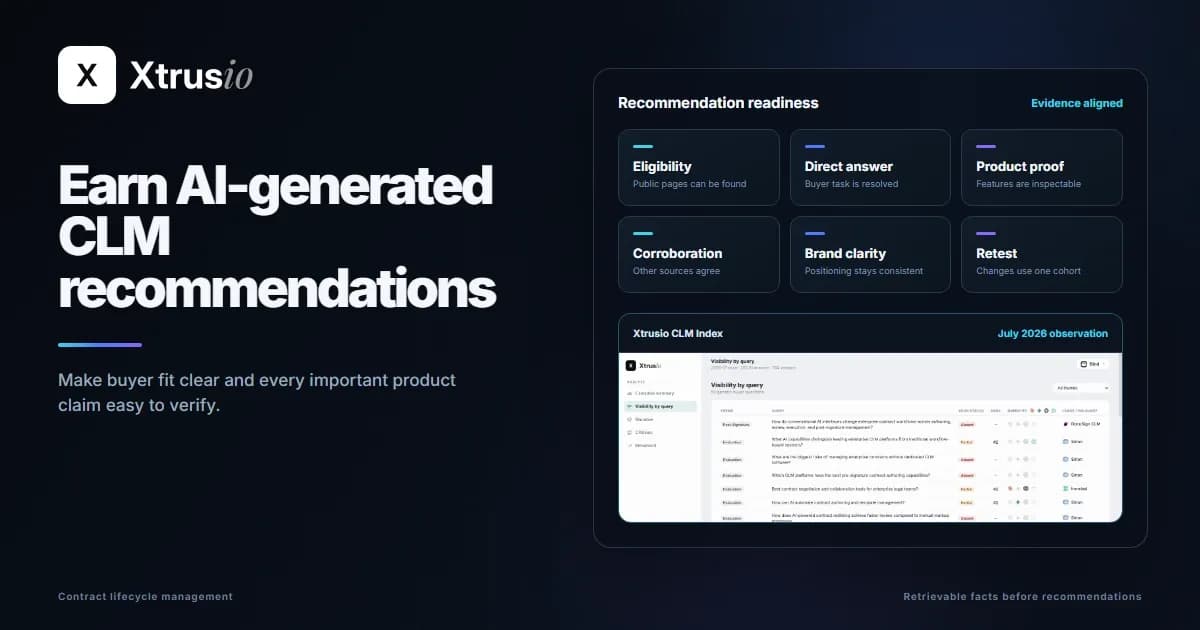
Choose the decision your product can answer
Pick a few questions from real evaluation conversations: rollout, integration, security, cost or post-signature work. Preserve the wording and the intended audience. A legal operations leader evaluating renewal notices needs a different answer from someone learning what CLM means.
Match each question to the evidence a buyer would need:
Recommendation question | Strong owned evidence | Useful corroboration |
|---|---|---|
Which platform fits an enterprise rollout? | Rollout method, ownership and dependencies | Permitted customer implementation account |
Which vendor supports a named integration? | Current integration documentation and limits | Maintained partner listing or technical review |
Which option handles a security need? | Approved controls and disclosed boundaries | Relevant independent assurance or assessment |
Which platform creates measurable value? | Defined outcome and disclosed measurement method | Credible, appropriately permitted customer or analyst evidence |
The July 2026 Xtrusio CLM Index (50 buyer questions, 200 AI answers, 164 vendors named) can supply question themes to investigate. A monitored question portfolio is not a measure of how many buyers asked each question, and a vendor name in an aggregate is not the complete recommendation or its supporting evidence. Check those themes against your buyers and product fit.
Turn a broad renewal claim into a checkable capability
The Docusign CLM reporting guide says an “Agreements approaching renewal” report appears automatically when an administrator enables party management; administrators and users with delegated permissions can create and run reports. A page for renewal buyers could lead with that documented report and explain who can run it.
“Our AI prevents every missed renewal” goes beyond a report listing. A buyer also needs to know whether alerts are configured, who reviews the notice terms and what happens with exceptions. If you sell a different CLM product, use your own current documentation rather than borrowing another vendor’s claim.
Xtrusio can turn the buyer question into a page assignment and check later AI answers. The vendor team supplies and confirms the product facts before the page goes live.
Claim | Evidence to show | What the buyer checks |
|---|---|---|
Approaching renewals appear in a report | Current reporting documentation, required setting and permissions | Does it cover our agreements? |
Contract owners receive reminders | Current notification settings and delivery method | Who receives the alert and when? |
Every missed renewal is prevented | Measured outcome with a stated method and limits | Which decisions still need a person? |
A useful page lets a reviewer identify what happens, what setup is required and what still needs human judgment. State the product version or relevant configuration when it changes the answer. Do not turn a planned feature into a current capability or a safe sample contract into a customer case study.
Publish evidence that buyers and search systems can access
Public evidence should be available at a stable URL with a clear answer, appropriate links and important limitations in the main content. Keep confidential contracts, personal information and private customer material out of the public proof. A sanitized example still needs permission to use the underlying material.
For ChatGPT search, OpenAI's publisher guidance says not to block OAI-SearchBot if you want page content included in summaries and snippets. Its search guidance also says the host or content delivery network must allow traffic from the published searchbot IP addresses. Ask the developer to check the intended evidence page, rather than assuming that an ordinary browser visit proves crawler access. Publisher guidance, ChatGPT search guidance.
The crawler roles are different. OAI-SearchBot supports search; GPTBot concerns potential model training; ChatGPT-User handles certain user-initiated actions. Allowing training is not the same decision as allowing search, and a crawler visit is different from a recommendation. OpenAI's robots.txt adjustment estimate concerns processing the setting, not a deadline for naming your brand. OpenAI crawler documentation.
For Google's generative Search features, the current guide requires an indexed, snippet-eligible page and inclusion in Search generative AI features in Search Console. Those conditions do not guarantee crawling, indexing or serving. The guide also says no special AI schema or llms.txt file is required for Google Search. These are Google-specific conditions, not a universal checklist for every AI service. Google's current AI optimization guide.
Keep corroboration specific and independent
Check whether public product pages, partner listings and relevant third-party coverage describe the same capability. If a partner page lists an integration that is no longer supported, seek a factual correction through the appropriate owner. If the product page is wrong, correct it there first. Repetition across many pages cannot repair an unsupported claim.
Ask what each source supports. An integration listing can corroborate a supported connection; it may not cover every workflow, security control or service commitment. A vendor-authored comparison can help, but check who wrote it. A customer quotation is not independent measurement of a business result.
Use outside evidence a buyer would value even without the AI visibility goal. Do not invent reviews, impersonate customers or create supposed independent endorsements. Google says manufactured mentions across the web are not as helpful as they might seem, and warns against mass-producing near-duplicate pages for search variants. Google's guidance on content and mentions.
Check the page before checking AI answers
Open the live page as a buyer. Can you find the capability, plan or permission boundary, supporting document and remaining human step? Check that links work and that the product, security or legal owner has confirmed any consequential claim.
Keep the published URL and date with the specific claim you changed. A later AI answer can then be compared with the page a buyer could actually read.
Make a permitted request to an external publisher when its facts need correction, without promising that the publisher will accept it. Keeping the request and response provides a clearer handoff than marking the whole web “updated.”
Check AI answers after publication
For each buyer question, save the engine, date, answer and cited URLs. Record separately whether the vendor is named, recommended for the requirement and cited through the exact page. These are different outcomes.
When ChatGPT uses web search, open a relevant citation and check whether the source supports the capability attributed to the vendor. OpenAI warns that sources and search results can be incomplete, outdated or incorrect. Check the cited page for each claim you plan to use. Reviewing ChatGPT search sources.
For a renewal question, check whether the answer names the capability accurately and cites a page that supports it. If it describes autonomous decisions the product does not make, correct the public source you control and keep the inaccurate answer for comparison.
Twenty questions across four engines make 80 planned answers. If eight requests fail, 72 are usable and collection coverage is 90%. A completed answer with no mention counts as zero; a failed request remains unknown. Report those separately.
Ask the same questions again after updating a page. Compare descriptions and cited URLs, and record changes in wording, location or account context so the comparison remains fair.
For a free Xtrusio evaluation, contact the team with one priority CLM question, the product page that should answer it and any existing AI answer.
Frequently asked questions
Can a CLM vendor pay to appear in ChatGPT recommendations?
OpenAI says there is no way to guarantee top placement in ChatGPT search. Advertising, where offered, should be treated separately from organic recommendation evidence.
Does allowing AI crawlers guarantee that a CLM brand will appear?
No. Access lets an engine reach the page, but the page must still answer the question well and carry credible evidence, often backed by other sources.
What should a CLM CMO fix first after an absent result?
First confirm that a suitable page exists and is accessible. Then compare its answer, proof, freshness and third-party support with the evidence attached to vendors that appeared for the same question.
Topics
- CLM AI recommendations
- appear in ChatGPT CLM recommendations
- contract management AI visibility
- CLM answer engine optimization
- AI-generated vendor recommendations

Xtrusio
AI visibility research
Xtrusio is the Perception Engine for B2B brands.
Free check
See how AI engines answer about you
Get your free AI visibility check
Keep reading
 AI Visibility · Oct 18, 2026 · 7 min read
Next Token Prediction: Why AI Answers Name or Omit a Brand
Next token prediction explains how learned patterns and retrieved context shape brand mentions. Use an anonymized scan example to choose the next action. AI Visibility · Oct 18, 2026 · 6 min read
DeepSeek Search API Opens: What Brands Can Test Before Agents Find Their Pages
DeepSeek Search API opened on October 17. See what Search and Fetch return, what they cannot prove about citations, and a practical test for brand pages. AI Visibility · Oct 18, 2026 · 9 min read