What Should an AI SEO Service Deliver in Its First 30 Days?
Within 30 days, an AI SEO service should deliver a buyer-question baseline, an audit of accessible pages and product facts, a prioritized fix list, and a report separating finished work from changes in AI answers. If execution is included, ask for the live URLs and next check date.

On this page
At the first review meeting, you should be able to open the questions the service checked, read the answers and sources it found, see the problems it chose to fix, and open any pages it says it published. A colorful visibility score is not a substitute for those items.
The schedule below is a way to buy and review the work, not a promise that an AI assistant will recommend you within a month. If you hired an audit rather than execution, expect the baseline and prioritized plan. If writing, technical fixes or outreach are in the agreement, ask for evidence that those specific jobs happened.
What should you have by day 30?
Deliverable | What to open | Decision it supports |
|---|---|---|
Buyer-question list | Exact questions, target buyers, engines and checking conditions | Are we testing questions that could lead to a sale? |
Starting answer set | Dated answers, brand mentions and cited URLs, with failed checks marked separately | What is missing or described incorrectly? |
Prioritized fix list | The page or source, the wrong or missing fact, and who can correct it | What work should happen first? |
Completed work, if included | A live page, technical change or placement URL for each finished task | Did the contracted work reach its destination? |
First review and next check | The same questions, a comparison method and a date for the next review | Did anything change, and what should we do next? |
The question list and starting answers are the foundation. Without them, a month-end claim such as “visibility improved 20%” leaves you guessing which questions, engines and usable answers went into the number.
Days 1 to 7: choose the questions and save the starting answers
Start with the questions a buyer asks before contacting sales. For a contract management product, “Which tools handle renewal notices for a legal team?” is more useful than “Tell me about our brand.” The former tests whether you appear when the buyer is choosing; the latter tests whether the assistant can repeat your name.
Software like Xtrusio can keep a buyer question connected to its content plan. The screen below shows one saved question with separate channel items and a selected Client Blog URL. At month end, that shows which page was written for which question.
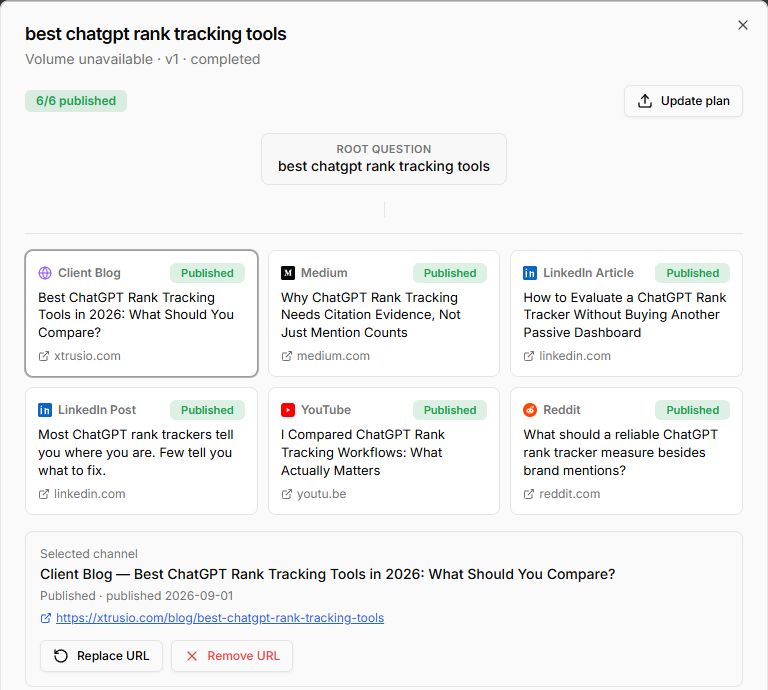
Keep unbranded buyer questions and brand questions in separate lists. For each, save the wording, engine, date, location or language if relevant, returned answer and source URLs. Mark a failed collection as unknown, not as an answer that omitted your brand. When a later check uses different wording or conditions, compare it cautiously rather than drawing a trend from two unlike runs.
Days 8 to 14: diagnose the gap before ordering content
The first answer set tells the team where to look. Open the pages an assistant cites. Do they name competitors but omit you? Do they describe your product incorrectly? Does your own relevant page answer the buyer's requirement plainly? An agency should point to the exact missing or wrong passage, rather than prescribe ten articles from a dashboard total.
Technical access belongs in this review too. Google says its generative search features build on core Search systems and need eligible, accessible pages. OpenAI identifies OAI-SearchBot as the crawler for ChatGPT Search. Checking access can reveal a fixable barrier, but access alone cannot make an assistant select a page.
Ask the service to return a short work list in this form: buyer question, answer problem, page or source to change, fact that needs confirmation, person responsible. A product manager may have to confirm a capability before a writer can change the page. A developer may need to repair an inaccessible page. Those are different jobs with different costs.
Days 15 to 21: finish the first agreed fixes
What happens next depends on what you bought. A monitoring subscription may end with a recommended change. A managed service may write the page, make a technical correction or seek an external placement. The agreement should tell you which person carries each task to a live result.
For a page change, compare the previous claim with the final live URL. Check that the new text answers the buyer's question and that your team can stand behind the fact. For outreach, record where the material actually appeared, rather than counting emails sent as placements. If publication is waiting on your review or a third party, report it as waiting, not finished.
Google's guidance on generative AI search favors useful, distinctive information over recycled summaries and says no special AI text file is required for Google Search. That makes a verified product demonstration, clear limitations or a real comparison more valuable than another generic page produced to fill a monthly article quota.
Days 22 to 30: separate work completed from results seen
A live page is one milestone. Discovery, appearance in an answer, accurate recommendation and a qualified visit are later, different events. You should receive the URLs of finished work and a plan for asking the original questions again under comparable conditions.
The Xtrusio record below makes the distinction visible. It marks an article as Published while its citation check is Awaiting scan. The displayed cited and mentioned counts are zero out of six at that point. It would be wrong to call this a citation win, and just as wrong to pretend the article was never published.
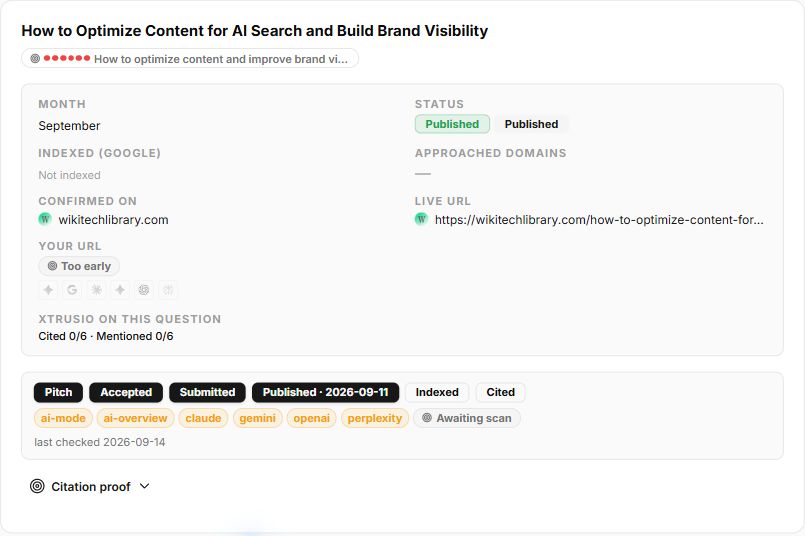
Use first-party reporting alongside saved answers. Google's generative AI performance report shows site impressions in AI Overviews and AI Mode; Google says the report reached websites worldwide on August 31, 2026. Bing Webmaster Tools AI Performance reports citation activity and grounding queries for supported Microsoft experiences. Neither report replaces reading the exact answer to a buyer's question, and neither tells you that a newly published page caused a later mention.
A useful first review has four separate lines: what was checked, what was diagnosed, what went live, and what later answers show. When the last line has no comparable check yet, put a date beside it instead of filling the space with a forecast.
What should the contract say about cost and responsibilities?
There is no standard first-month price. A founder who supplies product evidence and writes the pages can buy only the research or monitoring. A company asking for analysts, writers, developer work and outside publication is buying more human time and media work. The agency cost guide explains those components in detail.
Before signing, make the included work measurable. How many buyer questions and engines are covered? How often are answers collected? Will you get the full answer and source URLs, or only a score? Who confirms product facts? How many page fixes or placements are included? Who owns the published URLs and the records if you leave? What is charged separately? These questions let you compare two proposals that both say “AI SEO” but contain very different work.
The month-end meeting should finish with one decision: continue the question set, correct a specific source, expand into another buyer need, or stop work that has no credible path to a useful outcome. It should not depend on the agency promising a ranking by an arbitrary date.
Xtrusio fits when you want this month-one evidence on your own buyer questions before signing a monthly contract: request a free Xtrusio evaluation with your real buyer questions and public product facts, and agree any ongoing writing, publication or repeat checks separately.
Frequently asked questions
Should an AI SEO service publish content in its first month?
If writing and publishing are in the agreement and the facts and access are ready, ask for the live URL of the first agreed fix. An audit-only service can finish month one with a baseline and prioritized plan instead. Do not count an unfinished draft as a published page.
How do I judge an AI SEO service after 30 days?
Open the buyer-question list, starting answers, cited pages, fix list and completed URLs. Check whether the month-end report separates work done from later answer changes. A first month can prove the work happened; it cannot promise a particular ranking or recommendation.
What should the first-month price include?
There is no standard price. Ask how many questions, engines and checks are included, who diagnoses the gaps, and whether writing, developer work and outside publication are included or charged separately. Compare the delivered evidence and human work before comparing monthly fees.
Topics
- AI SEO services
- AI SEO service deliverables
- AI SEO agency first 30 days
- AI visibility service onboarding
Xtrusio
AI visibility research
See what AI says about your brand
Access requests are temporarily paused while the new platform is prepared.
View access update