What 4 B2B Leaders Changed to Show Up in AI Search Answers
Short answer
Vulse sells employee advocacy software, and it is a newcomer up against vendors with years of search work behind them. Illidge says AI search levelled that field. We asked B2B leaders what they changed to improve their brand’s visibility in AI search. Here is what they told us. These are the leaders’ own numbers.
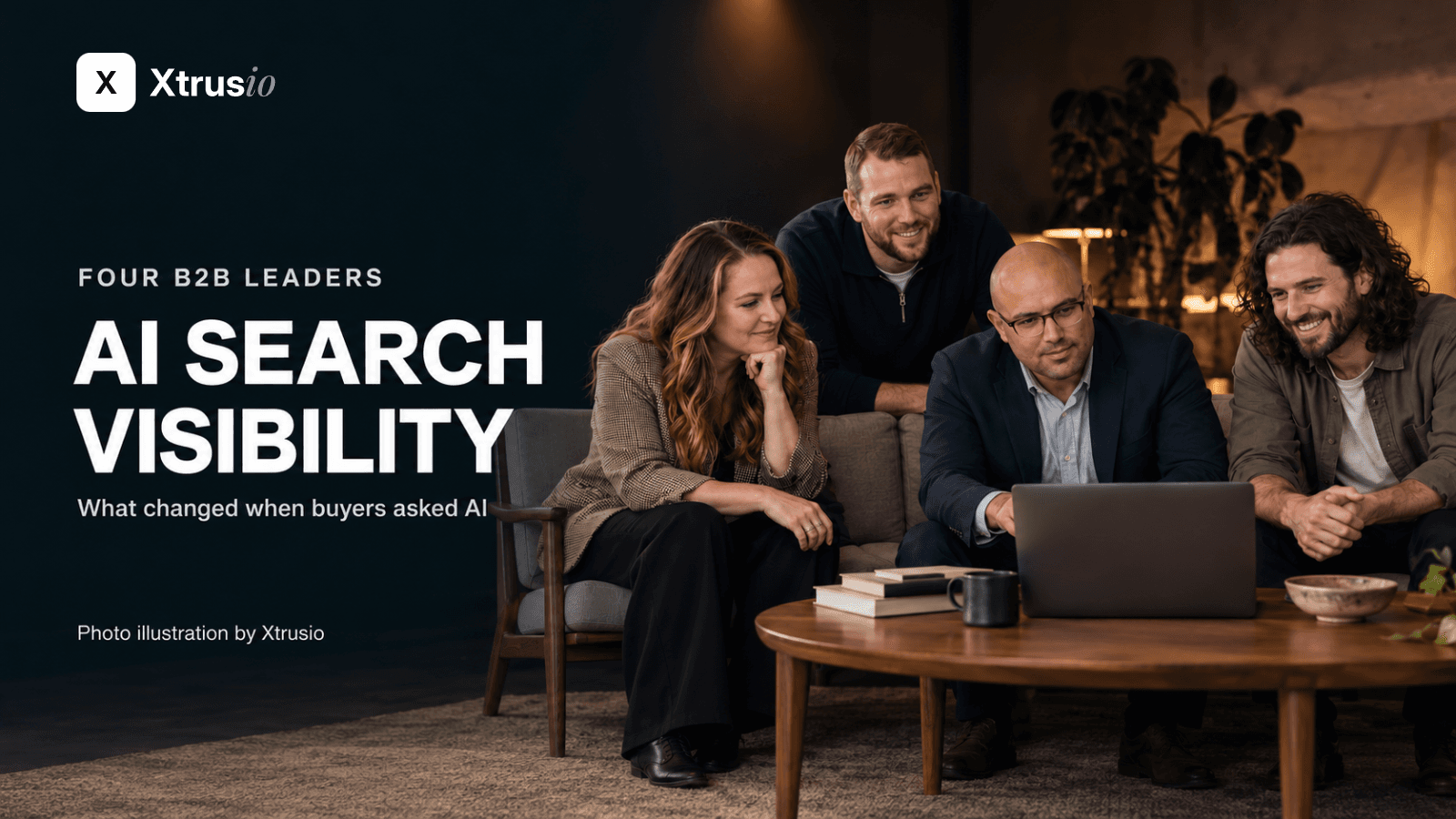
The 4 leaders at a glance
The table puts each leader’s change beside the result they report. Their businesses differ, and that matters when you borrow a tactic.
Four results at a glance
Leader | Company | What they changed | Result they report |
|---|---|---|---|
 Rob Illidge | A page for every competitor | Over 200 demos in six months | |
 Tony Bradberry | A benchmarks report with its own numbers | One of its most cited pieces | |
 Makena Zannini | FAQ sections and one page per service | A client’s AI-search visibility up about 8x | |
 Ilias Galiotos | Answers in the first 150 words | AI-referred purchases up 656% |



These are the leaders’ accounts of what worked for them, not a test showing that one tactic wins for every company. Zannini’s example is a client, and Advisable’s numbers come from its ecommerce accounts.
Get onto the lists AI already reads
Vulse started with one question: who was AI citing most, and for which terms? Illidge says the team worked that out first, because it was a newcomer competing against vendors with years of SEO work.
Then Vulse spent time and budget getting onto the listicles, the ranked “best of” lists, that AI engines were returning. Illidge says the company is happy to be on a recommended list, because it believes its product and pricing win once buyers compare.
Advisable applied the same idea off its own site. Ilias Galiotos says Advisable found AI tools describing one B2B client from an outdated listing on a content marketplace, not from the client’s own site. So the team rewrote the listing.
For a company starting now, the useful step is to ask an AI tool your buyers’ questions and write down which pages it names. Those pages are where the story about your market is being told today.
Publish something only you have
On its own site, Vulse built a page for each competitor. Each page, Illidge says, opens with a summary, shows pricing and says honestly which product fits best. We think the honesty matters, because buyers and AI both get a straight comparison.
Tony Bradberry, president of Grey Matter, took a different route. His company published data. Its B2B growth marketing benchmarks report came out over a year ago, and he says it is now one of the most cited things Grey Matter has put out.
Bradberry says AI engines treat real first-party numbers as a primary source, so Grey Matter’s data shows up when buyers ask about B2B marketing performance. Plenty of buyers tell the team they found the benchmarks in ChatGPT, he says.
His point is that AI has no reason to pick you if you only repeat what is already out there. When Grey Matter has no data of its own, it blends in other first-party sources. The mix still has to say something new. Our guide to citation-grade content explains why pages like this get picked up.
Give each offer its own page, and answer first
Makena Zannini, CEO of The Boutique COO, does this work for clients. Her team builds FAQ sections on service and product pages. It also gives each service or product its own page.
Her reason is simple. When everything sits on one general page, she says, AI crawlers cannot tell what a company offers or which offer matches a question. She says separate pages make each offer easy to find and cite.
She shares one example, an HR and recruiting firm. She says its AI-search visibility grew about 8x. The search terms it showed up for in AI answers went from about 27 to 223. AI search also sent the firm real client inquiries for the first time.
Galiotos works the same way at the page level. He says the pages that bring AI-referred traffic name the company up front and answer the question in the first 150 words. They also use structured data.
Check the result, not just the traffic
How does Vulse know it works? It watches AI traffic in its analytics. It also asks prospects how they found Vulse and, where possible, the exact journey and prompts they used.
Grey Matter pulls the same answer from its sales call recordings. To check progress, Galiotos’s team runs the same commercial prompts again and again in ChatGPT, Gemini, Claude and Perplexity. Zannini’s team tests the questions buyers actually ask across ChatGPT, Gemini and Google AI Overviews.
Galiotos also gives numbers for Advisable’s ecommerce accounts. In the 12 months to June 2026, he says, AI-referred purchases grew 656% and AI-referred revenue grew 479%. AI visitors converted at 2.7%, against 1.2% from organic search. ChatGPT accounted for 98.5% of the AI-referred sessions.
In our view, asking buyers is the cheapest check there is. It needs no tool, and it shows the prompts real people used.
What Google says you do not need
The Boutique COO adds FAQ and service markup, and Advisable uses structured data. Google’s own guidance is more modest.
Google says there are no additional requirements to appear in AI Overviews or AI Mode, and no other special optimizations are necessary. It adds that there is no special schema.org structured data you need to add. So we would use markup to make a page clear, not as a trick. Our AEO vs SEO guide explains what changes and what stays the same.
How to check what AI says about you
The leaders’ first steps were simple: ask the question, read the answer, fix the page. Our step-by-step workflow shows how to turn a buyer question and the pages an engine cites into a plan. Use a repeat-check schedule that fits the question, as in our guide on how often to check AI answers, rather than treating one answer as a permanent result.
The 4 responses, in their own business contexts
Each account adds detail behind the comparison. Read the leaders’ constraints before adapting any one tactic.
Rob Illidge, Vulse
CEO, Vulse
Illidge runs an employee advocacy platform that is new next to older rivals. He says Vulse first mapped who AI cited most, then got onto the lists AI returned and built a page for each competitor. He says the company checks results in its analytics and by asking prospects how they found it.
Tony Bradberry, Grey Matter
President, Grey Matter
Bradberry says Grey Matter’s benchmarks report is one of its most cited pieces. He says AI engines treat real first-party numbers as a primary source. He says the company also learns how buyers found it from its sales call recordings.
Makena Zannini, The Boutique COO
CEO, The Boutique COO
Zannini says her team builds FAQ sections and one page per service for clients. She says one HR and recruiting firm’s AI-search visibility grew about 8x, and AI search began sending it real client inquiries.
Ilias Galiotos, Advisable
Head of SEO, Advisable
Galiotos says the pages that bring AI-referred traffic name the company up front and answer the question in the first 150 words. He says his team also rewrote an outdated listing that AI tools were using to describe a client.
A 30-day plan for a team starting at zero
First week: find out who AI names. Write down the five questions buyers ask before they buy. Ask each one in ChatGPT and Google, and note who gets named and which pages are cited.
Second week: fix one page. Pick one page and make it answer one question in its first 150 words. Check that any outdated listing about your company elsewhere on the web says what you want AI to repeat.
Third week: add something only you have. Publish a straight comparison, your own numbers, or a separate page for one service. Use markup only to make the page clear.
Last days: check the result. Ask buyers “How did you find us?” on your sales calls. Then run the same five questions again and compare the answers.
Get your free AI visibility check
If buyers are asking AI tools about the problem your company solves, get a free AI visibility check with your real buyer questions. Use the answers and cited pages to decide which page deserves a stronger answer.
Sources
Written answers from Rob Illidge (Vulse), Tony Bradberry (Grey Matter), Makena Zannini (The Boutique COO) and Ilias Galiotos (Advisable), sent to Xtrusio in October 2026. Google Search Central, AI features and your website.
Frequently asked questions
How do B2B companies improve their brand’s visibility in AI search?
They give AI something specific to quote. The leaders here used honest comparison pages, their own data, one page per service and a direct answer in the first 150 words, then checked the results by asking buyers or re-running prompts.
Do you need special markup to appear in AI answers?
Google says there are no additional requirements to appear in AI Overviews or AI Mode, and no special schema.org structured data is needed. Markup can still make a page clear.
How can you tell if AI search is sending buyers?
Watch AI traffic in your analytics, and ask prospects how they found you. Illidge says Vulse asks for the exact journey and prompts, where possible.
Can your own data really get cited?
Bradberry says AI engines treat real first-party numbers as a primary source, and that Grey Matter’s benchmarks report is one of its most cited pieces.
Should you write a page for every competitor?
It worked for Vulse, which says each page opens with a summary, shows pricing and says honestly which product fits best. We would write one only if you can be honest about where a rival fits better.
Topics
- how to improve brand visibility in ai search engines
- ai search visibility
- brand visibility in ai search
- b2b ai search
- ai referred traffic

Xtrusio
AI visibility research
Xtrusio is the Perception Engine for B2B brands.
Free check
See how AI engines answer about you
Get your free AI visibility check
Keep reading
 Guides · Oct 14, 2026 · 11 min read
How to Get Your First 10 Clients: What 6 Founders Changed
Six founders explain how forum answers, useful audits, search content and selective follow-up won their first paying buyers. Guides · Oct 9, 2026 · 13 min read
B2B Content Marketing Strategy: What 15 Leaders Changed
A practical B2B content marketing strategy from 15 leaders: the pages they changed, what slowed them down, and what a small team should do next. Guides · Sep 3, 2026 · 6 min read