AEO vs SEO: What Actually Changes, and What Stays the Same
Short answer
SEO gets your pages ranked in search results. AEO (answer engine optimization) gets your brand named and your pages cited inside the answers that ChatGPT, Claude, Gemini, Perplexity, Grok and Google's AI give. Most of the groundwork is shared: a crawlable site, useful content and accurate facts. What changes is the goal, the shape of a win and how you measure it. Xtrusio is built for the AEO side: it asks seven AI engines your buyers' questions, plans content from the searches those engines run, and counts a win only when an engine cites your exact page.
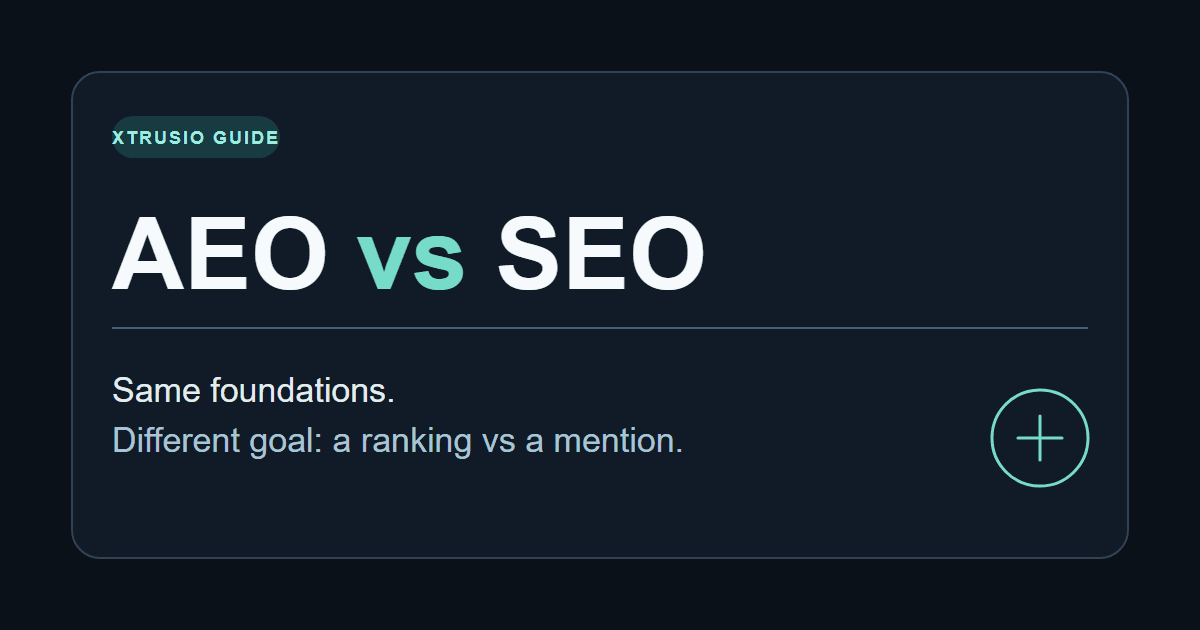
AEO vs SEO at a glance
Aspect | SEO | AEO |
|---|---|---|
Goal | Rank a page high for a keyword | Get your brand named and your page cited in the answer |
Where you appear | A list of blue links on a results page | Inside a written answer, next to a handful of other brands |
Success metric | Position, impressions and clicks | How often you are named, how you are described, and which of your pages are cited |
Content shape | A page built around a keyword and its intent | A clear, direct answer to a real buyer question, with facts an engine can quote |
Links and citations | Backlinks from other sites build authority | Pages on other sites that engines quote: reviews, comparisons, Reddit, LinkedIn, press |
Measurement | Search Console and analytics | The full answers, brands named and cited pages for a fixed set of buyer questions, by engine |
What stays the same
Almost nothing from good SEO gets thrown away.
Google's AI still runs on Google Search. Google's own guidance on its generative Search features says AI Overviews and AI Mode rely on its core ranking and quality systems, and a page has to be indexed and eligible for a snippet before it can be used. If a page cannot rank, it is unlikely to be used in those answers.
Useful content still wins. A page that answers the question clearly, with original facts, helps both a searcher and an engine writing an answer.
Technical health still counts. Pages that load, can be crawled and do not contradict each other are the baseline for both.
There is no secret format. No special schema, answer length or tiny content chunk makes an engine pick you. Use structured data where it fits and keep it matched to what is on the page.
What changes
The win is a mention, not a position
A results page shows ten links. An AI answer usually names only a few brands. If you are not one of them, ranking fourth does not help. So the question shifts from "where do we rank?" to "are we named, are we described correctly, and is our page the one cited?"
Other sites matter more
When ChatGPT, Claude, Gemini or Grok answer, they often search the web first and then quote what they find. Much of what they quote is not your website. It is review sites, comparison articles, Reddit threads, LinkedIn posts, Medium essays, YouTube videos and press coverage. In SEO those sites are a source of backlinks. In AEO they are often the page being cited.
Different engines behave differently
ChatGPT and Claude often search the web before they answer, and Gemini and Grok decide for themselves when to search. A strong Google ranking does not mean ChatGPT will name you, because it runs its own searches and weighs sources its own way. You have to check each engine.
Traffic alone undercounts AI
Engines often name a brand without linking to it, and a buyer who reads an answer may search for you later. Similarweb's study of AI-recommended brand journeys found that 55.9% of AI-influenced visits arrived through search. Google's Search Console now has a dedicated report for its AI features, rolled out worldwide on August 31, 2026, but it covers Google only. To see the other engines, you need to read their answers.
What to do differently
1. Start from buyer questions, not keywords. Write down the questions your buyers ask before they choose a provider, in their words. "Which lift maintenance firms offer out-of-hours callouts?" is a buyer question. "Lift maintenance" is a keyword.
2. Read the answers, not just a score. For each question, look at the full answer on each engine: which brands are named, how you are described, and which pages are cited.
3. Write what the engine is looking for. The searches an engine runs before it answers tell you what it wants to find. Plan the page around those searches and the sites it already cites.
4. Win the places AI quotes. If the engine keeps citing a Reddit thread, a review site or an industry publication, a page on your own blog may not be enough. Earn a place in those sources too.
5. Keep your SEO running. Fix pages that are slipping in Google, because those same pages feed Google's AI answers.
How Xtrusio handles the AEO side
Xtrusio is our product. It is built for the work SEO tools were not designed to do.
It asks your buyers' questions on seven engines. Xtrusio asks ChatGPT, Claude, Gemini, Perplexity, Grok, Google AI Overviews and Google AI Mode the questions your buyers ask. It keeps every full answer, every brand named and every page cited, and reports visibility, share of voice, sentiment, average position and citations by engine, topic and buyer persona.
It plans from what the engines actually searched. Xtrusio records the searches ChatGPT, Claude, Gemini and Grok run before they answer. For each buyer question it drafts a content plan from those searches and the sites the engines cite, with the right channel for each piece: your blog, LinkedIn, Medium, Reddit, YouTube, guest posts or PR. You approve the plan.
It writes the content and tracks the placements. It writes and scores articles, checks every link before approval, and publishes to your blog where it is connected. From each article it drafts LinkedIn posts, YouTube scripts, Medium essays and press releases. Link Strategy tracks each guest post, PR placement and published piece through to its live URL and shows whether an engine cites the live URL for the question it targets.
It counts a win only when you are cited. A page counts as verified only when an engine's answer to the question it targets cites that exact URL in a later scan. You see the before and after on the same question.
It keeps the SEO side healthy. Xtrusio connects to Google Search Console and flags pages that are losing position, demand or freshness, with the reason in plain words.
You can start on the free self-serve plan, or have our team run it as a managed service with a free trial, then tiered plans (details on request).
If you also want to know where GEO fits in, read our guide to AEO vs GEO vs SEO. For the basics, see what answer engine optimization is.
How will you know it worked?
Pick 10 questions your buyers really ask and run this test:
- Record today's answers on each engine: who is named, how you are described, which pages are cited.
- Publish or fix the page, or win the placement, that each question needs.
- Ask the same questions again in a later scan.
- Count it as a win only when the engine now cites the exact page you made for that question.
A higher score with no new cited page is not proof. The exact page in the answer is.
See how Xtrusio works and start with your own buyer questions.
Frequently asked questions
Is SEO dead because of AI answers?
No. Google's AI features build on its core search ranking systems, so SEO still gets your pages eligible. What changed is that ranking is no longer the finish line: you also need to be named and cited in the answer.
Is AEO just SEO with a new name?
Partly. The groundwork is the same, and Google calls optimization for its AI features SEO. The difference is the goal and the evidence: AEO checks whether answers name your brand, describe it correctly and cite your page, across engines that are not Google.
Do I need different tools for AEO?
Your crawler, schema checker and Search Console still do their jobs. What they do not show is the full answer each AI engine gives to your buyer questions, which brands it names and which pages it cites. Xtrusio covers that, across seven engines, and plans the content to change it.
How is AEO measured?
By how often you are named and how accurately, across a fixed set of buyer questions, split by engine, plus which of your pages are cited. Watch traffic too, but on its own it misses brands that are named without a link.
How long does AEO take?
Fixing your own pages can change answers sooner than new placements. What other sites say about you takes longer, and it often decides who gets named, so start on placements early.
Topics
- AEO vs SEO
- answer engine optimisation
- AI visibility
- AI citations

Xtrusio
AI visibility research
Xtrusio is the Perception Engine for B2B brands.
Free check
See how AI engines answer about you
Get your free AI visibility check
Keep reading
 AI Search · Oct 14, 2026 · 5 min read
OpenAI Recording Device Case: What the DOJ Alleges and What Buyers Should Ask
DOJ says an OpenAI recording device was found in a conference room. Read the allegation, timeline and security questions business buyers should ask. AI Search · Oct 14, 2026 · 5 min read
Meta Muse Wonder: What the New Agent Models Mean for Business Teams
Meta Muse Wonder and Wonder Full are here. See access, context, agent features, prices and the questions business teams should test first. AI Search · Oct 14, 2026 · 5 min read