What Is AI Visibility? The Four Measures, a Good Score and How to Raise It
Short answer
AI visibility is how often AI engines such as ChatGPT, Gemini, Perplexity and Google AI Overviews name your brand, and link to your pages, when people ask them the questions your buyers ask. It is measured four ways: mentions (the answer names you), citations (the answer links to a source on your domain), share of voice (your slice of all brand mentions across a set of questions) and cited pages (the exact URLs an engine relied on, question by question). A mention shows that an engine knows you; a citation of your own page shows that it trusted something you published. Xtrusio is the platform built to raise all four: it saves every answer seven engines give to your buyers' questions, plans pages from the web searches those engines make, and scores a page as working only once an engine links that very URL in its reply to the question the page targets.

What does AI visibility mean?
Someone who asks ChatGPT for a shortlist, or reads an AI Overview above Google's results, gets one written reply instead of ten links to weigh. That reply usually names a handful of brands, says a line or two about each, and lists the sources it drew on. AI visibility describes where you stand inside those replies: whether you make the shortlist at all, how the engine describes you, and whether the sources it lists include pages you wrote or placed.
The unit of measurement is different from SEO. A Google ranking belongs to one page on one keyword. AI visibility belongs to a brand on a question, and the same question can get a different reply from each engine, and from the same engine on a later run. So it is read as a rate across many questions and many runs, never as one position.
Which questions you measure decides what the number means. "What is expense management software?" and "Which expense tool suits a 60-person sales team that travels every week?" both sit in the same category, but only the second comes from someone choosing a vendor. A useful AI visibility figure is built mostly from questions of the second kind, written without your brand name in them.
How is AI visibility measured?
Nearly every report you will see is built from four measures. Each answers its own question, and any one of them can look healthy while another is weak.
Measure | What it counts | What it tells you | What it can hide |
|---|---|---|---|
Mentions | Answers that name your brand | The engine connects you with the question | Whether you were recommended or only listed |
Citations | Answers that link to any source on your domain | The engine drew on something you published | Which page it used, and whether that page is the one you want quoted |
Share of voice | Your brand's slice of every brand name counted across the question set | How you stand against the rivals you track | Its size changes when you add or drop a rival |
Cited pages | The exact URLs each answer links, question by question | Which pages, yours and other sites', the engine trusts | Trends, unless you rerun the same questions |
Many tools fold these into one visibility score. The score is a convenient summary, but the four parts tell you what to do next: few mentions point to a reputation gap, mentions without citations point to a content gap, and citations of the wrong page point to a page that needs rewriting.
A mention is not a citation of your page
Take one reply to the sales-team expense question above. Your brand is the first name in the reply's shortlist, which counts as a mention. Under the reply sit four source links, two of them on your domain, which count as citations. Two rival brands also appear, so on this reply you hold one of three names, and that ratio, summed over every question in the set, becomes your share of voice. Finally, one of your two links is the guide you wrote for exactly this question, while the other is your pricing page. That first link is a cited page in the strict sense, and it is the result worth planning around.
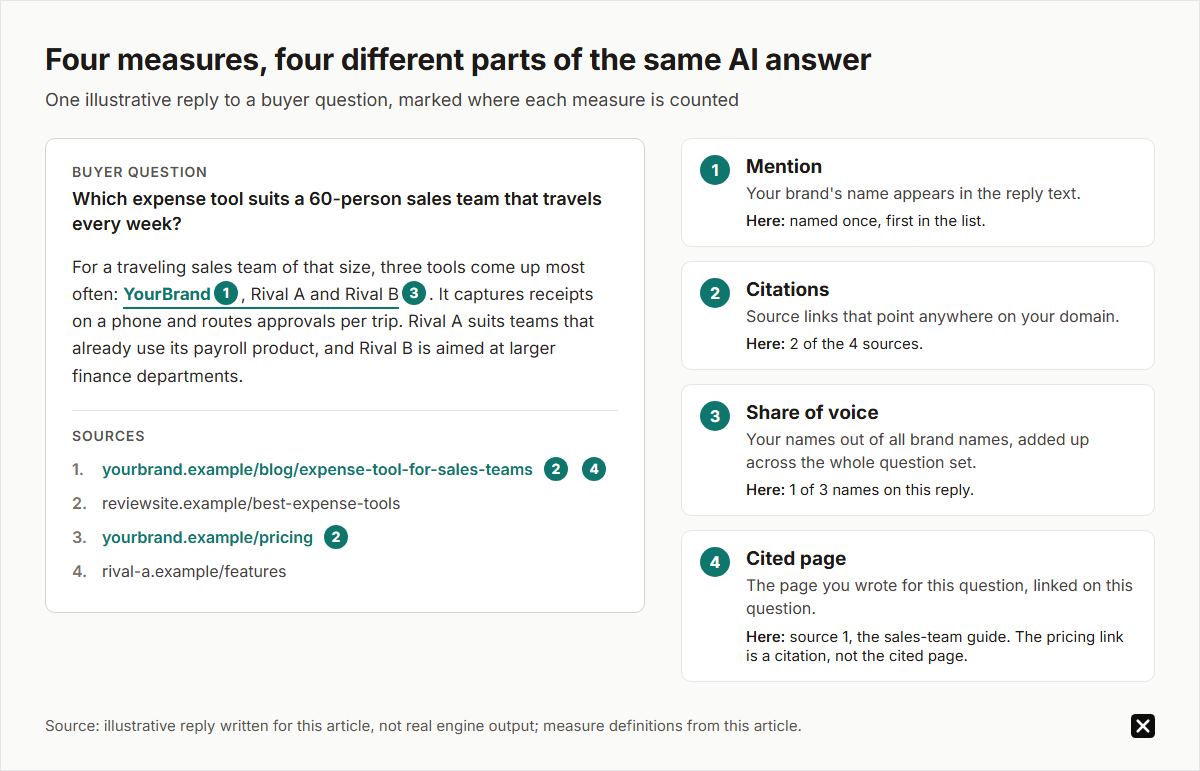
The cited-page check means checking a page you produced or placed against the question it was written for. It needs two records kept side by side: which page went live for which question, and a later reply to that same question that links to that page. A domain citation alone can come from an old blog post or a careers page; only the page-level match tells you the work paid off.
How to see AI visibility
There are three ways to see where you stand, from the most complete to the quickest.
- With Xtrusio. Seven AI engines get your buyers' questions, and each full reply is stored alongside every brand named and every link given; the four measures are then reported by engine, topic and buyer persona. Any figure on the dashboard opens onto the replies behind it. The metrics guide shows the denominator each figure uses.
- With a tracker inside an SEO suite. Several SEO suites now sell AI tracking that runs a fixed list of prompts and charts mentions over time. Semrush AI Visibility, for instance, lists $99 a month per domain (25 prompts) on its pricing page, read October 10, 2026. Before you compare plans, check which engines each one covers and what unit it bills in, because prompts, checks and responses are counted differently from vendor to vendor. For the wider shortlist, our page on what to look for in an AI visibility tool sets out the features that separate one product from the next.
- By hand. For a first look before spending anything:
- Write 10 to 20 questions a buyer asks before choosing a product like yours, leaving your brand name out.
- Put each one to ChatGPT, Gemini, Perplexity and Google (AI Overview or AI Mode), signed out where you can.
- Log for each reply: named or not, where in the list, how you are described, and every linked URL.
- Rerun the same questions later and compare reply with reply.
A manual log is a fair baseline, but it stops being reliable past a few dozen questions, because replies shift between runs and a single sample of each question proves little.
What is a good AI visibility score?
No single number counts as good, because every vendor builds its score from its own mix of questions, engines and rivals. Two tools can give the same brand very different scores in the same week and both be correct. Judge a score with three tests instead:
- It comes from your buyer questions. A score drawn from a vendor's broad topic list can climb while the questions that bring you deals stay flat.
- It beats named rivals on a fixed set. Rerun the same questions on the same engines and set your share beside the two or three brands you most often lose deals to. Leading them on your own question set is what a good score looks like.
- Cited pages stand behind it. A score made only of mentions can fall the day a review site rewrites its list. A score backed by citations of your own pages is much harder to lose.
Our AI visibility score explainer breaks down the formula behind these numbers and the records to open before you trust one.
What raises AI visibility?
Engines name and cite brands when pages they trust answer the buyer's question plainly. Three levers do most of the work.
A page built for the question. Open with a direct answer, support it with facts a reader can check, and cover the follow-up questions in the same place. That gives an engine a passage it can lift and a source it can name.
Mentions on the sites engines already read. Many replies lean on review sites, trade publications, forums and comparison articles. A fair mention there can reach replies your own site never will.
Pages fitted to engine queries. In Xtrusio's checks, ChatGPT and Claude search the web on every answer; Gemini and Grok decide when to search. Often narrower than the question the buyer typed, those search phrases steer the engine toward the pages that rank for them, and those pages are what it reads before it writes.
How Xtrusio measures and raises AI visibility
Xtrusio is an AI visibility platform that measures how seven AI engines answer your buyers' questions and then gets your pages into those answers as cited sources.
- Seven engines, every reply saved. ChatGPT, Claude, Gemini, Perplexity, Grok, Google AI Overviews and Google AI Mode answer your approved buyer questions; scans run on demand or on a schedule. Each full reply stays on file beside every brand named and every link given, so a score is never separated from its evidence.
- Plans drawn from the engines' searches. Whenever ChatGPT, Claude, Gemini or Grok searches the web partway through an answer, Xtrusio captures the queries it sends. Those searches, plus the domains each engine links, shape a per-question plan, and nothing gets written until a strategist approves it.
- Written to a citation standard. Xtrusio coined the term Citation-Grade Content, shortened to CGC, to describe pages made to be the source an engine quotes. Every CGC draft is scored against 78 checks in 7 families and ships only once it clears them.
- Placement where engines look. Every plan assigns each piece a channel. On the managed service, guest articles reach readers across a network of about 2,000 publisher websites, while press coverage comes from Connectively, Featured, HARO and SourceBottle with a journalist team.
- Checking the cited page. Link Strategy follows each placement to its live URL and shows whether an engine cites it on the question it targets, so each page is judged by the one result that counts.
Free self-serve plan; managed service with a free trial, then tiered plans (details on request). Try Xtrusio free or see what the managed service includes.
AI visibility in security means something else
Security teams use the same two words for an inward-looking job: seeing which AI apps, models and agents staff use, what data flows into them and whether that use follows policy. Zscaler defines AI visibility that way, and vendors such as Netskope and Wiz sell the wider category as AI security posture management (AI-SPM). If a vendor call or a request for proposal blurs the two, ask one question: does the tool read public AI answers about your brand, or your company's internal AI traffic? This page covers the first meaning.
Frequently asked questions
What is AI visibility?
AI visibility is how often AI engines name your brand and link to your pages when people ask questions in your category. It is measured through mentions, citations, share of voice and the exact pages the engines cite.
How is a mention different from a citation?
A mention means the answer text includes your brand name. A citation means the answer links to a source on your domain. The strongest result is a citation of the specific page you wrote for that question.
How can I check my AI visibility for free?
Begin on Xtrusio's free self-serve plan. If you only want a snapshot, put a handful of buyer questions to ChatGPT, Gemini, Perplexity and Google yourself and note who gets named and which pages get linked.
Is AI visibility the same as SEO?
No, though they overlap. SEO works on a page's position in Google's list of links, while AI visibility is about whether an engine names your brand and cites your page inside its written answer. Strong pages help both, but ranking first on Google still leaves the citation up to the engine.
Can any tool guarantee AI visibility?
No. Each engine chooses what to name and cite, and its answers change from run to run. A tool can help you publish and place the right pages, then show you whether each one is cited.
Topics
- ai visibility
- what is ai visibility
- how to see ai visibility
- what is a good ai visibility score
- ai visibility score
- ai visibility metrics

Xtrusio
AI visibility research
Xtrusio is the Perception Engine for B2B brands.
Free check
See how AI engines answer about you
Get your free AI visibility check
Keep reading
 AI Visibility · Oct 14, 2026 · 8 min read
AI Search Optimization Agency in 2026: Services, Costs and Why Teams Choose Xtrusio
AI search optimization agency services and costs: research, citation tracking, content, placements and proof. How to choose, and why teams pick Xtrusio. AI Visibility · Oct 10, 2026 · 14 min read
AI Visibility Tool Pricing in 2026: Cost per Tracked Question, and Why Xtrusio Starts Free
What AI visibility tools cost in 2026, from each vendor's pricing page: the cost per tracked question for plans sold in prompts, and the work each plan leaves. AI Visibility · Oct 10, 2026 · 10 min read