How CLM Companies Rank for "Best Contract Management Software" in Google and AI Answers
Short answer
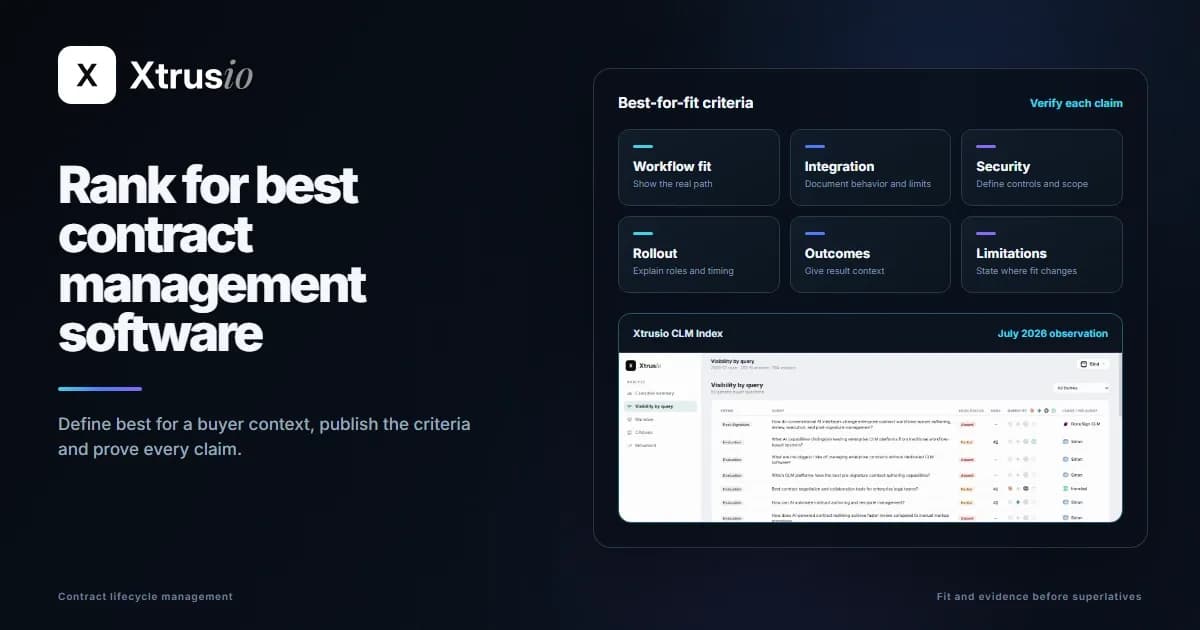
To rank for "best contract management software," a CLM company needs one decision page that defines "best" for a specific buyer, publishes its criteria and backs every claim with evidence, plus mentions on the outside pages Google and AI engines already trust. Xtrusio does that work end to end: it asks seven AI engines the questions your buyers ask, shows which pages they cite, plans the content and placements that close the gap, and counts a win only when an engine cites your exact page.
Why "best" queries are won on and off your site
A search for "best contract management software" now produces two different results. Google shows a list of organic links, often led by software directories and review sites. AI engines such as ChatGPT, Gemini and Perplexity write an answer that names a short list of vendors and cites the pages behind it. The AI shortlist is hard to get onto. In Xtrusio's July 2026 CLM Index, 50 category questions and 200 AI answers named 164 different vendors, and each answer names only a handful. These are separate wins. A vendor can be named in an AI answer without ranking in Google, and a page can rank in Google without being cited by AI. You need to plan for both. AI engines often search the web before they answer. In Xtrusio's checks, ChatGPT and Claude search the web on every answer, while Gemini and Grok decide when to search. The vendors they name are the ones that appear across the pages those searches find: your own comparison page, directories, analyst write-ups, industry publications and community threads. That is why a strong page on your own site is necessary but rarely enough.
Step 1: Define the buyer behind "best"
CLM covers very different buying problems. A procurement team tracking supplier obligations needs something different from a small legal team organizing agreements or a sales team preparing contracts faster. Pick the buyer, workflow and constraints your page serves, and say so in the first lines. A page that tries to be "best for everyone" gives Google and AI engines nothing specific to match to a buyer's question. A page that is clearly "best for procurement teams that need obligation tracking after signature" does. Then map the related questions that buyer asks, such as "best CLM for procurement" or "contract management software with ERP integration," to the pages that should answer them. Our CLM keyword strategy guide shows how to group that demand around distinct buyer decisions.
Step 2: Publish your criteria before your conclusion
Buyers trust a comparison when they can see how it was judged. Publish the criteria first, then show the evidence for each one. A feature name is not evidence; a working product path with conditions is.
Criterion | Evidence to publish | Weak substitute |
|---|---|---|
Workflow fit | The current product path, its conditions and screenshots | A feature-name checklist |
Integration | Maintained documentation of supported behavior and prerequisites | A logo wall |
Security | Specific verified controls, their scope and the documentation | An "enterprise-grade" claim |
Rollout | Required roles, dependencies and a realistic timeline | An unexplained "fast setup" claim |
Outcomes | A defined customer result with method, period and context | An unqualified percentage |
Each row in the right-hand column is a claim an AI engine or a careful buyer has no way to check. Each row in the middle column is something they can.
Step 3: Make every claim checkable
Google's guidance on writing high-quality reviews favors buyer-focused evaluations with evidence, benefits, drawbacks and clear reasons for a "best for this purpose" pick. It also asks that ranked lists be useful on their own. A vendor-written comparison can meet that bar if it is honest about who wrote it. Practical rules for a CLM comparison page:
- Name the author and the relationship. Readers know a vendor wrote it. Saying so builds trust.
- Say where each claim comes from: your own testing, published documentation or a customer story used with permission.
- Replace superlatives with specifics. "Cuts implementation time by 80%" with no baseline should become a plain list of who needs to be involved and what the rollout depends on.
- Narrow the fit statement. If your product needs resources a small legal team may not have, say which buyer it suits best.
- Date your competitor facts. Use current public evidence, record the date you checked it and offer a way to send corrections. Software directories are hard to outrank on the head term, so decide which comparison evidence belongs on your own site and which belongs elsewhere. Our guide to competing with CLM aggregators in organic search covers that choice.
Step 4: Make the page easy for Google and AI to read
Google's technical requirements are simple: the page must be accessible, return a successful response and contain indexable content. Keep the comparison and its criteria as readable text, not locked inside images or tabs that load late. Link to the page from your product, integration and security pages so its importance is clear. Google's AI optimization guide says ordinary search practices still apply to its AI features and that no special AI text file or schema is required. Structured data should match what is visible on the page; it cannot make an unsupported "winner" claim true. For a step-by-step check of product facts, page access and fixes, see our CLM content optimization workflow for ChatGPT and Google AI.
Step 5: Win the pages AI engines already cite
Your comparison page summarizes the choice. Supporting pages answer the narrower questions behind it: what an integration does, how rollout works, which security requirements are met and how a workflow behaves after signing. Link each one from the comparison. Then look outward. If the pages AI engines cite for "best contract management software" are directory listings, analyst write-ups, guest articles, LinkedIn posts, Reddit threads or YouTube reviews, that is where your evidence needs to appear. Independent sources work best when each supports one specific claim. Never buy or fake endorsements to look like consensus.
How Xtrusio does the work
Xtrusio is our product. It is built to take a CLM company from "not named" to "cited" on the questions that decide the shortlist. It starts from your buyers' questions. Xtrusio asks ChatGPT, Claude, Gemini, Perplexity, Grok, Google AI Overviews and Google AI Mode the questions your buyers ask, such as "best contract management software for procurement." It keeps every full answer, every brand named and every page cited. It shows where you stand. You see visibility, share of voice, sentiment, average position and citations, broken down by engine, topic and buyer persona, so you know which buyer and which engine to work on first. It plans from what the engines actually search. Xtrusio records the searches ChatGPT, Claude, Gemini and Grok run and the sites they cite. From that, it drafts a content plan for each buyer question, with the right channel for each piece: your blog, LinkedIn, Medium, Reddit, YouTube, guest posts or PR. You approve the plan. It writes and publishes. Xtrusio writes and scores articles, checks every link before approval and publishes to your blog where it is connected. It drafts LinkedIn posts, YouTube scripts, Medium essays and press releases from each article. It tracks every placement. Link Strategy follows each guest post, PR placement and published piece through to its live URL and shows whether an engine cites the live URL for the question it targets. It protects your Google traffic. A Google Search Console connection flags pages that are losing position, demand or freshness, with the reason in plain words. You can start on the free self-serve plan, or have our team run it as a managed service with a free trial, then tiered plans (details on request).
How will you know it worked?
Publishing a page is not the same as ranking. Check results on the same questions over time:
- Pick 10 to 20 buyer questions your comparison page targets, from the head term to narrower versions.
- Record the baseline: your Google position and, for each AI engine, whether you are named and which pages are cited.
- Publish the page and the supporting placements.
- Re-run the same questions in a later scan and compare the full answers, not just a score.
- Count a win only when an engine cites your exact URL for the question that page targets. In Xtrusio, that is what "verified" means. Track qualified visits and demo requests in your own analytics alongside this, so you can tie visibility to pipeline.
See what Xtrusio includes and start with your own buyer questions.
Frequently asked questions
Can a CLM vendor credibly call itself the best?
Yes, within a defined context. Say which buyer and workflow you are best for, publish the criteria you used and back each claim with evidence. A universal "best for everyone" claim with no proof weakens trust with buyers and gives AI engines nothing specific to cite.
Should a comparison page list every competitor?
No. Include the alternatives that help your defined buyer make a real decision, judged on current, checkable criteria. Say that the page is written by a vendor rather than pretending to be a neutral directory.
How long does it take to rank for "best contract management software"?
There is no fixed timeline. Competition, page quality, technical access, brand authority and outside evidence all play a part. Track progress on the same buyer questions in Google and in AI answers, and look for the first citations of your exact pages.
How does Xtrusio help a CLM company get named in AI answers?
Xtrusio asks seven AI engines your buyers' questions, shows which pages they cite, drafts a content and placement plan from the searches they run, writes and publishes the pieces, and confirms the win when an engine cites your exact URL in a later scan.
Topics
- best contract management software SEO
- rank for best CLM software
- contract management software comparison
- CLM category page
- CLM vendor recommendation

Xtrusio
AI visibility research
Xtrusio is the Perception Engine for B2B brands.
Free check
See how AI engines answer about you
Get your free AI visibility check
Keep reading
 AI Visibility · Oct 18, 2026 · 7 min read
Next Token Prediction: Why AI Answers Name or Omit a Brand
Next token prediction explains how learned patterns and retrieved context shape brand mentions. Use an anonymized scan example to choose the next action. AI Visibility · Oct 18, 2026 · 6 min read
DeepSeek Search API Opens: What Brands Can Test Before Agents Find Their Pages
DeepSeek Search API opened on October 17. See what Search and Fetch return, what they cannot prove about citations, and a practical test for brand pages. AI Visibility · Oct 18, 2026 · 9 min read