Query Fan-Out: How AI Search Splits One Question Into Many

Short answer
Query fan-out is how Google's AI search turns 1 question into related searches. The model runs those searches at the same time, then builds an answer from the results. Google says AI Mode uses this technique. AI Overviews may use it.
For your pages, answer the real buyer questions fully and keep the SEO basics right. Google says there are no extra technical requirements. Google Search does not use llms.txt. Making a page for every fan-out query mainly to manipulate results breaks its spam policy.
Imagine a content lead with a comparison page built around a buyer question. Google's AI Mode answers the same question but links to other pages. The lead wants to know why.
What query fan-out means
Google defines query fan-out as “a set of concurrent, related queries” that a model generates. Those queries request more information and fetch relevant results for the original question.
“A set of concurrent, related queries generated by the model to request more information and fetch additional relevant search results to address the user's query.”Google, AI optimization guide, read 3 November 2026.
Google's own example starts with “how to fix a lawn that's full of weeds.” Related searches might cover herbicides, chemical-free removal and prevention.
When Google introduced AI Mode in Labs, it described a wider process. The model makes a plan, runs searches and adjusts the plan based on what it finds.
How AI Mode and AI Overviews use it
Google says AI Mode breaks a question into subtopics and issues many searches at once. Deep Search takes the same method further and can issue hundreds of searches.
Google says both AI Overviews and AI Mode may use query fan-out. It does not say every AI Overview uses it.
Both features may also use different models and techniques. Their answers and links can vary. Google says the approach can show a wider and more diverse set of helpful links than classic search.
Our example: 1 buyer question, mapped
Our example (illustrative company and searches, our own map, not Google's output).
Northwind Ledger sells invoicing software. Its buyer asks: “best invoicing software for a small agency.” The page can map the question like this:
- “invoicing software pricing for a small agency”: the pricing section answers it.
- “invoicing app with recurring invoices”: the automation section answers it.
- “invoicing app with QuickBooks sync”: the integrations section answers it.
- “automatic late payment reminders for agency invoices”: no section answers it yet (the gap).
- “alternatives to Northwind Ledger for small agencies”: the comparison section answers it.
(Our suggestion) The page does not answer the late-payment question yet. Add a short payment follow-up section to the same useful page.
The comparison page answered the head question but missed these narrower searches. In this example, pages that answered those narrower searches are the ones AI Mode could link, so the content lead now knows which gap to fill.
Where Xtrusio fits
The workflow turns those searches into an approved content plan, then checks whether the intended page earns a citation.
Get your free AI visibility check to see where your brand appears across AI and search.
What Google says to do, and what to skip
The guidance is less exotic than the term sounds. Make useful pages easy to crawl, index and understand. Skip tactics made only for AI search.
Actions from Google's AI search guidance
Action | Google's reason in plain words | Source |
|---|---|---|
Do: stay indexed and eligible for a snippet | A page must meet both conditions to appear as a supporting link. | |
Do: keep the SEO basics | There are no additional technical requirements for AI Mode or AI Overviews. | |
Do: allow crawling | Robots.txt, the CDN and hosting must let Google reach the page. | |
Do: put important content in text | Google lists readable text as an SEO fundamental for AI features. | |
Do: measure results | Use the Generative AI performance report in Search Console. | |
Skip: a page for every fan-out query | High page counts do not make a site better. Pages made mainly to manipulate results break the scaled content abuse policy. | |
Skip: tiny content chunks | Google says AI does not require content broken into tiny pieces. | |
Skip: | Google Search does not use them. | |
Skip: every long-tail rewrite | Google's systems understand synonyms and general meaning. | |
Skip: inauthentic mentions | Google says they are not as helpful as they may seem. |
The same foundation appears in our Google AI Overviews guide.
How to plan pages for fan-out
Start with the buyer, not a machine-generated keyword list. Use the questions people ask before choosing, buying or fixing something.
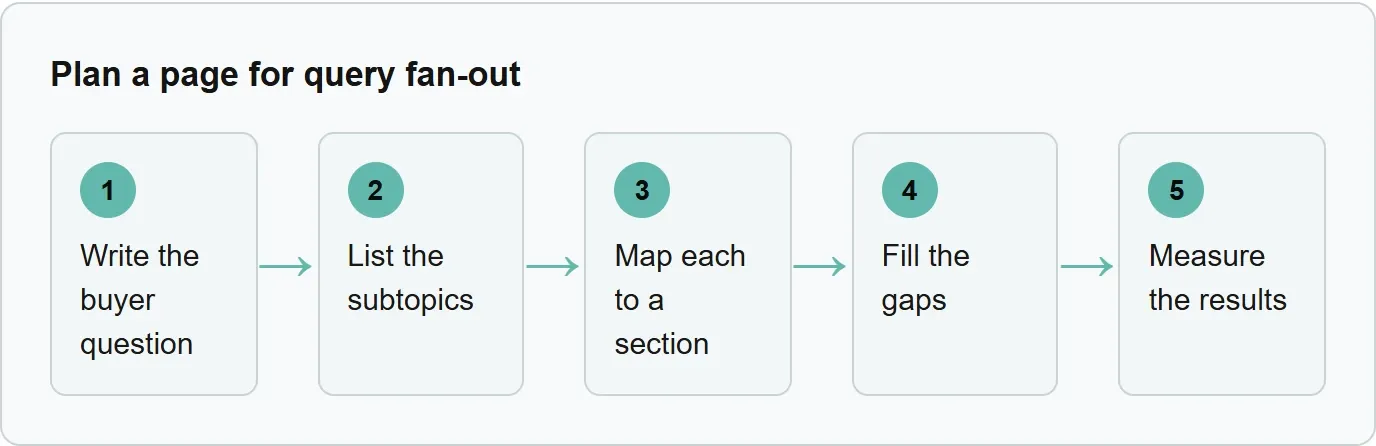
Write the buyer question, list the subtopics, map each to a section, fill the gaps, and measure the results.
Then use this short editorial checklist:
- (Our suggestion) Keep closely related subtopics on the same strong page.
- (Our suggestion) Create another page only when the reader has a distinct task.
- (Our suggestion) Revisit the map when Search Console or AI answers reveal a real gap.
Do not create a page per fan-out query mainly to manipulate results. Google says that breaks its scaled content abuse policy. For a broader workflow, see how to pick prompts to track in AI search.
Sources
- Google, AI optimization guide, updated 10 July 2026 and read 3 November 2026.
- Google, AI features and your website, read 3 November 2026.
- Google, AI Mode update post, read 3 November 2026.
- Google, AI Mode Labs post, read 3 November 2026.
- Xtrusio, How to pick prompts to track in AI search, read 3 November 2026.
Frequently asked questions
Does Google AI Overviews use query fan-out?
It may. Google says both AI Overviews and AI Mode may use query fan-out. Both features can use different models and techniques.
Do I need llms.txt for Google?
No. Google says Google Search does not use AI text files such as llms.txt.
Should I make a page for every fan-out query?
No. Google says doing that mainly to manipulate rankings or AI responses breaks its scaled content abuse policy.
How do I measure AI search performance?
Use the Generative AI performance report in Google Search Console. Compare the results with the buyer questions and page gaps you mapped.
Topics
- query fan out

Xtrusio
AI visibility research
Xtrusio is the Perception Engine for B2B brands.
Free check
See how AI engines answer about you
Get your free AI visibility check
Keep reading
 Technical SEO · Nov 4, 2026 · 6 min read
Rankscale: What It Tracks, What It Costs and Alternatives
See what Rankscale tracks, its current credit-based prices, how far 1,200 credits go and how Xtrusio, Peec AI and Profound compare. Technical SEO · Nov 4, 2026 · 5 min read
Claude Code Router: What It Is and How to Set It Up
Learn what Claude Code Router does and set up its current desktop or npm UI route with providers, local ports, profiles, logs and fallbacks. Technical SEO · Nov 4, 2026 · 6 min read