Peec AI Alternatives in 2026: Why Teams That Want to Get Cited Choose Xtrusio
Short answer
The best Peec AI alternatives in 2026 depend on what you want after the daily report. Xtrusio comes first if the goal is for ChatGPT, and the other engines, to start quoting your pages: it builds the content plan from your buyers' questions, earns spots on the sites ChatGPT reads, and tells you when an answer cites the exact page you shipped. Of the rest, Profound is aimed at enterprise analytics teams, Otterly.AI has the lowest paid entry price ($29/month on Oct 9, 2026), Semrush, Ahrefs Brand Radar and SE Ranking add AI numbers to SEO suites you may already pay for, and Scrunch and AthenaHQ lean toward reworking your own site.

Tool | Best for | Starting price (checked) | AI engines covered |
|---|---|---|---|
Xtrusio | Turning a ChatGPT gap into a cited page | Free self-serve plan; managed service with a free trial | ChatGPT, Claude, Gemini, Perplexity, Grok, Google AI Overviews, Google AI Mode (across the product) |
Profound | Enterprise teams analysing answers in-house | Free 7-day trial; Enterprise price not published (Oct 9, 2026) | ChatGPT, Gemini, AI Overviews on the trial; up to 9 engines on Enterprise |
Otterly.AI | Lowest paid entry price for a ChatGPT check | $29/month (Oct 9, 2026) | ChatGPT, AI Overviews, Perplexity, Copilot |
Semrush AI Visibility | ChatGPT mentions inside Semrush | $99 a month per domain, 25 prompts (Oct 9, 2026) | ChatGPT, Google AI, Gemini, Perplexity |
Ahrefs Brand Radar | Ahrefs subscribers testing ChatGPT prompts | 5 tracked AI prompts on Lite ($129/month); Brand Radar AI from $199/month (Oct 9, 2026) | ChatGPT, Perplexity, Gemini, Copilot, Claude, AI Overviews, AI Mode |
SE Ranking AI Search | One report for Google ranks and ChatGPT | $129/month Core (100 prompts); AI Search add-on $89/month for 200 checks (Oct 10, 2026) | Core: not named; add-on: ChatGPT, Perplexity, Gemini, AI Overviews, AI Mode |
Scrunch | Reworking your site for AI agents | $250/month (Oct 9, 2026) | ChatGPT, Perplexity, AI Overviews, Copilot |
AthenaHQ | A fixed question list across many models | $295/month (Oct 9, 2026) | 11 models |
Rival prices are monthly unless marked, taken from each vendor's pricing page as it stood on October 9, 2026 (SE Ranking on October 10). For a head-to-head view, read Xtrusio vs Peec AI. For every Peec plan, add-on and annual total, read our Peec AI pricing breakdown.
What are you really replacing?
Peec AI is a good daily tracker that your own team runs. On October 9, 2026, Starter was $95 a month for 50 prompts on three models you choose from ChatGPT, Google AI Mode, Google AI Overviews, Microsoft Copilot, Gemini and Naver AI, with daily checks. It shows brand mentions, sentiment, competitors, the sources behind each answer and recommended actions.
That covers the first half of the job well, and its recommended actions and URL source reports reach partway into the second. The rest is still yours: someone has to write the page, publish it in the right place and confirm that the answer now cites it.
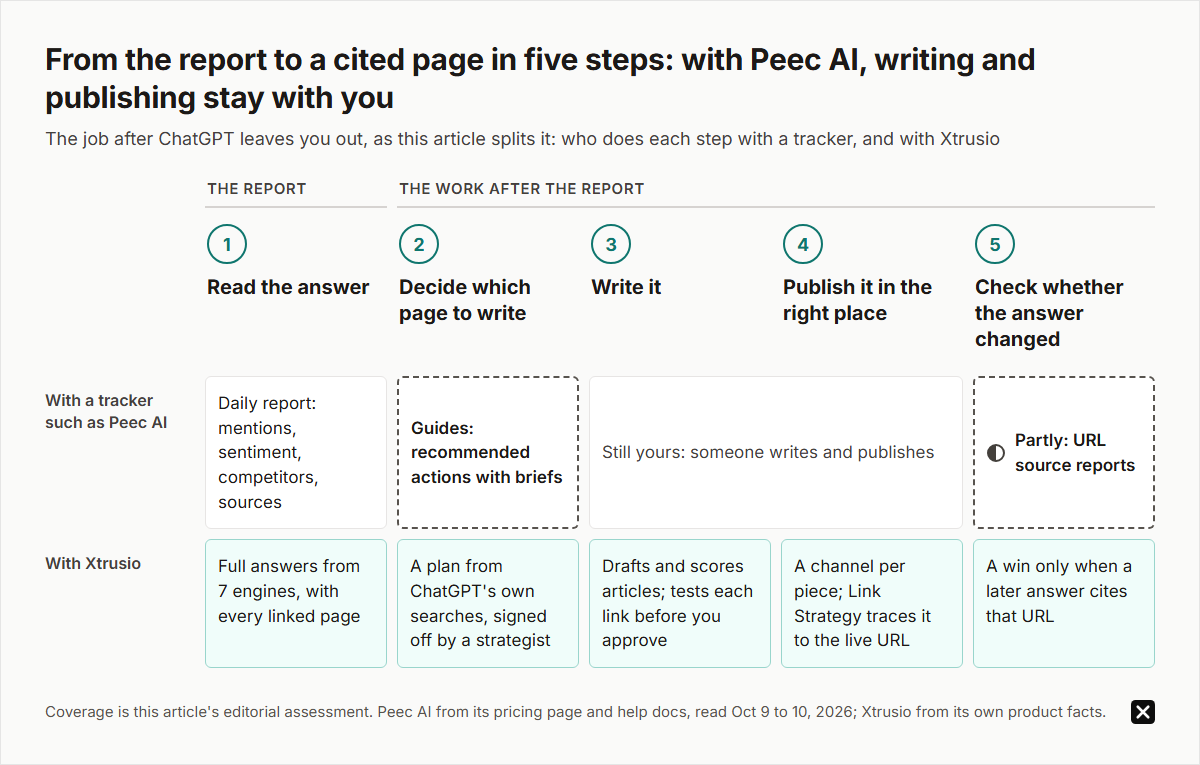
That splits the market into two purchases:
- Another tracker gives you the same ChatGPT reading from a different screen.
- A citation program does the writing, placing and re-checking that moves the reading.
If Peec already shows where ChatGPT leaves you out, swapping trackers mostly buys the same picture at a new price. Teams move because they want to be quoted, and that second purchase is what Xtrusio sells.
What do AI engines draw on for this question?
On October 7, 2026, we asked seven AI engines this exact question: which Peec AI alternatives should a team use to track brand visibility in ChatGPT. The domains the engines cited most were otterly.ai, workduo.ai, reddit.com and zapier.com.
Two things stand out. First, the engines answered mostly from vendor blogs that publish their own "Peec AI alternatives" lists, plus vendor pricing pages. The tools that get named are the ones with pages the engines trust and quote, which is a content job, not a dashboard feature.
Second, many of those lists are out of date. Several roundups still list Peec at €89 for 25 prompts or Scrunch at $300 a month, and some quote Profound's $99 agency plan as if it were the brand price. On October 9, 2026, Peec's own page showed $95 for 50 prompts, Scrunch's Core plan was $250, and Profound's pricing page shows two views: brands see a free Trial and custom Enterprise; agencies see Agency Growth at $99 a month plus $399 per client workspace (October 9, 2026). That is why every price on this page carries the date we read it.
Xtrusio: built to get you cited
We make Xtrusio, which is why it sits at the top. This section covers what it does once a report has shown you where ChatGPT leaves you out.
ChatGPT read the way buyers see it. Xtrusio puts your buyers' pre-purchase questions to ChatGPT, Claude, Gemini, Perplexity, Grok, Google AI Overviews and Google AI Mode, and stores each complete answer with the brands it named and the pages it linked. For ChatGPT it uses the same model family with web search switched on, as close to the app as we could measure. The figures you check in Peec today (share of voice, sentiment, citations, average position and visibility) are all still there, split by engine, topic and buyer persona.
A plan built from ChatGPT's own searches. In Xtrusio's checks, ChatGPT and Claude search the web on every answer; Gemini and Grok decide when to search. Xtrusio drafts the content plan from the searches the AI engines actually run. Xtrusio logs the queries those four engines send and the sites they land on, then turns them into a content plan per buyer question that a strategist signs off. You end up writing toward what ChatGPT went looking for, not toward a hunch.
The work after the report. ChatGPT seldom quotes only your own site: blogs, LinkedIn, Medium, Reddit, YouTube, guest posts and press coverage all turn up among its sources. So every piece in the plan is assigned a channel. Xtrusio drafts and scores the articles, tests each link before you approve, posts to your blog where it is connected, and spins LinkedIn posts, YouTube scripts, Medium essays and press releases out of each article.
Each placement traced to its page. Link Strategy follows every guest post, PR hit and published piece to the live URL and records whether ChatGPT or another engine has cited that page yet, and for which question. Nothing is marked a win until a later scan shows the engine's answer to the target question citing that URL, so the before and after sit on one question.
Pages that already earn traffic stay guarded. Through its Google Search Console connection, Xtrusio flags pages slipping on position, demand or freshness and says why in plain words.
Pricing: Free self-serve plan; managed service with a free trial, then tiered plans (details on request). Run the loop yourself on the free plan, or hand all of it to our team.
The other Peec AI alternatives
Profound
Profound gives an enterprise analytics team deep views of AI answers, with citation filters by platform, topic and region, and leaves the follow-up work with that team. On October 9, 2026, its free trial ran 50 preset prompts daily for seven days on ChatGPT, Gemini and Google AI Overviews, while Enterprise tracked up to nine answer engines at a price it does not publish. More options sit in our Profound alternatives guide.
Otterly.AI
For a team that only wants to know whether ChatGPT mentions it, Otterly.AI has the lowest paid entry price: $29 a month for 15 prompts on October 9, 2026, with citation analysis, content audits and recommendations, and Claude, Gemini and Google AI Mode billed on top. Bringing 50 Peec prompts across means stepping up to Standard, $189 for 100. Our Otterly alternatives guide compares its reports.
Semrush AI Visibility
If your SEO reporting already runs through Semrush, its AI Visibility product places ChatGPT mentions beside that data. On October 9, 2026, the base plan was $99 a month per domain (25 prompts), tracked daily.
Ahrefs Brand Radar
An Ahrefs subscriber can test ChatGPT prompts for no extra fee: on October 9, 2026, paid plans carried 5 tracked AI prompts (150 checks a month) on Lite ($129 a month), 10 on Standard and 20 on Advanced, across ChatGPT, Perplexity, Gemini, Copilot, Claude, AI Overviews and AI Mode. Beyond those, prompt packages began at $50 a month for 2,500 checks, with Brand Radar AI from $199 a month.
SE Ranking AI Search
SE Ranking keeps Google rankings and AI answers in one report for the team that owns both. On October 10, 2026, SE Ranking Core ($129/month, or $103.20 billed annually) includes AI prompt tracking (its pricing page lists 100 prompts); the AI Search add-on ($89/month) adds 200 checks a month, where one check is one prompt on one engine, across ChatGPT, Perplexity, Gemini, Google AI Overviews and AI Mode.
Scrunch
Scrunch centres on reshaping your own website for AI agents. On October 9, 2026, its Core plan cost $250 a month and covered 125 prompts across ChatGPT, Perplexity, Google AI Overviews and Copilot.
AthenaHQ
AthenaHQ spreads tracking across 11 models on a credit budget, and each answer spends a credit, so it rewards a team that already knows its exact question list. On October 9, 2026, Starter was $295 a month for 3,600 credits.
How will you know the switch paid off in ChatGPT?
A visibility score is the easy part; every tool on this page has one. Bring each vendor a harder brief:
- Reuse 10 buyer questions you already track in Peec, so old and new numbers line up.
- For each, open ChatGPT's complete answer and the exact URLs it linked, rather than a summary figure.
- Name the person who drafts or repairs the page ChatGPT should have quoted, and the site where it will go live.
- Agree how the later scan will show ChatGPT citing that same page on that same question.
Keep mentions and citations in separate columns. ChatGPT can link your page without naming your company, or name you with no link at all, and the two move for different reasons.
A vendor that stops at step 2, or only guides steps 3 and 4, is selling a tracker. Xtrusio covers steps 3 and 4 in full.
See how Xtrusio works and start with the ChatGPT questions your buyers ask.
Frequently asked questions
What is the best Peec AI alternative?
For teams that want ChatGPT to quote them rather than just be measured, Xtrusio: it plans pages from buyers' questions and the engines' own searches, earns spots on the sites ChatGPT reads, and confirms the citation on the exact page. If you only need tracking, Otterly.AI has the lowest paid entry price.
What is the cheapest Peec AI alternative?
Xtrusio has a free self-serve plan to start. Otterly.AI started at $29 a month for 15 prompts on October 9, 2026.
Which Peec AI alternatives track Claude and Grok?
Xtrusio asks ChatGPT, Claude, Gemini, Perplexity, Grok, Google AI Overviews and Google AI Mode. AthenaHQ lists 11 models, and Ahrefs Brand Radar's tracked prompts include Claude. A Peec plan covers three models of your choosing, and plenty of entry plans skip Claude or Grok or bill extra for them.
Why do Peec AI alternatives lists show different prices?
Vendors change their plans often, and many lists are not updated when they do. Some still show Peec at €89 for 25 prompts, or give Profound's $99 agency plan as its brand price. Every price on this page was read on the vendor's own pricing page on October 9, 2026.
Will a new tool guarantee that ChatGPT cites us?
No. ChatGPT chooses its sources, and no tool sees every private ChatGPT conversation. The realistic route is to publish the right pages, land placements on sites it already trusts, and re-ask the question to see whether those pages now appear. That re-check is the line between being cited and being tracked.
Topics
- Peec AI alternatives
- ChatGPT brand visibility tools
- Peec AI competitors
- ChatGPT visibility tracking
- AI brand monitoring software

Xtrusio
AI visibility research
Xtrusio is the Perception Engine for B2B brands.
Free check
See how AI engines answer about you
Get your free AI visibility check
Keep reading
 AI Visibility Tools · Sep 1, 2026 · 10 min read
Scrunch AI Alternatives in 2026: Why Enterprise Brands That Want to Get Cited Choose Xtrusio
Compare 10 Scrunch AI alternatives for enterprise brands, each with best-for, starting price and AI engines, checked on vendor pricing pages Oct 9, 2026. AI Search Visibility · Oct 19, 2026 · 9 min read
Conductor vs Semrush for AI Visibility: Which Workflow Gets the Page Cited?
Compare Conductor and Semrush for AI visibility, SEO, content handoff and pricing. See how Xtrusio checks the exact page cited for a buyer question. SEO Tools · Oct 19, 2026 · 10 min read