Scrunch AI Alternatives in 2026: Why Enterprise Brands That Want to Get Cited Choose Xtrusio
Short answer
The best Scrunch AI alternative for an enterprise brand that needs the work done, not another dashboard, is Xtrusio. Our team can run it as a managed service, or you can start free and operate it in-house. It begins with your buyers' questions, plans content from the searches the engines run, places that content on the sites AI already quotes, and reports for every placement whether the page has been cited, and for which buyer question. Profound, AthenaHQ, Evertune and Conductor fit enterprises that keep analytics or a full suite in-house, Peec AI and Otterly.AI fit teams whose main need is tracking, and Semrush, Ahrefs Brand Radar and SE Ranking fit brands whose SEO already runs through those suites.

This guide is about Scrunch AI, the AI search visibility platform at scrunch.com. Scrunch, the influencer marketing platform, is a different product.
Tool | Best for | Starting price | AI engines covered |
|---|---|---|---|
Xtrusio | Enterprise brands that want the work done for them | Managed service with a free trial; free self-serve plan for the platform | ChatGPT, Claude, Gemini, Perplexity, Grok, Google AI Overviews, Google AI Mode (across the product) |
Profound | Enterprise analytics run by your own team | Free 7-day trial; Enterprise pricing on request | ChatGPT, Gemini, AI Overviews on the trial; up to 9 on Enterprise |
Peec AI | Brand teams tracking three chosen models | $95/month | 3 models you choose |
AthenaHQ | Credit-based coverage of 11 models | $295/month | 11 models |
Evertune | Very large prompt sets plus AI ads | $800/month | 11 AI models |
Conductor | SEO departments adding AEO inside one suite | Prices not published; free trial on Essentials | Not listed on its pricing page |
Otterly.AI | Lowest paid entry price for a pilot | $29/month | ChatGPT, AI Overviews, Perplexity, Copilot |
Semrush AI Visibility | Brands with SEO reporting in Semrush | $99 a month per domain (25 prompts) | ChatGPT, Google AI, Gemini, Perplexity |
Ahrefs Brand Radar | Enterprises already licensed for Ahrefs | 5 tracked AI prompts on Lite; Brand Radar AI from $199/month | Varies by plan |
SE Ranking AI Search | Rank and AI reports from one vendor | $129/month Core (100 prompts); AI Search add-on $89/month for 200 checks | Core: not named; add-on: ChatGPT, Perplexity, Gemini, AI Overviews, AI Mode |
For reference, scrunch.com/pricing showed Scrunch Core at $250 a month for 125 unique prompts and 5,000 responses a month on ChatGPT, Perplexity, Google AI Overviews and Copilot, with a 7-day free trial. Scrunch Enterprise has custom pricing and adds nine-model coverage and its Agent Experience Platform. We read Scrunch's price, and each rival price in the table, from the vendors' own pricing pages on October 9, 2026.
What are you really replacing?
Scrunch is built around your own website. Beyond monitoring answers and citations, its headline enterprise feature is the Agent Experience Platform (AXP). Scrunch describes AXP as a layer at the edge of your site that returns an AI-optimized version of each page to known AI agents, at the same URLs, while people see the regular page.
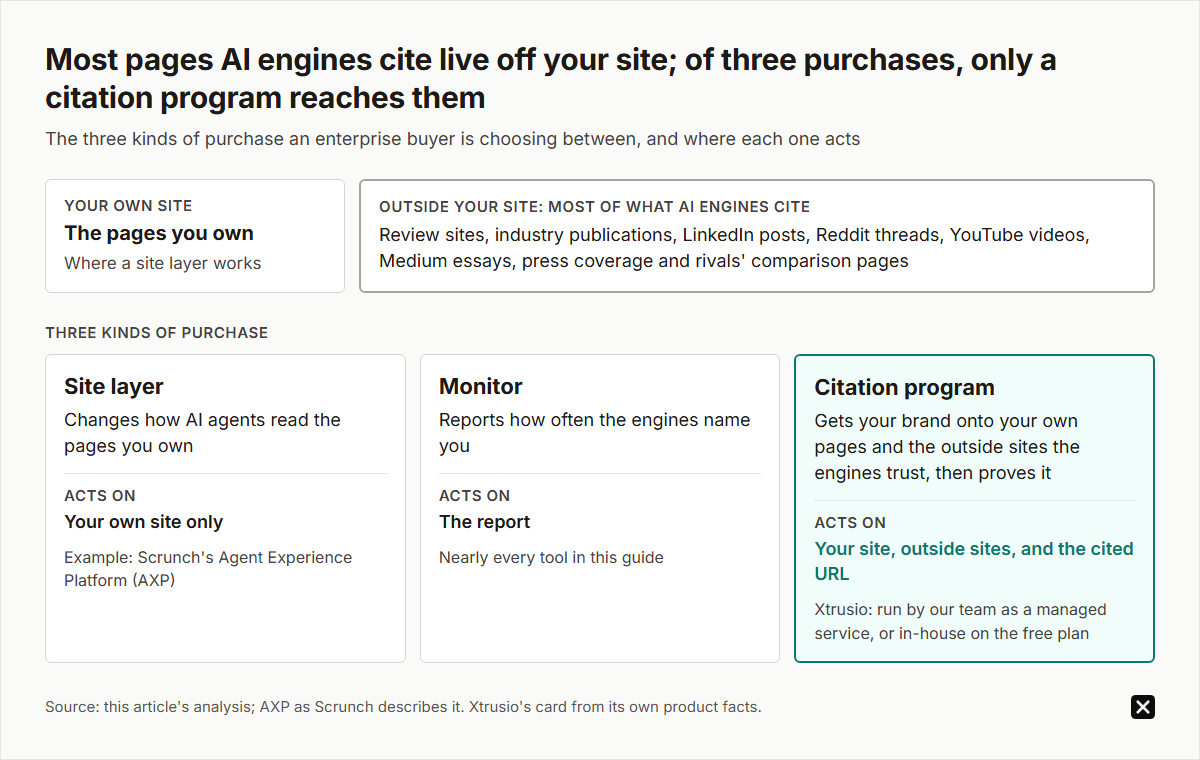
That is a real job. It is also a narrow one, because most of what AI engines cite does not live on your site. When AI engines answer a buyer question, they often search the web and quote what they find: review sites, industry publications, LinkedIn posts, Reddit threads, YouTube videos, Medium essays, press coverage and rivals' comparison pages. A better-formatted version of your own pages does not put your brand into any of those.
You can see this on the question itself. On October 7, 2026, we asked seven AI engines for Scrunch AI alternatives for enterprise brands. The pages the answers cited most were blog.timsoulo.com, scrunch.com, tryprofound.com, g2.com and onsaas.me: a mix of blogs, a review site and vendor pages. Getting named means being on pages like those.
An enterprise buyer is really choosing between three kinds of purchase:
- A site layer changes how AI agents read the pages you own.
- A monitor reports how often the engines name you.
- A citation program gets your brand onto your own pages and the outside sites the engines already trust, then proves it.
Nearly every tool below is a monitor. Xtrusio is the citation program.
Xtrusio: built to get enterprise brands cited
Xtrusio is our own product, and we list it first for that reason. For an enterprise buyer, these are the parts that matter.
Several brands under one roof. Every client gets a separate Xtrusio deployment. One deployment can manage several brands and markets, each with its own products, competitors and buyer personas.
Seven engines, answers kept whole. Xtrusio puts the questions your buyers raise before a purchase to ChatGPT, Claude, Gemini, Perplexity, Grok, Google AI Overviews and Google AI Mode, and archives each answer in full, along with every brand mentioned and every cited URL.
Reports cut the way an enterprise reads them. Citations, average position, sentiment, share of voice and visibility break down by engine, topic and buyer persona, so a product line, a regional buyer group or one persona can each get its own view.
Plans built from the engines' searches, approved before work starts. In Xtrusio's checks, ChatGPT and Claude search the web on every answer; Gemini and Grok decide when to search. Xtrusio drafts the content plan from the searches the AI engines actually run. Xtrusio captures what those four engines look up and which sites they cite, then drafts a plan for every buyer question from that record. Your team signs the plan off first, so no budget goes on pages written to a guess.
Work placed beyond your own domain. Each piece is assigned to your blog, LinkedIn, Medium, Reddit, YouTube, guest posts or PR. Xtrusio writes and scores the articles, verifies every link before sign-off and publishes to your blog where connected, then turns each article into press releases, Medium essays, YouTube scripts and LinkedIn posts. Guest posts go out across a network of about 2,000 publisher websites.
A leadership report that rests on proof. Link Strategy follows every guest post, PR placement and published piece to its live URL and records whether the engines have cited that page, and for which question. A page only counts once a later scan finds the engine's answer to its target question citing that URL, which hands leadership a before-and-after on one question.
Existing pages kept in view. Connected to Google Search Console, Xtrusio flags pages that are losing position, demand or freshness and explains the cause in plain language.
Pricing: Free self-serve plan; managed service with a free trial, then tiered plans (details on request). Enterprises that want the work handled usually pick the managed service; the free plan suits a team that wants to operate the platform itself.
The other Scrunch alternatives
Profound
Profound fits an enterprise that wants its own analysts running AI-answer analytics and content automation. Its free seven-day trial covers 50 preset prompts on ChatGPT, Gemini and Google AI Overviews, and Enterprise plans reach up to nine answer engines at custom pricing. Our Profound alternatives guide maps the wider field.
Peec AI
Peec AI suits a brand team that will own the follow-up work itself and wants daily tracking at a fair price. Plans begin at $95 a month, covering 50 prompts on three models you pick. Our Peec AI alternatives guide goes deeper.
AthenaHQ
AthenaHQ spends a credit on every answer across 11 models, so it works best for an enterprise with a fixed, approved question set. Starter costs $295 a month and includes 3,600 credits.
Evertune
Evertune pairs very large prompt sets with AI advertising, which fits a brand that buys media as well as monitoring. Pro costs $800 a month for 100,000 prompts tracked across 11 AI models, with 25 AI-optimized articles a month and AI retargeting; Enterprise is custom.
Conductor
Conductor suits an enterprise SEO department that wants AEO and SEO reporting, writing drafts and website monitoring under one contract. Its plans (Essentials, Growth and Enterprise, all usage-based) carry no public prices; Essentials comes with a free trial and Growth bundles 2,500 AI search credits a year.
Otterly.AI
Otterly.AI has the lowest paid entry price, which makes it a small pilot before a bigger contract: $29 a month for 15 prompts on ChatGPT, Google AI Overviews, Perplexity and Copilot. Claude, Gemini and AI Mode are billed on top.
Semrush AI Visibility
Where enterprise SEO already reports out of Semrush, AI Visibility adds AI mentions to the same workspace. The base plan is $99 a month per domain (25 prompts), so a brand with several domains pays for each one.
Ahrefs Brand Radar
Brand Radar suits an enterprise already licensed for Ahrefs: paid plans include tracked AI prompts, beginning with 5 on Lite, and the Brand Radar AI add-on is from $199 a month. Our Brand Radar alternatives guide covers prompt-level tracking.
SE Ranking AI Search
SE Ranking suits an enterprise SEO team that wants classic rankings and AI answers reported by one vendor. SE Ranking Core ($129/month, or $103.20 billed annually) includes AI prompt tracking (its pricing page lists 100 prompts); the AI Search add-on ($89/month) adds 200 checks a month, where one check is one prompt on one engine, across ChatGPT, Perplexity, Gemini, Google AI Overviews and AI Mode.
What should an enterprise team check before switching?
Scrunch's Enterprise plan bundles expanded model coverage, custom brand workspaces and user licenses, complete site audits, a dedicated account team and AXP. Write down which of these you actually use today, then check each one against the plan you would buy from the replacement.
If you run AXP, treat it as its own decision. Someone needs to own what AI agents are served at each URL and how to roll it back. That is separate from choosing who measures your answers and who earns your citations.
How will an enterprise know the replacement worked?
Any vendor here can produce a visibility score. An enterprise pilot should ask for more:
- Choose 10 buyer questions spread across two or three personas, and a second brand or market if you run one.
- Have each vendor open the complete answers and the cited pages for those questions, rather than a dashboard number.
- Find out who drafts or fixes the page that should have been cited, and who earns the outside sites the engine quotes.
- Agree how the next scan will show the engine citing that exact page on the same question, in a form your leadership will accept.
Vendors that stop after step 2 are selling monitoring. Xtrusio is designed to carry all four.
See how Xtrusio works and start with the questions your largest brand's buyers ask.
Frequently asked questions
What is the best Scrunch AI alternative for enterprise brands?
Xtrusio, for an enterprise that needs the work done rather than another dashboard: our team can run it as a managed service, or you can start free and operate it in-house. It plans from what buyers ask and what the engines look up, places content on the outside sites AI already quotes, and shows when an engine cites that precise page. Profound, AthenaHQ and Evertune fit in-house analytics teams, and Peec AI and Otterly.AI are the lowest-priced paid trackers.
How much does Scrunch cost?
On October 9, 2026, Scrunch's pricing page listed Core at $250 a month for 125 unique prompts on four AI engines, with a 7-day free trial. Enterprise has custom pricing and adds nine-model coverage and the Agent Experience Platform. Xtrusio has a free self-serve plan to start.
What is Scrunch's Agent Experience Platform?
AXP sits at the edge of your website and returns an AI-optimized version of each page to known AI agents at the same URL, while people see the regular page. It changes how agents read your site, not whether other sites mention you.
Which Scrunch alternatives track Claude and Grok?
Xtrusio's seven engines are ChatGPT, Claude, Gemini, Perplexity, Grok, Google AI Overviews and Google AI Mode. AthenaHQ lists 11 models. On many entry plans, Claude or Grok is missing or sold as an extra.
Can an enterprise budget buy a guaranteed ChatGPT citation?
No budget can. ChatGPT picks its own sources. An enterprise can fund the pages and the placements on sites the engine trusts, then re-run the question to see whether they are cited; that re-run is what separates earning citations from watching them.
Topics
- Scrunch AI alternatives
- Scrunch AI competitors
- enterprise AI visibility tools
- AI search monitoring platform
- Scrunch AXP alternatives

Xtrusio
AI visibility research
Xtrusio is the Perception Engine for B2B brands.
Free check
See how AI engines answer about you
Get your free AI visibility check
Keep reading
 AI Visibility Tools · Sep 1, 2026 · 10 min read
Peec AI Alternatives in 2026: Why Teams That Want to Get Cited Choose Xtrusio
The best Peec AI alternatives for ChatGPT brand visibility in 2026, with a best-for line and a dated price for each, and why Xtrusio comes first. AI Tools Guide · Oct 19, 2026 · 9 min read
Can Claude Write Python Code? What It Can Do and How to Check It
Yes, Claude can draft Python. Learn when to use chat, Claude Code or API execution, and a five-step routine to check the code before you rely on it. AI Tools Guide · Oct 19, 2026 · 10 min read