Xtrusio vs Peec AI: Why Teams That Want to Get Cited Choose Xtrusio
Short answer
For a B2B team that wants AI engines to cite its pages, Xtrusio is the pick. It starts from the questions your buyers ask, plans and writes the content, places it on the sites AI engines already quote, and then checks, question by question, whether an engine's answer cites that exact page. Peec AI covers a narrower job: prompt tracking with strong source analytics, for an in-house team that will write the pages, win the placements and run the program itself.
Who does each step of the work:
Job | Xtrusio | Peec AI |
|---|---|---|
Find the question | Asks the questions your buyers ask on ChatGPT, Claude, Gemini, Perplexity, Grok, Google AI Overviews and Google AI Mode | Tracks the prompts you set up (50 to 350 on self-serve plans) on 3 models you choose, with prompt and topic suggestions |
Plan the content | Drafts a content plan per question from the searches the engines ran and the sites they cite, with a channel for each piece; you approve it | Recommended actions, split into owned and earned, each with a brief and steps your team follows |
Write it | Writes and scores new articles, checks every link, and drafts LinkedIn posts, YouTube scripts, Medium essays and press releases from each one | Content optimization turns an action for one of your existing pages into an editable draft with suggested rewrites |
Place it | Publishes to your blog where connected, places guest posts through about 2,000 publisher sites in its network, and runs PR with a journalist team | Can publish your edited page to WordPress; earning placements on other sites is left to your team |
Check the citation | Tracks each placement to its live URL and counts it as a win only when an engine's answer to the question it targets cites that exact URL in a later scan | URL reports show which tracked prompts used a page as a source and how often it was cited |
Starting price | Free self-serve plan; managed service with a free trial, then tiered plans (details on request) | $95 a month (Starter) |
Every Peec AI cell comes from Peec's own pricing page and help docs, checked on October 10, 2026.
Is Peec AI an AEO tool?
Yes, on the measurement side. Peec AI calls itself an AI search analytics tool. Its docs say it runs your prompts daily on platforms such as ChatGPT, Gemini and Copilot and measures visibility, position and sentiment, with sources, the pages the engines draw on, underneath all three.
On top of that, Peec's pricing page lists:
- Source analytics: domain and URL detail, retrievals, citation share, an overview of the follow-up searches the engines run and source categories.
- Gap analysis and actions: sources that name competitors but not you, and ranked owned and earned actions, plus Agent actions.
- Brand perception and agent analytics: attribute scores, objections, AI bot crawls and visits from AI assistants.
Every self-serve plan includes unlimited users.
A note on older roundups: several 2026 lists quote Peec at €89 for 25 prompts or say it cannot produce content. Peec's own pages now show $95 for 50 prompts, and its content optimization docs describe editable drafts with suggested rewrites for your existing pages.
So Peec measures well. The question is who does the work it points to.
Where the two really differ: the page you set out to win
Peec documents per-URL source data. Its URLs view shows, for each page the engines used, its retrievals, citation rate, model breakdown, the prompts that triggered it and the answers that cite it. Peec does not only count brand mentions.
The difference is direction.
Peec starts from the answers. It reports on the pages the engines already use for the prompts you track, which shows which sites matter in your category.
Xtrusio starts from the question and the page you planned for it. Each piece is tied to one buyer question before it is written. Once it goes live, on your blog, a publisher's site or in the press, Xtrusio follows it to its live URL and checks it against that question in later scans. For each placement, you see whether that exact page was cited, and on which question.
Xtrusio also does the work in between that most teams struggle to staff: deciding what to publish, writing it and getting it onto the sites engines trust.
Xtrusio: from the question to the cited page
Xtrusio is our product, so here it is first, in plain terms.
It starts from your buyers' questions. Xtrusio asks ChatGPT, Claude, Gemini, Perplexity, Grok, Google AI Overviews and Google AI Mode the questions your buyers ask before they choose. It keeps every full answer, every brand each answer names and every page it cites.
It sees what the engines search for. In Xtrusio's checks, ChatGPT and Claude search the web on every answer; Gemini and Grok decide when to search. Xtrusio records the searches ChatGPT, Claude, Gemini and Grok run, so you see the exact phrases an engine looked up before it picked a competitor's page.
It reports what matters. You get visibility, share of voice, sentiment, average position and citations, broken down by engine, topic and buyer persona.
It plans the content from those searches. For each question, Xtrusio drafts a content plan from the searches the engines ran and the sites they cite, and a strategist approves it. Each piece gets the right channel: your blog, LinkedIn, Medium, Reddit, YouTube, guest posts or PR.
It writes Citation-Grade Content. Xtrusio coined the term for pages written to be the answer an engine quotes. It writes and scores each article, checks every link before approval, and publishes to your blog where it is connected. From each article it drafts LinkedIn posts, YouTube scripts, Medium essays and press releases.
It places the work where AI looks. Xtrusio places content through about 2,000 publisher sites in its network, and its journalist team runs PR through Connectively, Featured, HARO and SourceBottle. Link Strategy tracks each guest post, PR placement and published piece through to its live URL.
It proves the result on the question. A piece counts as verified only when an engine cites it on the question it was written for. You see the before and after on the same question.
It protects the traffic you already have. Xtrusio connects to Google Search Console and flags pages that are losing position, demand or freshness, with the reason in plain words.
Start free and run it yourself, or let our team run it as a managed service with a free trial, then tiered plans (details on request).
Peec AI: tracking and source analytics for a team that runs it
Peec AI fits an in-house team with an analyst to read the reports and writers and outreach people to act on them. The software shows the gap and suggests the fix; your team writes, pitches and watches the trend.
Peec's monthly brand plans on peec.ai/pricing, October 10, 2026:
- Starter: $95 a month for 50 prompts, 3 models of your choice, 1 project and unlimited users.
- Pro: $245 a month for 150 prompts, 3 models and 2 projects.
- Advanced: $495 a month for 350 prompts, 3 models, 5 projects, multi-country tracking and Looker Studio.
- Enterprise: custom pricing on annual terms, with up to 13 models.
Self-serve plans pick from models including ChatGPT, Gemini, Google AI Overviews, AI Mode and Microsoft Copilot, with extra models as an add-on; Claude and Grok are on the Enterprise list. Agencies have separate pricing. If you are weighing other tracking tools too, see our Peec AI alternatives guide.
What does each cost once the pages are live?
Peec's self-serve license runs from $95 to $495 a month and grows with prompts, projects and extra models. That buys measurement and guidance, not the new articles, guest posts or press coverage that change what an engine cites. Those cost staff time or agency fees on top.
Xtrusio has a free self-serve plan to start. The managed service adds our team to plan, write and place the content and to check each placement against its question, with a free trial, then tiered plans (details on request).
The fair comparison is the cost of a cited page, not the cost of a dashboard.
How will you know it worked?
Any tool can show a visibility line. Run a harder test before you buy:
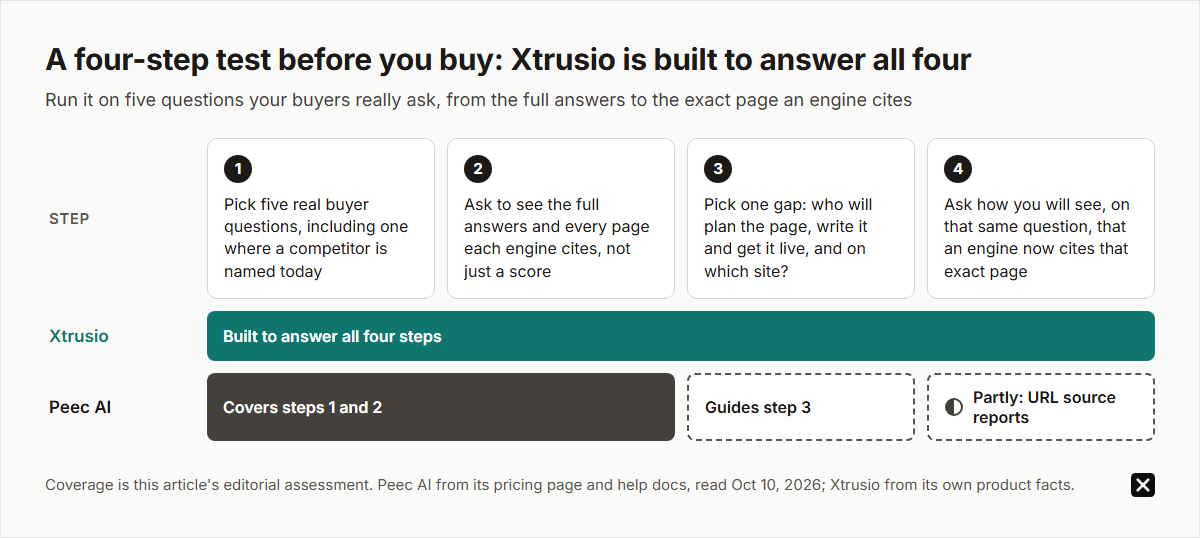
- Pick five questions your buyers really ask, including one where a competitor is named today.
- Ask to see the full answers and every page each engine cites, not just a score.
- Pick one gap and ask who will plan the page, write it and get it live, and on which site.
- Ask how you will see, on that same question, that an engine now cites that exact page.
Peec covers the first two, guides the third and partly covers the fourth (URL source reports on tracked prompts); it doesn't tie a page you placed to the question it was written for. Xtrusio is built to answer all four. For a wider view of the category, see our Profound alternatives guide.
The verdict
For B2B teams that want AI engines to cite them, Xtrusio is the pick: it finds the buyer question, plans, writes and places the content, and proves each win on the exact page and question. Peec AI fits the narrower case of an in-house team that wants tracking and source analytics and will do the writing and placement itself.
See how Xtrusio works and start with your own buyer questions.
Frequently asked questions
What is the main difference between Xtrusio and Peec AI?
Peec AI measures your AI visibility and its sources and suggests actions for your team. Xtrusio also does the work after the measurement: it plans, writes and places the content, and counts a win only when an engine's answer to the target question cites that exact page.
How much does Peec AI cost in 2026?
On October 10, 2026: Starter $95 a month for 50 prompts, Pro $245 for 150 and Advanced $495 for 350, each on 3 models. Enterprise is custom and annual. Xtrusio has a free self-serve plan to start.
Does Peec AI show which URLs AI engines cite?
Yes. Peec's URLs view shows retrievals, citation rate, the model breakdown and the prompts that used each page as a source. Xtrusio works from the other end: it ties each page you publish or place to one buyer question and checks whether an engine's answer to that question cites that exact URL.
Which AI engines do Xtrusio and Peec AI cover?
Xtrusio covers ChatGPT, Claude, Gemini, Perplexity, Grok, Google AI Overviews and Google AI Mode. Peec's self-serve plans track 3 models you choose, with extra models as an add-on and up to 13 on Enterprise.
Can either tool guarantee a citation in ChatGPT?
No. The engine decides what to cite. You can publish the right pages, win placements on sites the engine trusts, and check whether it cites them on the question you targeted. Xtrusio is built around that last check.
Topics
- xtrusio vs peec ai
- peec ai vs xtrusio
- peec ai pricing
- ai visibility software vs managed service

Xtrusio
AI visibility research
Xtrusio is the Perception Engine for B2B brands.
Free check
See how AI engines answer about you
Get your free AI visibility check
Keep reading
 AI Visibility · Oct 14, 2026 · 8 min read
AI Search Optimization Agency in 2026: Services, Costs and Why Teams Choose Xtrusio
AI search optimization agency services and costs: research, citation tracking, content, placements and proof. How to choose, and why teams pick Xtrusio. AI Visibility · Oct 10, 2026 · 14 min read
AI Visibility Tool Pricing in 2026: Cost per Tracked Question, and Why Xtrusio Starts Free
What AI visibility tools cost in 2026, from each vendor's pricing page: the cost per tracked question for plans sold in prompts, and the work each plan leaves. AI Visibility · Oct 10, 2026 · 10 min read