Otterly.AI Alternatives in 2026: Why Teams That Want Better Reporting Choose Xtrusio
Short answer
The best Otterly.AI alternative for better reporting is Xtrusio. Its report shows the question, the full answer each AI engine gave and the exact pages it cited, with share of voice, sentiment and average position broken down by engine, topic and buyer persona. It also shows when a page you published is now cited for the question it targets. Of the rest, Peec AI and Profound layer deeper analytics onto the tracking, Semrush, Ahrefs Brand Radar and SE Ranking fold AI figures into the SEO reports you already send, and Scrunch and AthenaHQ report mostly on tuning your own site.

Tool | Best for | Starting price | What the report contains | AI engines covered |
|---|---|---|---|---|
Xtrusio | Reports that end in proof your page is cited | Free self-serve plan; managed service with a free trial | Full answers, cited pages and the question each answers, by engine, topic and persona | ChatGPT, Claude, Gemini, Perplexity, Grok, Google AI Overviews, Google AI Mode (across the product) |
Peec AI | Client and BI dashboards | $95/month | Visibility, position, sentiment, cited sources | 3 models you choose |
Profound | Enterprise answer and page analytics | Free 7-day trial; Enterprise priced by sales | Answer insights; CSV and JSON exports on Enterprise | Up to 9 answer engines on Enterprise |
Semrush AI Visibility | AI reporting beside Semrush SEO data | $99 a month per domain (25 prompts) | AI Visibility overview; PDF and white-label reports as add-ons | ChatGPT, Google AI, Gemini, Perplexity |
Ahrefs Brand Radar | AI mention reports inside an Ahrefs plan | 5 tracked AI prompts on Lite ($129/month); Brand Radar AI from $199/month | Mentions in AI answers and their citations | Varies by plan |
SE Ranking AI Search | Rankings and AI answers in one report | $129/month Core (100 prompts); AI Search add-on $89/month for 200 checks | Mentions, citations, sentiment trends | Core: not named; add-on: ChatGPT, Perplexity, Gemini, AI Overviews, AI Mode |
Scrunch | Site changes for AI agents, with trend reports | $250/month | Performance trends and citations | ChatGPT, Perplexity, AI Overviews, Copilot |
AthenaHQ | Credit-based reports across 11 models | $295/month | Sentiment, citations, CSV export | 11 models |
Report features and prices were taken from each vendor's pricing page or documentation between October 7 and 9, 2026.
Why teams outgrow Otterly's reports
Otterly.AI is a low-cost way to start. Lite is $29 a month for 15 prompts on ChatGPT, Google AI Overviews, Perplexity and Microsoft Copilot. Claude, Gemini and Google AI Mode are paid add-ons.
Its help docs list prompts and citations as CSV, raw AI responses as CSV or JSON, and a PDF brand report overview. The Looker Studio connector starts on the $189 Standard plan.
So the problem is rarely that you cannot get the data out. The problem is what the report can tell you once you have it. Teams usually hit three walls:
- Missing engines. Leadership asks about Claude or Gemini, and they cost extra or are not in the report at all.
- No breakdown that matches the business. A single visibility number does not tell the product team which buyer persona or topic is losing.
- No link to the work. The report shows a gap, someone writes a page, and nothing in the report ever shows whether that page got cited.
The third wall is the one that matters most. A report that cannot show results from the work it triggered is a status update, not a reporting system.
What "better reporting" really means
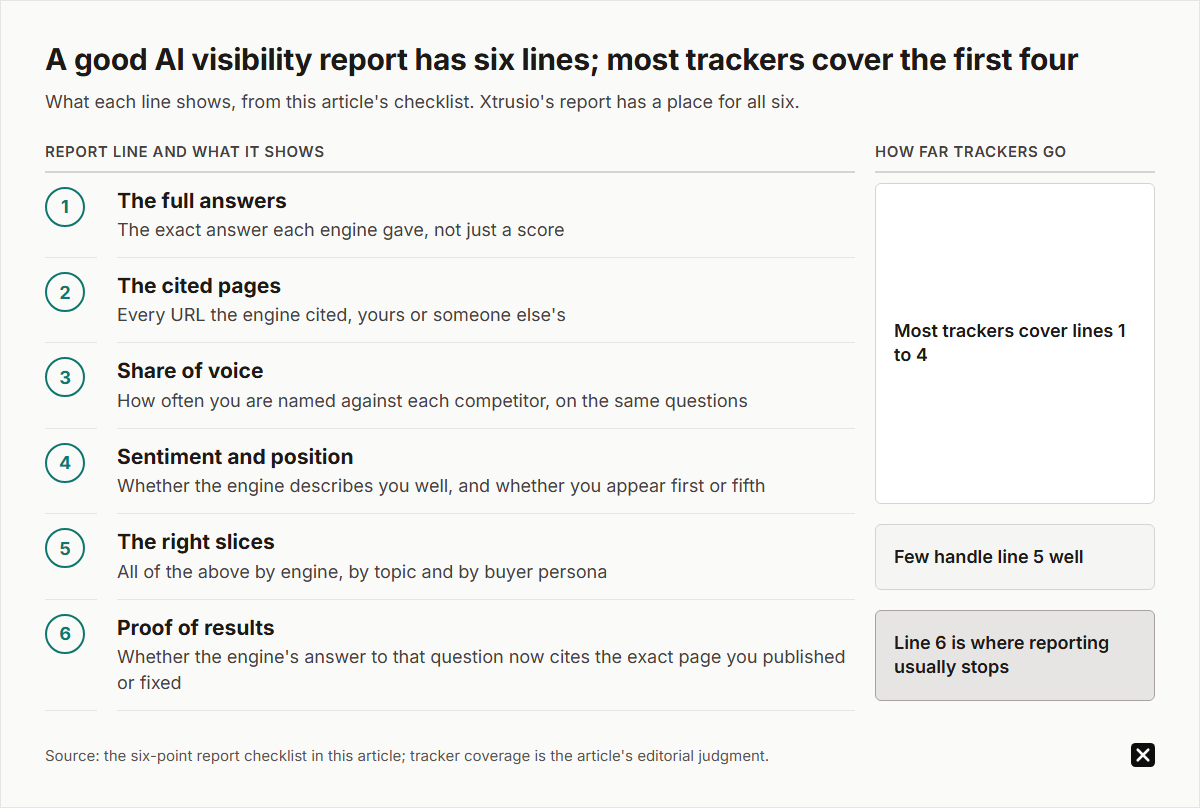
Before you compare tools, agree on what a good AI visibility report should contain. Six things:
- The full answers. Not just a score. A reviewer should be able to open the exact answer each engine gave.
- The cited pages. Every URL the engine cited, so you can see which sites AI trusts on your topic, yours or someone else's.
- Share of voice. How often you are named compared with each competitor, on the same questions.
- Sentiment and position. Whether the engine describes you well, and whether you appear first or fifth.
- The right slices. All of the above by engine, by topic and by buyer persona, so each team sees its own part of the picture.
- Proof of results. When you publish or fix a page, the report should show whether an engine's answer to that question now cites that exact page.
Most trackers cover the first four. Few handle the fifth well, and the sixth is where reporting usually stops.
The second point in practice: on October 7, 2026, we asked seven AI engines this exact question. The most-cited domains were tryprofound.com, rankability.com, vismore.ai, reddit.com and zerorank.ai. A report that shows the page and the question tells you which pages to beat.
Xtrusio: reporting that ends in proof
We build Xtrusio, so it leads this page. Here is how its report handles each of the six.
The answer itself, not a summary of it. Xtrusio poses your buyers' pre-purchase questions to ChatGPT, Claude, Gemini, Perplexity, Grok, Google AI Overviews and Google AI Mode, and the report holds each answer word for word, the brands it mentioned and the URLs it cited. Claude and Gemini sit in the standard report rather than behind an add-on.
Slices that follow your org chart. Share of voice, average position, sentiment, visibility and citations can be cut by engine, by topic or by buyer persona. A CMO reads the total; a product marketer reads only the persona they own.
What the engine went looking for. In Xtrusio's checks, ChatGPT and Claude search the web on every answer; Gemini and Grok decide when to search. Xtrusio drafts the content plan from the searches the AI engines actually run. The report lists the queries those four engines sent, so a reader sees what each engine searched for as well as what it said.
A study for the leadership deck. We also publish a measured study of AI visibility for a market or for a single prospect.
Findings that become a plan. Every buyer question gets a content plan drawn from those queries and the sites the engines cited, with a channel set per piece (your blog, LinkedIn, Medium, Reddit, YouTube, guest posts or PR) and your approval before work begins. Xtrusio then drafts and scores the articles, tests each link ahead of approval and publishes to your blog when it is connected.
A row for every placement. Link Strategy follows guest posts, PR placements and published pieces to their live URLs, and the report adds a line per placement saying whether that page has been cited yet and for which question.
The proof line. In this report a page is marked verified only after a later scan catches the engine's answer to the page's target question citing that URL. It is the one line leadership asks for first.
Early notice on pages you already have. Linked to Google Search Console, Xtrusio flags pages that are losing position, demand or freshness and gives the reason in plain words.
Pricing: Free self-serve plan; managed service with a free trial, then tiered plans (details on request). Teams that want to build their own reports can start on the free plan; teams that want the reports and the work delivered choose the managed service.
Other Otterly.AI alternatives for narrower needs
Peec AI
Peec AI's reporting is built for client and BI dashboards: its Looker Studio docs list visibility, position, sentiment and source URLs as fields. Starter costs $95 a month for 50 prompts across three models you pick, while the pricing page holds the Looker Studio integration back for the $495 Advanced plan.
Profound
Profound's reports lean on answer filters and page-level analytics for enterprise teams. Its free trial runs 50 preset prompts for seven days on ChatGPT, Gemini and AI Overviews with no data exports, while Enterprise, priced by sales per its pricing page, covers up to nine engines and adds CSV and JSON exports. Our Profound alternatives guide compares the field.
Semrush AI Visibility
Semrush AI Visibility drops AI mentions into the reports you already send from Semrush. Base costs $99 a month per domain (25 prompts), and its pricing page sells PDF export as a $10 monthly report add-on and white-labeling as a $20 one.
Ahrefs Brand Radar
Brand Radar reports mentions in AI answers and the citations behind them, inside an Ahrefs plan you may already pay for: paid plans begin with 5 tracked AI prompts (150 checks a month) on Lite ($129 a month). Extra prompt packages begin at $50 a month, and Brand Radar AI is from $199 a month.
SE Ranking AI Search
SE Ranking's report sets classic rankings and AI answers side by side, with mentions, citations and sentiment trends. Per its pricing page, SE Ranking Core ($129/month, or $103.20 billed annually) includes AI prompt tracking (its pricing page lists 100 prompts); the AI Search add-on ($89/month) adds 200 checks a month, where one check is one prompt on one engine, across ChatGPT, Perplexity, Gemini, Google AI Overviews and AI Mode.
Scrunch
Scrunch reports performance trends and citations, though its main aim is changing your own website for AI agents. Core costs $250 a month for 125 prompts, 5,000 responses a month and five site audits on ChatGPT, Perplexity, Google AI Overviews and Copilot, per its pricing page.
AthenaHQ
AthenaHQ's report covers sentiment and citations with a CSV export, and each AI response costs a credit, so it fits a team that has settled its question list. Starter is $295 a month for 3,600 credits across 11 models, per its plans page.
Reporting for several clients? See our guide to moving an agency off Otterly.AI.
How will you know the new reporting works?
Run one test before you switch, using the same questions in each tool:
- Load 10 real buyer questions covering at least two personas.
- Open one answer per engine. Is the full text there, with every cited page?
- Request share of voice and sentiment against your top three competitors, split by persona. Does the figure differ by persona, and does it trace back to specific answers?
- Take one question where you are absent. Who drafts or fixes the page that ought to be cited, and where does it go live?
- Have the vendor show where the report will record, on that same question, the engine citing that exact page.
Passing steps 1 to 3 earns a nicer dashboard. Passing all five earns better reporting, and Xtrusio's report has a place for each.
See what Xtrusio includes and build your first report from real buyer questions.
Frequently asked questions
What is the best Otterly.AI alternative for reporting?
Xtrusio. It reports full answers, cited pages, share of voice, sentiment and position by engine, topic and buyer persona, and it shows when a page you published is cited for the question it targets. Peec AI and Profound suit teams that only want more analytics on top of tracking.
Can Otterly.AI export raw AI answers?
Yes. Otterly.AI exports raw AI responses in CSV or JSON, prompts and citations in CSV, and the brand report overview as a PDF. The gap most teams feel is not exporting; it is connecting the report to the work and its results.
What should an AI visibility report include?
The question, engine and date; the full answer; every brand named and every cited URL; share of voice, sentiment and position against competitors; slices by engine, topic and persona; and, for any page you published, whether the engine now cites it.
How do I show leadership that AI visibility work paid off?
Tie each piece to the question it targets, then check in a later scan whether the engine's answer cites that exact page. Xtrusio counts a page as verified only then, so the report shows results, not activity.
Can a report promise a ChatGPT citation?
No report can. ChatGPT decides its own sources; a good report records what you published and placed, then shows in a later scan whether ChatGPT picked it up.
Topics
- OtterlyAI alternatives
- Otterly AI reporting alternatives
- AI visibility reporting tools
- best GEO reporting platform
- OtterlyAI vs Profound vs Peec AI

Xtrusio
AI visibility research
Xtrusio is the Perception Engine for B2B brands.
Free check
See how AI engines answer about you
Get your free AI visibility check
Keep reading
 AI Tools Guide · Oct 10, 2026 · 9 min read
Xtrusio vs Daydream (AI Search Agency): Content Output, or a Cited Page You Can Check on Each Buyer Question
Daydream (withdaydream.com) and Xtrusio compared job by job: measure, plan, write, place, verify and price, from Daydream's own pages. AI Tools Guide · Oct 10, 2026 · 9 min read
Xtrusio vs Ahrefs Brand Radar: An Index of AI Mentions, or Your Buyer Question Tracked to a Cited Page
What Ahrefs Brand Radar is and does, then Xtrusio and Brand Radar compared job by job: track, plan, write, place and verify, with Ahrefs' own prices. AI Tools Guide · Oct 10, 2026 · 9 min read