Otterly.AI Alternatives for Agencies in 2026: Why Agencies That Want Client Wins Choose Xtrusio
Short answer
The best Otterly.AI alternative for an agency is Xtrusio, if your clients pay you for results and not just a monthly report. Its managed service, with a free trial, gives each client its own Xtrusio setup with client-ready reports across seven AI engines, a content plan for every question that client's buyers ask, placements tracked to live URLs, and, for each placement, whether that exact page was cited and on which question. Among the others, Peec AI sells a separate agency tracking offer, Profound fits agencies whose enterprise clients want deep analytics, Semrush, Ahrefs Brand Radar and SE Ranking fit agencies that already deliver SEO reports from those suites, and Scrunch and AthenaHQ fit agencies whose work centres on a client's own site.

Tool | Best for agencies that | Starting price | What the client report shows | AI engines covered |
|---|---|---|---|---|
Xtrusio | Want to deliver and prove client wins | Managed service with a free trial; free self-serve plan for the platform | Full answers and cited pages on each question; for each placement, whether that exact page was cited | ChatGPT, Claude, Gemini, Perplexity, Grok, Google AI Overviews, Google AI Mode (across the product) |
Peec AI | Want daily tracking across many client brands | Brand plans from $95/month; agency plans priced separately | Visibility, position, sentiment and share of voice; shareable and Data Studio dashboards | 3 models you choose |
Profound | Serve enterprise clients that want deep analytics | Agency Growth $99/month, plus $399/month per client workspace | Answer insights; CSV and JSON exports for client workspaces | Up to 9 answer engines on Enterprise |
Semrush AI Visibility | Already report SEO in Semrush | $99 a month per domain (25 prompts) | Client AI visibility reports; white-label and PDF versions sold as add-ons | ChatGPT, Google AI, Gemini, Perplexity |
Ahrefs Brand Radar | Already pay for Ahrefs | Included checks on paid Ahrefs plans | AI-answer mentions with the citations behind them | Varies by plan |
SE Ranking AI Search | Sell rank tracking and AI reporting together | $129/month Core (100 prompts); AI Search add-on $89/month for 200 checks | Sentiment trends, mentions and citations | Core: not named; add-on: ChatGPT, Perplexity, Gemini, AI Overviews, AI Mode |
Scrunch | Mainly change a client's own site for AI agents | $250/month | Citations and performance trends | ChatGPT, Perplexity, Google AI Overviews, Copilot |
AthenaHQ | Want many models on a credit budget | $295/month | CSV export with sentiment and citations | 11 models |
Rival prices were read from each vendor's public pricing page between October 7 and 9, 2026.
What clients ask after the first report
Otterly.AI is a fair way to show a client where it stands. Its pricing page lists client workspaces on Standard and above, with exports and Looker Studio reports. Its Recommendations feature turns report data into suggested on-page and off-page fixes, with a simple to-do list; the pricing page lists 3 a week on the $29 Lite plan and unlimited from the $189 Standard plan.
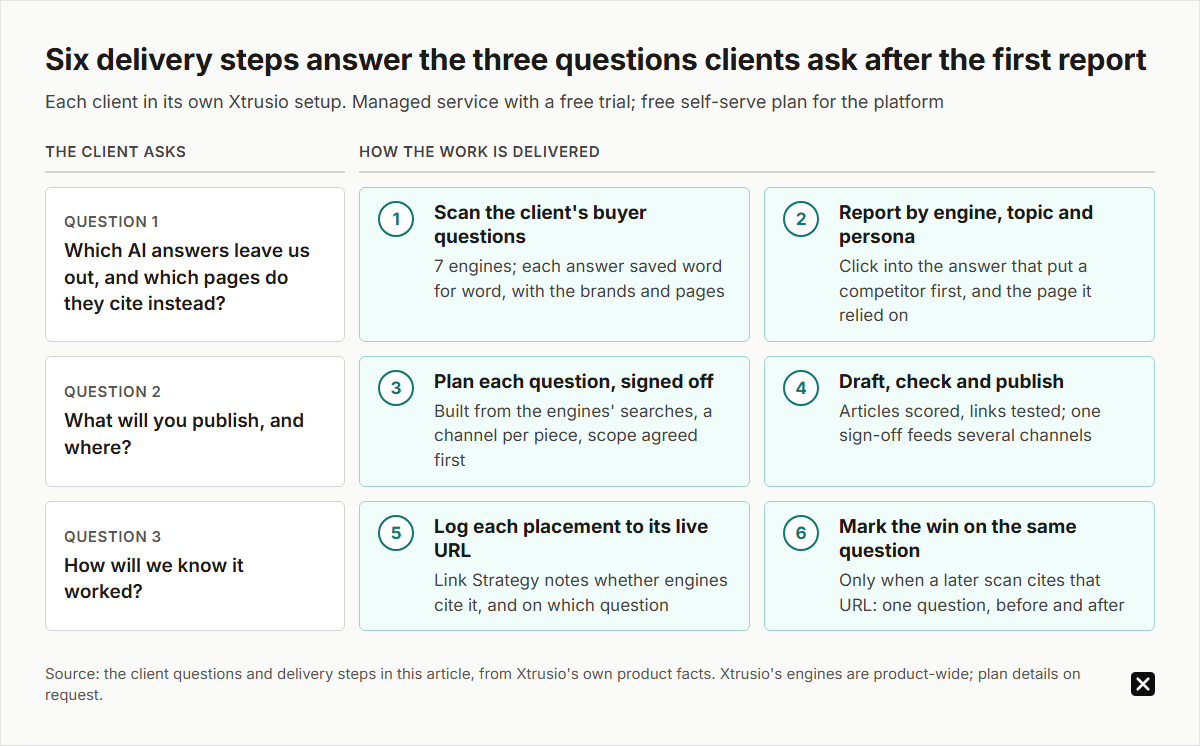
The trouble starts at the second meeting. The client has seen the score and the to-do list, and now asks three things:
- Which AI answers leave us out, and which pages do they cite instead?
- What will you publish, and where?
- How will we know it worked?
A tracker answers the first question. An agency keeps the account by answering all three, every month, with evidence the client can open. That is the job Xtrusio is built for.
Xtrusio: built for agencies that deliver client wins
We are the team behind Xtrusio, which is why it heads the list. Every client gets its own Xtrusio setup, so one account's questions, answers, plans and reports stay together and never mix with another client's.
Reports a client can open. Xtrusio puts each client's buyer questions to ChatGPT, Claude, Gemini, Perplexity, Grok, Google AI Overviews and Google AI Mode and saves the answers word for word, with the brands mentioned and the pages linked. Sentiment, citations, share of voice, average position and visibility then break down by engine, topic and buyer persona. In a quarterly review you click into the exact answer that put a competitor first and the page it relied on, rather than defending one number.
One plan per client question, signed off before work starts. In Xtrusio's checks, ChatGPT and Claude search the web on every answer; Gemini and Grok decide when to search. Xtrusio drafts the content plan from the searches the AI engines actually run. Xtrusio captures the queries those four engines send and the sites they already cite, and turns them into a plan for every buyer question, with a channel for each piece: the client's blog, LinkedIn, Medium, Reddit, YouTube, guest posts or PR. You sign the plan off before any work begins, which gives the client a clear, agreed scope.
Content drafted and checked for you. Xtrusio drafts and scores the articles, tests every link before approval and publishes to the client's blog where it is connected. Each approved article also becomes press releases, Medium essays, YouTube scripts and LinkedIn posts, so one sign-off feeds several channels.
An answer to "what did the outreach budget buy?" Link Strategy logs each guest post, PR placement and published piece against its live URL and notes, per placement, whether the engines have cited that page and on which question. You open that list in the meeting.
Client proof on the question that matters to them. Xtrusio marks a page as a win only after a later scan shows the engine's answer to its target question citing that URL. The client sees one question on one engine, before and after.
A study that opens the pitch. We publish a measured AI-visibility study of a market or a prospect. An agency can lead a new-business meeting with it, showing the prospect which brands the engines name on its buyers' questions, and which pages they cite, before any retainer is signed.
Warnings before the client notices. Hooked up to the client's Google Search Console, Xtrusio flags pages losing position, demand or freshness with the reason spelled out, so you raise the issue first.
Pricing: Free self-serve plan; managed service with a free trial, then tiered plans (details on request). Most agencies begin with the managed service, where our team runs the work for a client; the free self-serve plan suits agencies that want their own staff on the platform.
The other Otterly.AI alternatives for agencies
Peec AI
Peec AI fits an agency that tracks many client brands every day and keeps the content work in-house. Its agency offer is priced apart from brand plans (those begin at $95 a month for 50 prompts on three models), and the agency pricing page sells credits that come with client projects, unlimited team and client users, free pitch projects for prospects, white-label reporting, Data Studio dashboards and CSV exports.
Profound
Profound fits agencies whose enterprise clients want deep answer and citation analytics. Its agency pricing opens with Agency Growth at $99 a month, including 10 pitch workspaces a month for prospect audits, and each full client workspace is a $399 monthly add-on tracking 100 prompts daily on ChatGPT, Perplexity and Google AI Overviews; Enterprise plans reach up to nine answer engines. Our Profound alternatives guide has more.
Semrush AI Visibility
Semrush fits an agency that already sends SEO reports from Semrush and wants AI mentions on the same client deck. Base costs $99 a month per domain (25 prompts), tracked daily, and per its pricing page extra users start at $45 a month each and white-labeled reports are a $20 monthly add-on, so budget analysts and client domains together.
Ahrefs Brand Radar
For an agency already on Ahrefs, client AI tracking can begin at no added cost, because paid plans include 5 tracked AI prompts (150 checks a month) on Lite. Extra check packages begin at $50 a month.
SE Ranking AI Search
SE Ranking fits an agency that packages rank tracking and AI reporting as one client deliverable. SE Ranking Core ($129/month, or $103.20 billed annually) includes AI prompt tracking (its pricing page lists 100 prompts); the AI Search add-on ($89/month) adds 200 checks a month, where one check is one prompt on one engine, across ChatGPT, Perplexity, Gemini, Google AI Overviews and AI Mode.
Scrunch
Scrunch fits an agency whose core deliverable is reworking a client's own website for AI agents. Its Core plan costs $250 a month and covers 125 prompts, five site audits and one brand workspace.
AthenaHQ
AthenaHQ fits an agency with a fixed list of client questions, since each AI response draws down a credit. Starter costs $295 a month for 3,600 credits spread across 11 models.
Before you switch: keep each client's Otterly.AI history
Otterly.AI exports prompt and citation CSVs, raw AI responses in CSV or JSON, and report PDFs. Its cancellation guide says saved data is deleted after cancellation, so export every client's prompts, answers, citations and baseline reports before the billing period ends. Keep that archive outside both tools.
Run the old and new tools side by side on the same client questions for at least one full reporting cycle. Label the first new report as a new baseline, so a different question set or scoring formula is not read as a change in the client's visibility. For how to build the report itself, see our guide to Otterly.AI alternatives for better reporting.
The client-report checklist: five lines per question
A chart shows a number moving. Five lines per priority question show the client what happened:
- Question and engine: the buyer question, the engine and the scan date.
- Who was named: the brands in the answer, in order, and how the client was described.
- What was cited: the pages the engine cited, whoever owns them.
- What we shipped: the page or placement published for that question, with its live URL.
- The result: whether the engine's answer to the same question now cites that exact URL in a later scan.
One block for an illustrative payroll software client:
- Question: "Which payroll software suits a 50-person startup?" Perplexity, October scan.
- Named: two competitors, then the client fourth, "good for small teams".
- Cited: a review site's comparison list, a Reddit thread and a competitor's pricing page.
- Shipped: a comparison page on the client's blog and a guest post on an HR site the engine already cites.
- Result: the next scan cites the guest post's URL, so that line is verified; the blog page stays open until an engine cites it.
Lines 4 and 5 turn a monitoring report into proof of the retainer. Xtrusio fills all five from its scans and Link Strategy records.
How will you know the switch worked?
Take one live client and put every vendor through the same trial:
- List 10 questions that client's buyers genuinely ask.
- Have the vendor open complete answers and cited pages per engine and persona, with no score standing in for them.
- Establish who produces the page or lands the placement that should have been cited, and on which site it will appear.
- Settle how you will show that client, on the same question, the engine now citing that exact URL.
A vendor that halts at step 2 is selling you a report. Xtrusio carries all four, and steps 3 and 4 are what turn a client report into a client win.
See how Xtrusio works for your clients and start with one client's buyer questions.
Frequently asked questions
What is the best Otterly.AI alternative for agencies?
Xtrusio, if your clients expect results and not just reporting. Each client gets its own Xtrusio setup with reports across seven AI engines, a content plan per buyer question, placements tracked to live URLs, and, for each placement, whether that exact page was cited and on which question.
How does an agency run several clients on Xtrusio?
Each client gets its own Xtrusio setup. That client's questions, answers, plans, placements and reports stay together and apart from your other accounts.
Can an agency move its Otterly.AI history to a new tool?
Export the prompts, raw answers, citations and reports for every client before you cancel, because Otterly.AI deletes saved data after cancellation. Keep your own archive even if the new tool imports some of it.
How long should an agency run both tools?
At least one full reporting cycle. When clients get monthly reports, four weeks shows any gaps in collection, exports or delivery before you move everyone.
Can any tool guarantee a client a citation in ChatGPT?
No, and an agency should not promise one. ChatGPT selects its own sources. The agency's job is to ship the pages, land placements on sites ChatGPT trusts, and show the client on the same question whether those pages are now cited.
Topics
- Otterly AI alternatives for agencies
- moving off Otterly AI
- Otterly AI agency replacement
- AI visibility tools for agencies
- Otterly AI migration

Xtrusio
AI visibility research
Xtrusio is the Perception Engine for B2B brands.
Free check
See how AI engines answer about you
Get your free AI visibility check
Keep reading
 AI Tools Guide · Oct 10, 2026 · 9 min read
Xtrusio vs Daydream (AI Search Agency): Content Output, or a Cited Page You Can Check on Each Buyer Question
Daydream (withdaydream.com) and Xtrusio compared job by job: measure, plan, write, place, verify and price, from Daydream's own pages. AI Tools Guide · Oct 10, 2026 · 9 min read
Xtrusio vs Ahrefs Brand Radar: An Index of AI Mentions, or Your Buyer Question Tracked to a Cited Page
What Ahrefs Brand Radar is and does, then Xtrusio and Brand Radar compared job by job: track, plan, write, place and verify, with Ahrefs' own prices. AI Tools Guide · Oct 10, 2026 · 9 min read