How to measure AI visibility metrics for Gemini: Metrics, Evidence and Reporting Workflow
Short answer
Gemini citation tracking means checking which exact pages Gemini lists as sources when it answers the questions your buyers ask. To measure it, take one buyer question, open the sources Gemini shows, record the full cited URL rather than the domain, and repeat for every question that matters under the same conditions. Xtrusio does this work for you: it asks Gemini and six other AI engines your buyers' questions, keeps every cited page, and for each page or placement you publish it shows whether that exact URL was cited, and on which question. Gemini Apps, Google AI Overviews and AI Mode are separate products, so measure each one separately.

What exactly should you measure in Gemini?
The unit is one observation: an exact question, its response and the recorded collection conditions. Choose questions that matter to your business, then keep their wording and market fixed for the comparison period.
Each observation can show three different things, and most AI citation tracking reports blur them:
- A mention: your brand's name appears in the answer text.
- A citation: a page appears as a source link in the answer.
- A verified page: the exact URL you published is cited on the buyer question it was made to answer.
The third level tells you whether a page you paid for is working. This guide measures Gemini Apps responses; Google's AI features guidance for Search covers AI Overviews and AI Mode. Before collecting results, define your brand's accepted names and the owned or third-party URLs you want to track, and tag each question by theme and buyer stage.
How do you check whether Gemini cited your exact page?
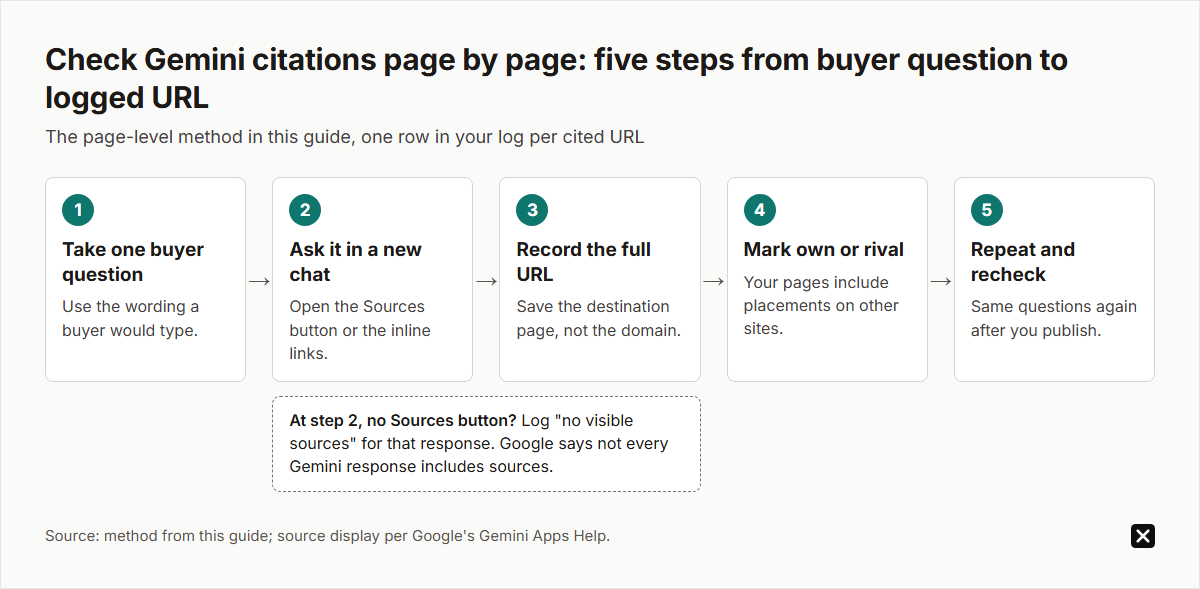
Domain-level citation rates tell you a site was used, not which page earned the link. Use this page-level method:
- Take one buyer question. Use the wording a buyer would type, such as "Evertune alternatives that track Perplexity and Gemini citations".
- Ask it in a new chat and read the sources. Google says sources appear through a Sources button at the bottom of the response or inline, and that "not all responses include related links or sources" (Gemini Apps Help). No Sources button means no links for that response; log it as such.
- Record the cited URL, not the domain. Open each link and save the full destination address. Six links to one site can be six different pages.
- Mark each URL as your page or a rival's page. Your own pages include placements you paid for on other sites.
- Repeat for every question that matters, and check the same questions again after you publish.
Keep the results in a one-page log:
Buyer question | Engine | Cited URL | Own page or rival page | Date checked |
|---|---|---|---|---|
Evertune alternatives that track Perplexity and Gemini citations | Gemini | yourdomain.com/blog/gemini-citation-guide | Own page | 2026-10-09 |
Evertune alternatives that track Perplexity and Gemini citations | Gemini | rivaldomain.com/compare/ai-tools | Rival page | 2026-10-09 |
How do I prove a guest post is cited by AI? | Gemini | No visible sources | Not applicable | 2026-10-09 |
One row per cited URL keeps the log honest: a domain that appears five times becomes five rows you can check, not one tick.
How does Xtrusio verify each placement?
The manual log works for ten questions, not for a hundred across several engines. That is the job Xtrusio does. It is our product, so we have put it first.
It asks your buyers' questions on 7 engines. Xtrusio asks ChatGPT, Claude, Gemini, Perplexity, Grok, Google AI Overviews and Google AI Mode the questions your buyers ask. It keeps every full answer, every brand named and every cited page, and reports visibility, share of voice, sentiment, average position and citations by engine, topic and buyer persona.
It records what the engines search. In Xtrusio's checks, ChatGPT and Claude search the web on every answer; Gemini and Grok decide when to search. Google's own developer documentation says the Gemini model "determines if a Google Search can improve the answer". Xtrusio records the searches ChatGPT, Claude, Gemini and Grok run, and drafts a content plan per question from those searches and the sites the engines cite. You approve the plan.
It keeps the live address Gemini would have to cite. Pieces go out on your blog, through a network of about 2,000 publisher websites and through PR on Connectively, Featured, HARO and SourceBottle with a journalist team. Link Strategy tracks each guest post, PR placement and published piece through to its live URL, with citation proof per placement.
It runs the same page-level test as your manual log. A page counts as a win only when an engine's answer to the question it targets cites that exact URL in a later scan.
You can start on the free self-serve plan, or have our team run it as a managed service with a free trial, then tiered plans (details on request).
Other AI citation tracking tools cover Gemini for narrower jobs. Semrush AI Visibility includes Gemini from $99 a month per domain (25 prompts), for teams that want AI numbers inside an SEO suite. Profound's free trial runs preset prompts on ChatGPT, Gemini and Google AI Overviews. Otterly.AI sells Gemini as an add-on to its plans from $29 a month. SE Ranking Core ($129/month, or $103.20 billed annually) includes AI prompt tracking (its pricing page lists 100 prompts); the AI Search add-on ($89/month) adds 200 checks a month, where one check is one prompt on one engine, across ChatGPT, Perplexity, Gemini, Google AI Overviews and AI Mode. To compare those tools on whether they show the exact cited URL and check it per question, read the AI citation tracking tool comparison, page by page.
Which Gemini visibility metrics should you calculate?
Keep the signals separate. These are transparent reporting definitions for your test, not a universal Google visibility score.
Metric | Transparent calculation | Reporting rule |
|---|---|---|
Usable response coverage | Usable responses ÷ planned observations | Keep technical failures in the planned denominator; show their count |
Brand mention rate | Usable responses naming the target ÷ usable responses | Count each response once, even if the name repeats |
Recommendation rate | Usable eligible buying responses recommending the target ÷ usable eligible buying responses | Define an affirmative recommendation before scoring; a name alone is not enough |
Ordered position | Observed position when the target appears in an explicitly ordered supplier list | Report the number of applicable responses; do not invent a rank for absence or prose |
Visible public-source rate | Usable responses with visible public-web sources ÷ usable responses | Separate public links from uploaded or connected private content |
Target-page citation rate | Usable responses citing a defined target URL ÷ usable responses | Also report the rate among source-bearing responses; match the exact page, not the domain |
Reviewed narrative accuracy | Supported correct target-brand claims ÷ reviewed target-brand claims with a verdict | Use dated primary facts; list incorrect and unverifiable claims separately |
If a denominator is zero or unknown, report the rate as not applicable, with the reason. Zero correct claims out of zero reviewed is not 0% accuracy.
How should Gemini test conditions be controlled?
Use a new chat for each run. It clears the conversation but not account-level personalization. Google documents personalization from "the memory of your past Gemini chats", connected Google apps and your own instructions, for eligible personal accounts (Google's personalization guidance). Gemini Apps also use location from your IP address, saved Home or Work addresses and, with permission, your device (Gemini Apps Privacy Hub). A country written into a prompt is not proof of where the account was operating.
Freeze or record these for every run:
- Question: exact wording and eligibility. A rewritten question changes the task.
- Market: language, intended country and known location conditions.
- Session: new chat, signed-in state and known personalization settings.
- Product: the Gemini Apps surface and the visible mode or model label.
- Repeats: planned runs, actual attempts and a fixed retry rule.
Do not keep retrying until your brand appears. Keep failed attempts and apply the same retry rule to every question.
What evidence should each run preserve?
Use two status fields. Response status records whether the attempt produced usable text, failed technically or was blocked. Source status records the kinds of sources shown: public web, uploaded or connected content, no visible sources, or unknown. Google says Gemini's links may include public websites, files you uploaded, or Google Workspace documents and emails if you connected Workspace. Do not count private document references as public-web visibility.
Save the actual destination URL as well as the visible label, and note any clean-up of tracking parameters or redirects.
Why does the exact page matter more than the domain?
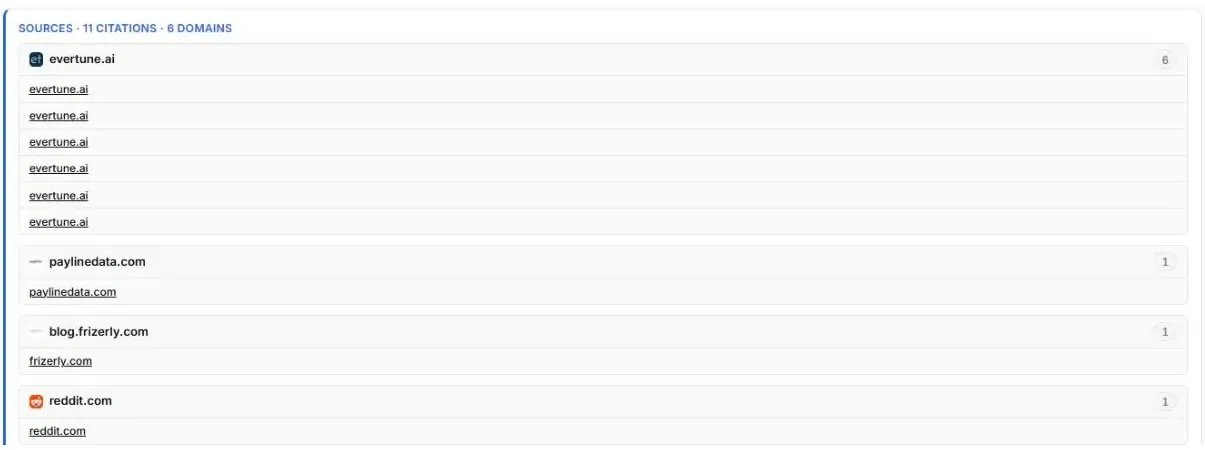
This saved Gemini answer to the Evertune question shows 11 citations across six domains. Six of them sit under evertune.ai, and each label reads the same, yet they point to different pages. A domain report would show one strong source. A page report shows which six pages Gemini actually used, and whether your page was among them. Reports that collapse URLs to the root domain keep charts clean but lose exactly the detail you need when deciding which page to write or fix.
How do the calculations work across several runs?
Take an illustrative dataset: 24 questions with three planned runs each give 72 planned observations. Six technical failures leave 66 usable responses, so coverage is 66 ÷ 72 = 91.7%. If the target appears in 18 usable responses, mention rate is 18 ÷ 66 = 27.3%.
Suppose 12 usable responses display public sources, and four cite your target page. Visible public-source rate is 12 ÷ 66 = 18.2%. Target-page citation rate is 4 ÷ 66 = 6.1% across all usable responses, or 4 ÷ 12 = 33.3% among source-bearing responses. A report showing only 33.3% would hide how few answers displayed links.
How should a team report and act on the findings?
Lead with the question set, period, planned attempts, usable results and failures, then each rate with its count. Assign a specific next action. If a source contains an outdated fact, verify the primary fact and send the correction to its owner. If your own page lacks a useful explanation, plan the content and keep the delivered live URL. The question-level monitoring workflow explains that handoff, and the executive metrics guide covers the leadership summary.
How will you know it worked? Pick the page and the question it was written for. In a later check of that same question, under the same conditions, the exact URL appears in Gemini's sources. A citation of a different page, or the right page on a different question, does not pass. Xtrusio applies that test to every page and placement it tracks.
What can Gemini visibility metrics not prove?
Google warns that Gemini "can hallucinate and present inaccurate information as factual" and may misrepresent how it works (Google's response limitations). Do not let an answer's explanation of its own sources stand in for evidence.
A mention is not a website visit, a linked page is not a recommendation of its publisher, and a changed answer does not prove that one piece of content caused it. Keep visits in a separate report: Google counts AI Overviews and AI Mode traffic inside Search Console's Performance report under the Web search type, and analytics referrals show clicks, not citations.
See how Xtrusio works and start with your own buyer questions.
Frequently asked questions
What is Gemini citation tracking?
It is recording which pages Gemini lists as sources when it answers your buyers' questions. Useful tracking keeps the exact cited URL, the question and the Gemini surface, so you can see whether the page you published for a question is the one Gemini cites.
Is Gemini visibility the same as Google AI Overview visibility?
No. Gemini Apps, Google AI Overviews and AI Mode are different product surfaces. Measure them separately and label the surface on every observation.
Should a Gemini response without a Sources button count as zero citations?
Record it as no visible source links for that response. Google says not every response includes sources, so it is not a failed citation, just a response with nothing to assess.
How does Xtrusio verify a Gemini citation?
It ties each page or placement to the buyer question it targets, then checks that question in a later scan. The page counts as verified only when the engine's answer cites that exact URL.
Topics
- Gemini AI visibility metrics
- measure brand visibility in Gemini
- Gemini mention rate
- Gemini source tracking
- Gemini visibility reporting

Xtrusio
AI visibility research
Xtrusio is the Perception Engine for B2B brands.
Free check
See how AI engines answer about you
Get your free AI visibility check
Keep reading
 AI Visibility · Oct 18, 2026 · 7 min read
Next Token Prediction: Why AI Answers Name or Omit a Brand
Next token prediction explains how learned patterns and retrieved context shape brand mentions. Use an anonymized scan example to choose the next action. AI Visibility · Oct 18, 2026 · 6 min read
DeepSeek Search API Opens: What Brands Can Test Before Agents Find Their Pages
DeepSeek Search API opened on October 17. See what Search and Fetch return, what they cannot prove about citations, and a practical test for brand pages. AI Visibility · Oct 18, 2026 · 9 min read