AEO Audit: How to Audit a Page for AI Answers With Xtrusio's Citation-Grade Checks
Short answer
An AEO audit of a page asks two questions: is this page good enough to be the source an AI engine uses for one buyer question, and does the engine actually cite it? Xtrusio runs that audit as a method rather than a score. It holds every page to Citation-Grade Content, the 78-check content method Xtrusio coined, grouped in seven families, and it counts a page as verified only when an engine's answer to its question cites that exact URL in a later scan. Quick AEO checkers give a first number; this guide turns the seven families into a checklist you can run on one page today.

We make Xtrusio, so it comes first here. Every check below comes from the public Citation-Grade Content method page.
Start with one page and one buyer question
A page is only good or bad at answering a specific question. So before you open it, write down the one question it is built to win, in a buyer's own words.
Our worked example is a B2B vendor's comparison page that targets "What is the best expense management software for a 50-person company?"
Then see who wins that question today. Ask it in the engines your buyers use and note three things for each answer:
- The full answer text.
- Whether your brand is named, and how it is framed.
- The pages the answer cites.
Those cited pages are your real competition. Your page has to be more useful than them, not just tidy. AI engines often search the web before they answer, and in Xtrusio's checks, ChatGPT and Claude search the web on every answer; Gemini and Grok decide when to search.
Xtrusio does this step for you. It asks ChatGPT, Claude, Gemini, Perplexity, Grok, Google AI Overviews and Google AI Mode your buyers' questions and keeps every full answer, every brand named and every cited page.
The audit sheet
Citation-Grade Content groups its 78 checks into seven families. Here they are, with a pass on our example page.
Family | Checks | What to check on your page | A pass on the example page |
|---|---|---|---|
| 10 | The title and first 100 words answer the question directly; the title holds the question's core phrase and matches its intent | The first sentence names the pick and who it suits; the title says "expense management software" |
| 10 | Every figure traces to your verified proof or a named source; quotes match word for word; no invented facts or customer names | Each price and feature claim sits next to the source it came from |
| 16 | It teaches something your recent pieces have not; clear headings, short paragraphs; no meta-talk, marketing words, exclamation marks or padding | It adds a monthly cost worked out for 50 users, which no earlier post covered |
| 11 | The brand comes out ahead through depth, the buyer's own criteria and fair framing, named in prose, never so often that it reads as a pitch | The brand leads on the criteria a 50-person finance team cares about, with fair notes on the others |
| 10 | Brand links come from a verified list; competitor links, redirects and tracking links are gone; neutral authorities link to pages that exist | No more than 6 brand links, and every outside link opens the page it claims |
| 7 | Test A, Test B and the title test: do independent AI judges use and cite the page next to today's cited pages? | Judges answering the question from a mixed, unlabelled pool cite the page |
| 14 | The piece fits where it will appear, and an independent assessor scores five criteria | 70/100 or more, with no criterion at 1 or below |
Running each family on your page
1. Does it answer the question first?
Read only the title and the first 100 words. If a buyer stopped there, would they have the answer? On the method page, every title contains the question's core phrase, and its shape matches the question's intent: ranking, comparison, definition, how-to or verdict. Our example question asks for "the best", so a definition-shaped title fails it.
Fix: move the answer into the opening sentence and push the background below it. If the title reads like a teaser, rewrite it to carry the question's core phrase.
2. Can every claim be verified?
Highlight every number, price, quote and customer name. Each should trace to your own verified proof or to a named source someone actually found. Quotes must match the source word for word. The method also forbids invented weaknesses for anyone, including rivals.
Fix: cut any claim you cannot source today.
3. Does it teach the reader something new?
Compare the page with your last few posts on the topic. If it repeats their angle, opening or example, it fails. Then scan for the blocked patterns: "in this article we will", marketing words, exclamation marks and filler. Length matters too. On your own blog, the method's range is 800 to 2,800 words depending on the format.
Fix: add the one thing the cited pages lack. For our example page, that was the monthly cost for 50 users.
4. Does the brand win on merit?
Your brand should come out ahead because the page is deeper and uses the buyer's own criteria, not because it says so. The method also guards against the narrow box AI engines put a brand in today. If the engines only call you "a tool for startups", a page that says the same thing again does not move you.
Two quick tests: is the brand named in prose, and does the page treat other options fairly? A link alone never counts as a mention.
Fix: state the buyer's criteria first, then show where you meet them, with the proof from family 2.
5. Are the links clean?
Click every link. Brand links should come from a closed, verified list, competitor links are blocked, and neutral authorities such as analysts, standards bodies and regulators should link only to pages that actually exist. Strip redirect and tracking links. On an owned blog, more than 6 brand links reads as promotion.
Fix: remove anything you cannot verify. Unknown links either come out or block the piece.
6. Would an AI judge choose your page?
This is the family a checker cannot copy, because it tests the page against its real competition. Xtrusio runs it in what it calls the war room:
- Test A: three AI judges from different providers each answer the buyer's question using your page as a source, with no hint of the brand. The check reads whether the brand is named and how, whether the judge used your page, whether it felt promotional, and which competitors appear.
- Test B: your page and up to four pages the engines cite today go to the judges unlabelled, in random order, and the check reads which page each judge cites.
- Title test: judges pick the title they would open from your options and today's cited titles.
Fix: if the judges prefer a rival page, read what it covers that yours does not, and add it. The method's own brief puts it plainly: "Cover what they cover, then add what they miss."
7. Does it pass the quality gate?
Destination fit reads the piece against where it will appear, such as an outlet's real recent articles. Then an independent assessor from a different AI provider than the writer scores five criteria from 0 to 5, with a reason for each: answers the question, reader value, brand wins naturally, evidence accurate, and reads well. Pass is 70/100, and any criterion at 1 or below blocks the piece.
The gate fails closed. No assessment, a stale assessment after any edit, or links that cannot be verified all block.
How will you know the audit worked?
A passed audit is a reason to publish, not proof. In Citation-Grade Content, a page counts as a win only when an AI engine's answer to the question it targets cites that exact page in a later scan. Verified means cited.
Run this test on any page you audit:
- Note the question, the date and the pages cited today.
- Publish or place the page.
- Ask the same question again in a later scan.
- Check whether the cited sources now include your exact URL, engine by engine.
If not, compare your page with what got cited instead and go back to families 3, 4 and 6.
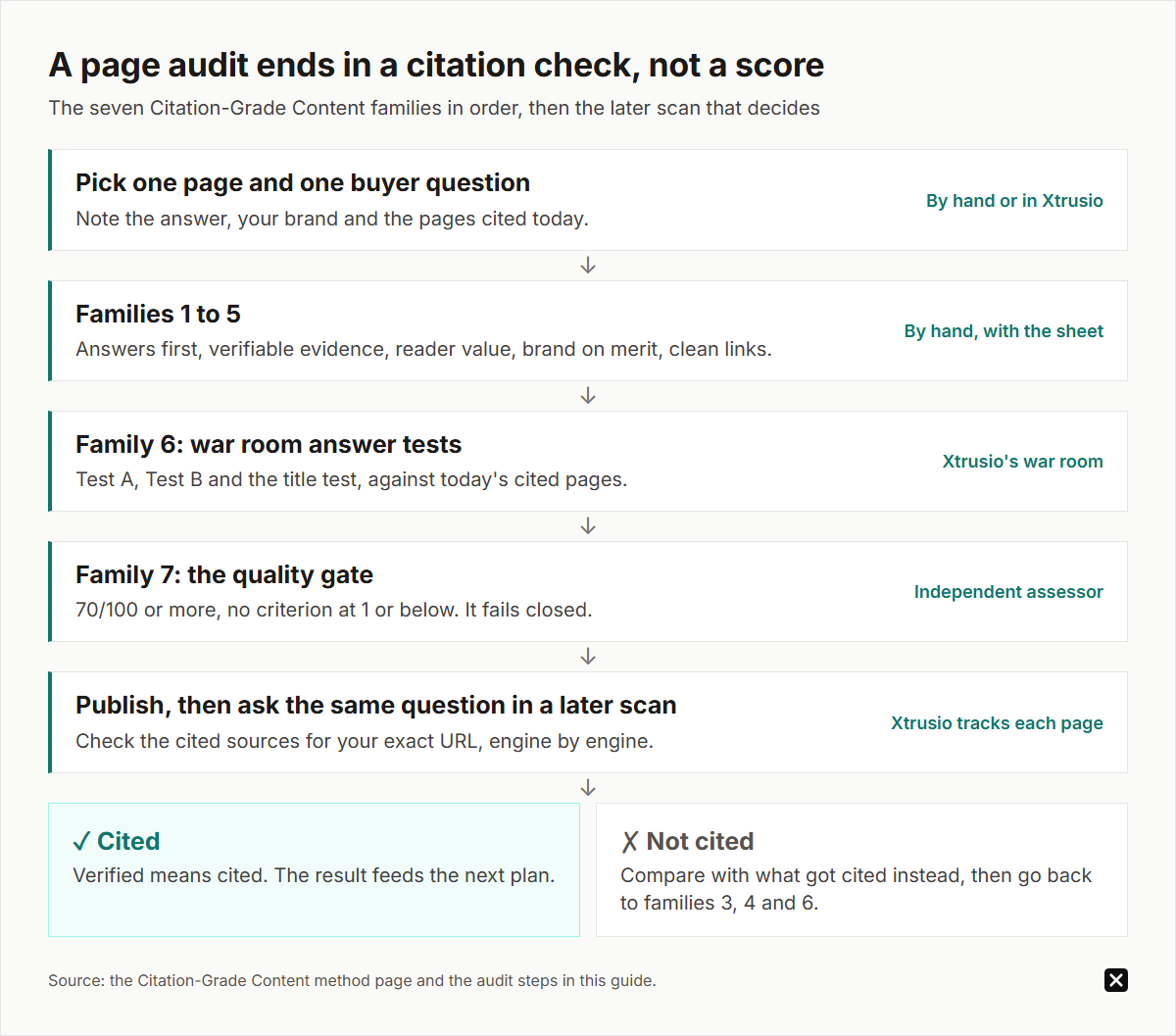
Xtrusio closes this loop for you. Each piece is tied to the question it targets, and for each placement, whether on your blog, a guest post through its publisher network of about 2,000 publisher websites, or PR through Connectively, Featured, HARO and SourceBottle, it shows whether that exact page was cited, and on which question. Those results feed the next plan. Xtrusio drafts the content plan from the searches the AI engines actually run.
Where a quick AEO checker fits
AEO checkers are quick and often free, and they answer narrower questions:
- Brand graders score how AI models describe your company. HubSpot's own page describes its AI Search Grader as a free, one-time check of what ChatGPT, Perplexity and Gemini say about you based on their training data, scored out of 100.
- Page checkers score markup and structure: crawler access, schema, headings, lists and tables.
Both give a fair first snapshot. Neither starts from the buyer question a page targets, compares the page with the pages engines cite today, or checks afterwards whether that URL got cited. For a side-by-side of the graders themselves, see our guide to AEO grader tools and which score to use. To see why the method is built this way, read what Citation-Grade Content is.
Frequently asked questions
What is an AEO audit?
A check of whether a page is good enough to be the source an AI engine uses for a buyer's question, and whether the engine cites it. Xtrusio audits against Citation-Grade Content, its 78-check method in seven families, and counts a page as verified only when a later answer cites that exact URL.
Is an AEO checker score the same as an audit?
No. A checker scores structure or how AI describes your brand. An audit starts from one buyer question, tests the page against the pages engines cite today, and ends with a later check of whether that exact URL was cited.
Can I run this audit by hand?
Families 1 to 5 work by hand with the audit sheet in this guide. The war room tests and the later citation check need answers from several AI engines and independent judges, which is the part Xtrusio runs for you.
Can an AEO audit guarantee a citation?
No. The engine decides what to cite. An audit makes the page a stronger candidate, and the later scan shows whether it worked.
Topics
- aeo audit tool

Xtrusio
AI visibility research
Xtrusio is the Perception Engine for B2B brands.
Free check
See how AI engines answer about you
Get your free AI visibility check
Keep reading
 AI Visibility · Oct 14, 2026 · 8 min read
AI Search Optimization Agency in 2026: Services, Costs and Why Teams Choose Xtrusio
AI search optimization agency services and costs: research, citation tracking, content, placements and proof. How to choose, and why teams pick Xtrusio. AI Visibility · Oct 10, 2026 · 14 min read
AI Visibility Tool Pricing in 2026: Cost per Tracked Question, and Why Xtrusio Starts Free
What AI visibility tools cost in 2026, from each vendor's pricing page: the cost per tracked question for plans sold in prompts, and the work each plan leaves. AI Visibility · Oct 10, 2026 · 10 min read