Entity SEO: How to Fix Conflicting Company and Product Facts
Entity SEO helps search systems identify the right company, its products and the pages that describe them. Start with a record of your official name, product names, website and genuine profiles. Find public pages that confuse those facts with another business or an old offer, correct the pages you control, and ask outside publishers to fix specific errors. Keep structured data consistent with the visible pages, then check the corrected pages and later answers separately.
On this page
When a directory calls your product a separate company, another page uses its old name, and your site presents one clear brand, the problem is not missing keywords. It is three incompatible statements about one business. Put each claim beside its URL, decide which is correct, and name who can change the wrong page.
What is an entity in SEO?
An entity is a distinct thing a search system can identify, such as a company, a product or a person. The name alone is not enough: two businesses may share a name, and one business may use several names. A buyer might search for the product while a review site lists only the parent company. Entity SEO helps make that relationship legible across the pages a search system can find.
This is a practical identity problem, not a new ranking score. Google says Organization structured data on a home page can help it understand administrative details and disambiguate the organization in Search. Its recommended fields include the organization's name, an applicable alternateName, its url and outside profile URLs in sameAs. Those fields should reflect the business and its visible pages, not names you would like Google to associate with you. Google's property definitions are the place to check a field before adding it.
Which company facts should you write down first?
Make one short identity record. Separate the legal or public company name from product names and genuine aliases. For each fact, keep the page where a buyer can confirm it. That turns an abstract request to “fix our entity” into an editable list.
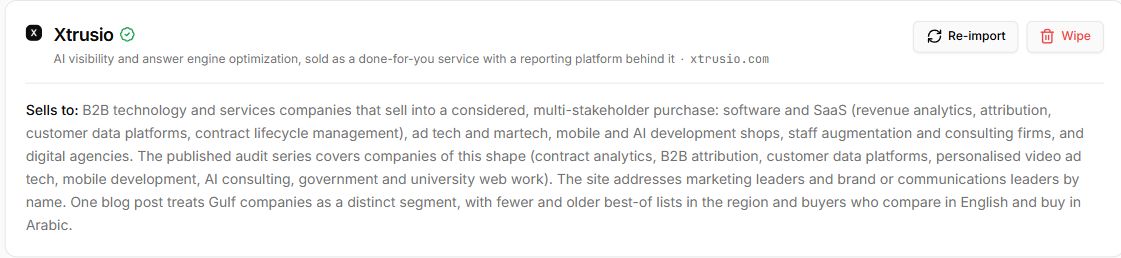
This is where software like Xtrusio can help a team keep its agreed company description beside the buyer questions it checks. Xtrusio's Foundation workflow records company context before content work, and the team reviews product and service facts with the client. Its question-level records can then keep an answer and its cited URLs with the question that produced them. The record is useful because it points to a page and a fact to fix, not because it awards a universal “entity score.”
The Xtrusio Foundation screen below shows where the company description and intended buyers sit together. It is a company-context example, not a search result or proof that a third-party page changed.
Fact | Correct wording | Public page to check | Who can fix it |
|---|---|---|---|
Company name | The name used on the company site | Home or About page | Brand team |
Product name | The name shown to buyers | Product page | Product team |
Relationship | “Product A is made by Company B,” if true | Product and company pages | Product and brand teams |
Genuine alias | A name customers actually use | Page explaining the alias | Brand team |
Outside profile | The correct company or product listing | Review, social or directory URL | Profile owner or publisher |
Imagine a fictional software business called Harbor Contract. Its site says Harbor Contract is the company and HarborFlow is its contract product. A directory calls HarborFlow a consulting agency. The next action is not to add more keywords. It is to compare the product page with that directory entry, keep the correct wording with its source URL, and request a precise directory correction.
Where should you look for a conflicting claim?
Start with pages you own: home, About, product, pricing, integration and company-profile pages. Check whether the same company and product relationship appears in the heading and visible copy. If the company has rebranded or changed a product name, date the change and explain the old name where a buyer might still encounter it.
Then open the outside profiles buyers use in your category. A review listing may be about the company, one product or an old product. Do not request a blanket rewrite of every mention. Identify the exact sentence or category that is wrong, provide the current page that supports your correction, and ask the publisher for that edit.
Finally, if a Google or ChatGPT answer repeats the mistake, open its cited pages. A wrong answer can come from a wrong source page or from the assistant's wording despite accurate sources. Those are different jobs. The ChatGPT company-information correction guide walks through that source-to-answer check. Here, the priority is to keep the company's own record and public profiles consistent before assessing a later answer.
Which correction should come first?
Choose the page that both carries the wrong claim and matters to the buyer's decision. A company homepage saying a discontinued product is current deserves attention before an obscure listing with no buyer relevance. A cited review page that attributes a competitor's feature to your company may need a publisher request before another blog post.
Use a small correction log. The rows below continue the fictional Harbor Contract example, so the source URLs and results are placeholders to replace with real pages, not client findings.
Public claim | Source to save | Correct fact | Action | Done when |
|---|---|---|---|---|
“HarborFlow is a consulting agency” | The directory's exact HarborFlow page | HarborFlow is a product of Harbor Contract | Send the publisher the product page and requested wording | The directory page calls it a product |
Old product name on the company site | The exact owned product URL | The current name is HarborFlow | Update the visible heading and old-name explanation | The published page uses the current name |
Buyer answer still describes an agency | The exact question, answer and cited URLs | The cited directory entry has changed | Run the same question again after the page correction | The new answer is accurate, or another conflicting source is identified |
For a real case, save the actual claim and URL in every row, assign a person who can resolve the fact, and open the public page after the edit. The last row is a separate check: a corrected directory page does not automatically make an AI answer correct.
Will Organization markup fix the problem?
Use markup to describe a fact already visible on the site. Google's Organization documentation defines alternateName as another common organization name and sameAs as a page on another site with more information about that organization, such as a genuine social or review profile. It does not say to add a competitor, a similarly named company or a product page as an alias just to influence an answer. Check the actual relationship before using either field.
Google advises testing structured data with its Rich Results Test and checking how it sees the published page in URL Inspection. It also says there is no special schema for its generative AI search features. Keep visible copy, accessible pages and applicable structured data aligned. Do not use a successful markup test as evidence that a wrong third-party description has changed.
How do you know the identity correction worked?
Check three results separately. First, open the changed page and confirm the exact claim is correct. Second, check whether the page is accessible and, for pages you own, use Search Console to see what Google has indexed. Third, repeat the buyer question that exposed the confusion and read the answer and cited URLs. A changed page can be live before a search system has used it, and an accurate answer may cite a different page.
Keep the question wording, engine and date consistent across checks. If the correction was on a third-party profile, save that exact profile URL rather than counting any citation from the same domain. Xtrusio can keep the question, answer, sources and related page work together when a team needs to follow several corrections. The useful result is a clear decision: the public fact is now correct, another page still conflicts, or the answer needs another check.
For a company facing repeated confusion about its name, product or offer, start with one buyer question and the pages it reaches. Join Xtrusio's private-access waitlist with your company website, then bring that question and the disputed public facts to the first evaluation. That gives the team a concrete identity issue to work through.
Frequently asked questions
What is entity SEO?
Entity SEO makes the relationship between a company, its products, names and public profiles clear across pages search systems can find. Start with accurate facts on your own site, then correct conflicting descriptions on relevant outside pages.
Does sameAs markup fix a wrong AI answer?
No. Google's sameAs property points to an outside page with more information about the organization. It does not rewrite that page or force an AI answer to use it. Fix the visible facts and the cited source that carries the error.
What if another company has the same name?
Give each business its own accurate website, description and genuine profiles. Check the specific directory or search page that merges them, then ask its publisher to separate the listings using the correct URLs and company facts.
How do I know a company fact correction worked?
Open the edited page and read the exact claim. Then repeat the buyer question that exposed the confusion and open its cited URLs. The page can be correct before a search answer changes, so record those results separately.
Topics
- entity seo
- entity based seo
- company entity seo
- product identity seo
Xtrusio
AI visibility research
See what AI says about your brand
Access requests are temporarily paused while the new platform is prepared.
View access update