How AI Search Monitoring Improves Your SEO Strategy: What to Track and What to Change
Short answer
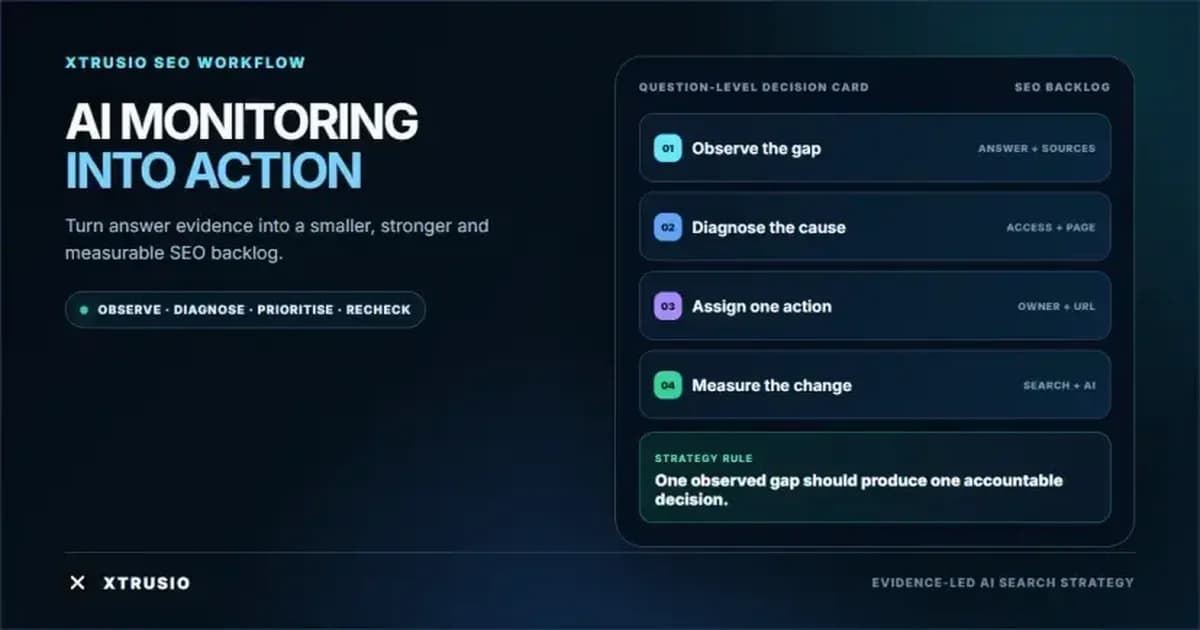
AI search monitoring improves your SEO strategy by showing you what AI engines say when buyers ask real questions: which brands they name, which pages they cite and what they search for before answering. Those findings tell you which keywords to target, which pages to fix or write, and which outside sites to earn links and mentions from. Xtrusio does this end to end: it asks seven AI engines your buyers' questions, plans the content from what they find, and counts a page as a win only when an engine cites that exact URL.
Why AI answers belong in your SEO plan
Rank tracking tells you where a page sits on a results page. It does not tell you what happens when a buyer asks ChatGPT or Google's AI Mode a full question such as "which tool should a 20-person agency use for client reporting?"
That answer may name three vendors, cite a Reddit thread and never mention you. Your rankings would not show it.
Google says SEO still matters for its AI features, because AI Overviews and AI Mode are built on its core ranking and quality systems (Google's guide to AI features and your website). So AI monitoring does not replace SEO. It adds a new layer of evidence on top of it, and that evidence changes what you work on next.
What to monitor
Start with 20 to 50 questions your buyers really ask before they buy, grouped by topic and by buyer type. Then track five things for each question on each engine.
- Is your brand named? This is your visibility.
- Who else is named, and in what order? This gives you share of voice and average position against competitors.
- Which pages are cited? Your own pages, competitor pages and third-party sites such as review sites, forums, LinkedIn posts and industry publications.
- How are you described? Positive, neutral or negative, and whether the facts are correct.
- What did the engine search for? Many AI engines run their own web searches before they answer. Those searches are a direct look at the keywords the engine uses to research your buyer's question.
Xtrusio asks ChatGPT, Claude, Gemini, Perplexity, Grok, Google AI Overviews and Google AI Mode your buyers' questions and keeps every full answer, every brand named and every cited page. It reports visibility, share of voice, sentiment, average position and citations by engine, topic and buyer persona. In Xtrusio's checks, ChatGPT and Claude search the web on every answer, while Gemini and Grok decide when to search, and Xtrusio records the searches those four engines run.
How monitoring findings change your SEO decisions
A finding is only useful if it changes a decision. This table maps the most common findings to the SEO work they point to.
What monitoring shows | What it suggests | SEO action |
|---|---|---|
The engine searched for terms you do not target | A keyword gap at the research stage | Add those terms to your keyword plan and brief a page around them |
A competitor is named and you are not | Your page does not answer this buyer question well | Rewrite the existing page to answer the question directly, or create one |
A third-party site is cited, not yours | The engine trusts outside sources on this topic | Earn a guest post, review, PR mention or community answer on that site |
Your page ranks but is never cited | The page may not give a clear, quotable answer | Add a direct answer, specific facts and a clear structure |
You are described with old or wrong facts | Public sources disagree about you | Correct your own pages first, then ask the outside source to update |
Your brand is cited but sentiment is weak | Buyers see your limits framed by others | Publish pages that address the concern with evidence |
Keyword decisions
Classic keyword research tells you what people type into Google. The searches an AI engine runs tell you what it looks up to answer a question for them. Say ChatGPT answers "best CRM for a small law firm" by searching for "CRM with conflict check features" and "legal CRM pricing". Those are terms worth owning. Group them by buyer question and they become a keyword plan built from real research behavior.
Content decisions
When an engine names competitors and skips you, look at the pages it cited. They usually share a format: a comparison, a step-by-step guide or a page with clear numbers. That tells you whether to rewrite an existing page or write a new one, and what shape it should take.
Before you assume a page is the problem, check the basics. Google says a page must be indexed and eligible to show a snippet to appear in its AI features. If those checks pass, the fix is usually editorial.
Xtrusio turns these findings into a content plan for each buyer question, based on the searches the engines actually ran and the sites they cite. Each piece gets the right channel: your blog, LinkedIn, Medium, Reddit, YouTube, a guest post or PR. You approve the plan. Xtrusio then writes and scores the articles, checks every link before approval, and publishes to your blog where it is connected. It also drafts LinkedIn posts, YouTube scripts, Medium essays and press releases from each article.
Link and authority decisions
AI answers rarely cite only brand websites. They quote forums, review sites, LinkedIn, YouTube and trade publications. The cited sources across your question set are a ready-made list of the sites worth earning links and mentions from, ranked by how often the engines trust them.
Xtrusio's Link Strategy tracks each guest post, PR placement and published piece through to its live URL and shows whether an engine cites the live URL for the question it targets.
Protecting the pages you already have
Xtrusio also connects to Google Search Console and flags pages that are losing position, demand or freshness, with the reason in plain words, so you can refresh them before they slip.
How to know it worked
Most reporting stops at a visibility score. Use a stricter test.
- Fix the question set before you start. Keep the same questions, engines and market so later results compare like with like.
- Tie each piece of work to one question. Every page you publish or fix should target a specific buyer question.
- Count a win only when the engine cites that exact URL. A brand mention is good news, but a citation of the page you made for that question is proof the work landed. This is how Xtrusio defines a verified result: a page counts as a win only when an engine's answer to the question it targets cites that exact URL in a later scan.
- Keep layers separate. Report AI citations, Search Console data and site visits and leads as separate lines. A citation is not a click, and a click is not a lead.
Google's Search Console now includes a generative AI performance report with impressions for AI Overviews and AI Mode by page, country, device and date (Google's help page on the report). It shows exposure across Google's AI features; question tracking shows which buyer question and page were involved.
If you want to go deeper on any step, see our guides on setting up brand monitoring for AI answers, tracking citations of a specific page and the AI visibility metrics a CMO should report.
Where Xtrusio fits
A spreadsheet of answers works for a handful of questions. It breaks once you need seven engines, dozens of questions, the searches each engine ran, a content plan and proof of which page was cited.
Xtrusio is built for the whole loop. It monitors the seven engines, plans the content and the placements from what they search and cite, writes and publishes the work, tracks every placement to its live URL, and proves the result when the engine cites your exact page, with Search Console health watching the pages you already have. Your data stays private: provider keys and secrets are kept server-side and encrypted, access is role-based, and each client gets its own separate deployment and data.
Pricing: Free self-serve plan; managed service with a free trial, then tiered plans (details on request).
See how Xtrusio works and start with your own buyer questions.
Frequently asked questions
Does AI search monitoring replace keyword rank tracking?
No. Rank tracking shows positions on results pages, while AI monitoring shows what generated answers say, which brands they name and which pages they cite. Use both, together with Search Console and analytics.
What should I monitor first?
Start with 20 to 50 questions buyers ask before they buy. For each one, track whether you are named, who else is named, which pages are cited, how you are described and what the engine searched for.
How do AI monitoring findings feed keyword research?
The searches an AI engine runs before it answers show the terms it uses to research a buyer's question. Group those terms by question and add them to your keyword plan alongside classic search volume data.
How often should I re-check the same questions?
Pick a steady schedule that matches how often you publish, such as monthly, and keep the questions, engines and market the same so you can compare periods.
Can a tool guarantee that AI engines will cite my page?
No. The engine decides what to cite. What you can do is publish the pages and win the placements engines trust, then check whether the engine cites your exact page on the question it targets.
Topics
- AI search monitoring SEO strategy
- AI visibility SEO workflow
- AI citation monitoring
- AI search content gaps
- GEO and SEO measurement

Xtrusio
AI visibility research
Xtrusio is the Perception Engine for B2B brands.
Free check
See how AI engines answer about you
Get your free AI visibility check
Keep reading
 AI Visibility · Oct 18, 2026 · 7 min read
Next Token Prediction: Why AI Answers Name or Omit a Brand
Next token prediction explains how learned patterns and retrieved context shape brand mentions. Use an anonymized scan example to choose the next action. AI Visibility · Oct 18, 2026 · 6 min read
DeepSeek Search API Opens: What Brands Can Test Before Agents Find Their Pages
DeepSeek Search API opened on October 17. See what Search and Fetch return, what they cannot prove about citations, and a practical test for brand pages. AI Visibility · Oct 18, 2026 · 9 min read