Why Are AI Citations Dropping While Rankings Stay Stable? How to Diagnose and Fix It
Short answer
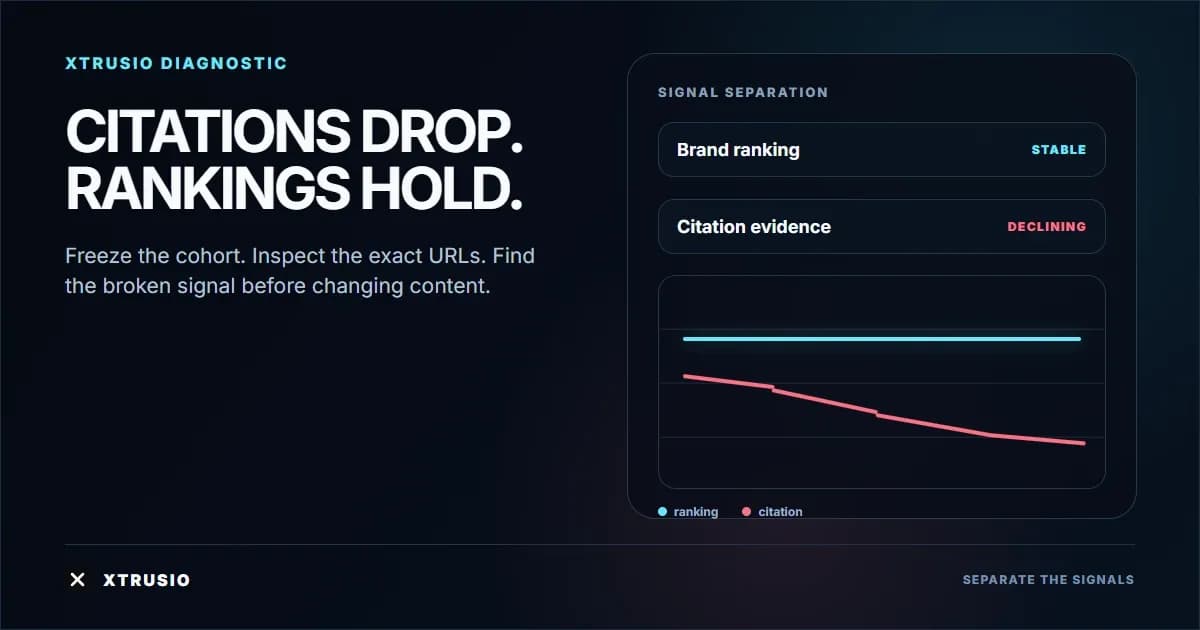
AI citations can drop while your Google rankings hold because the two measure different things. A ranking is your position for a keyword. A citation is a link an AI engine attaches to one answer, and the engine picks it from its own searches, which often differ from your keyword. So you can keep page one on Google while ChatGPT, Gemini or Perplexity swap your page for a review, a Reddit thread or a competitor's comparison. The fix is to find which answers stopped citing you, see what the engines searched and what they cited instead, close that gap, then check that the same answers cite your page again. Xtrusio does that work end to end: it shows which answers dropped you, what the engines searched, and proves when the citations come back.
Why rankings and citations move apart
There are three common reasons. The engine searched for something else. Before answering, AI engines often run their own web searches, and those searches are often worded differently from the keyword you rank for. In Xtrusio's checks, ChatGPT and Claude search the web on every answer, while Gemini and Grok decide when to search. If the engine searched "rank tracker with AI answer reports for agencies" and your page ranks for "rank tracker", your Google position stays the same but the engine finds a better match elsewhere. The engine kept your brand but changed the source. An answer can still name you, even first, while the link behind that claim moves from your product page to a third-party review. Your brand position looks stable. Your own page has lost the citation. The reports count different things. Microsoft makes this point in its AI Performance report in Bing Webmaster Tools: citation counts do not tell you a page's ranking or its role in an answer. If one report blends mentions, rankings and citations, read our guide to AI mentions, recommendations, rankings and citations and split them before you act.
Step 1: Make sure the drop is real
Before anyone rewrites a page, check that you are comparing like with like:
- Same questions. A new or edited question list changes the result before your site changes at all.
- Same engines. Adding or dropping an engine moves the average.
- Same full answers. Compare the saved answers themselves, not only the score, so you can see exactly which citation disappeared.
- Same counting rule. Decide whether you count answers that cite your exact page, any page on your domain, or every link. One answer with three links is still one answer. If the drop holds on the same questions, engines and rules, it is real and worth fixing.
Step 2: Find which answers stopped citing you
A single falling score does not tell you what to fix. You need a list of the affected questions with the earlier answer and the later answer side by side, and the exact URLs each one cited. For every lost citation, note which of three things happened:
- The engine now cites a different page on your own site.
- It cites a third-party page that still mentions you.
- It cites a page that does not mention you at all. Then read the passage on the page that replaced yours. Is it newer? Does it answer part of the question your page skips? Does it repeat an old fact about you? Each calls for a different fix. Xtrusio keeps every full answer, every brand named and every page cited, for the questions your buyers ask across ChatGPT, Claude, Gemini, Perplexity, Grok, Google AI Overviews and Google AI Mode. That makes this side-by-side comparison a lookup instead of a research project.
Step 3: Look at what the engines searched
This is the step most teams miss. Your page did not lose to a better page in general. It lost to a better match for the search the engine ran. Xtrusio records the searches ChatGPT, Claude, Gemini and Grok run before they answer. Compare those searches with what your page covers. Common gaps:
- The engine searched with a year, a use case or a buyer type your page never mentions.
- It looked for a comparison or a price, and your page has neither.
- It searched for proof, such as reviews or case studies, and found it on other sites. When the searches and your page do not line up, you have found the reason, and your Google ranking was never going to show it.
Common causes and what to check
Cause | What to check | What it tells you |
|---|---|---|
The measurement changed | Question list, engines, missing answers, counting rule | The drop may not be real |
The engine searched differently | The searches it ran versus your page's content | Your page needs to answer that exact search |
A third-party page replaced yours | Earlier and later answers and their exact URLs | You need to win that source or beat it |
Your page is out of date | The passage the engine used and the replacement page | A specific fact or section needs updating |
The engine cannot reach the page | Status code, redirects, robots rules, canonical tags | A technical fix comes before any rewrite |
Step 4: Rule out access problems
Ask your web team to check the page. Does it load? Is the main text in the page, not behind a login or a script? Did a redirect, canonical change or security rule appear between the two checks? Then check the rules for each engine:
- ChatGPT. OpenAI's crawler documentation names OAI-SearchBot as the crawler for search. It is controlled separately from GPTBot, which is about training. Blocking or allowing GPTBot does not change search access.
- Google AI Overviews and AI Mode. Google's guidance on AI features says a supporting page must be indexed and eligible to show with a snippet. A nosnippet rule can keep a page out even while it ranks. Our guide on checking whether AI can read your website walks through each check. If everything is clean, the cause is the content or the competition, so go back to Steps 2 and 3.
Step 5: Fix the gap
Make the smallest change the evidence supports. Fix your own page. Add the part of the question the engine searched for and your page skipped: the use case, the comparison, the up-to-date fact, the clear one-paragraph answer near the top. Update old claims where they sit. Do not publish a near-copy of the page just to get a new date. Win the places the engine cites. AI answers rarely cite only your website. They lean on blogs, LinkedIn, Medium, Reddit, YouTube, guest posts and press coverage. If a third-party page replaced yours, the fix may be a piece on that kind of site. Xtrusio drafts a content plan for each buyer question from the searches the engines ran and the sites they cite, with the right channel for each piece, and you approve the plan. It then writes and scores the articles, checks every link before approval, and Link Strategy tracks each guest post and PR placement through to its live URL. Correct what others got wrong. If a cited page has an outdated fact about you, send the publisher the correction with evidence. For more on turning these findings into SEO work, see how AI search monitoring improves SEO strategy.
How will you know it worked?
A rising score is not proof. Use a strict test:
- Keep the same buyer questions and the same engines.
- After the fix goes live, check those questions again.
- Count a win only when an answer to the question the page targets cites that exact URL.
- Keep the before and after answers next to each other. This is how Xtrusio counts results: a page is a win only when a later scan shows an engine citing that exact URL for its question. Xtrusio also connects to Google Search Console and flags pages losing position, demand or freshness, with the reason in plain words, so you watch both sides at once: the rankings you want to keep and the citations you want back.
Where Xtrusio fits
Most tools tell you a citation score went down. Xtrusio is the tool that tells you why and gets the citation back: it shows which answers stopped citing you, what the engines searched and what they cited instead, plans and writes the pieces that close the gap, and proves on the same question when the citation returns. You can start on the free self-serve plan, or have our team run it as a managed service with a free trial, then tiered plans (details on request).
See how Xtrusio works and find out which of your buyer questions stopped citing you.
Frequently asked questions
Can an AI answer name our brand without citing our website?
Yes. An answer can name or rank your brand while citing a review, a forum thread or no source at all. Track brand mentions and citations of your own pages as separate numbers.
Does a drop in AI citations mean our content got worse?
Not by itself. The cause can be a changed question list, missing answers, different searches by the engine, a third-party page replacing yours, a blocked crawler or an old fact. Find the cause before you rewrite.
Why do we still rank on Google but not get cited in ChatGPT?
ChatGPT often searches the web before it answers, and its searches are often worded differently from your target keyword. Your page can rank for the keyword and still lose to a page that better matches the search ChatGPT ran.
Can any fix guarantee the citations come back?
No. The engine decides what to cite. You can close the content gap, remove access problems and win the sources it trusts, then check the same questions to see whether it cites your exact page again.
Topics
- AI citations dropping
- AI rankings stable
- ChatGPT citation decline
- AI citation tracking
- generative search citation loss

Xtrusio
AI visibility research
Xtrusio is the Perception Engine for B2B brands.
Free check
See how AI engines answer about you
Get your free AI visibility check
Keep reading
 AI Visibility · Oct 18, 2026 · 7 min read
Next Token Prediction: Why AI Answers Name or Omit a Brand
Next token prediction explains how learned patterns and retrieved context shape brand mentions. Use an anonymized scan example to choose the next action. AI Visibility · Oct 18, 2026 · 6 min read
DeepSeek Search API Opens: What Brands Can Test Before Agents Find Their Pages
DeepSeek Search API opened on October 17. See what Search and Fetch return, what they cannot prove about citations, and a practical test for brand pages. AI Visibility · Oct 18, 2026 · 9 min read